
Painting Contractors · Base Coat Marketing
He Launched the Agency. Eight Weeks Later He Was Handed a Brain Scan.
Austin Houser started Base Coat Marketing in February 2022 at negative $2,000 a month. On his thirty fourth birthday his wife handed him an MRI showing a tumor next to his brain stem. He called every client and cancelled their subscriptions. Eleven months after launch the agency was at $89,000 in monthly recurring revenue.
Austin Houser with Josh Nelson on the Agency Success Interview series. Full interview, 58 minutes, recorded in March 2023 at $89,000 MRR.
Read the full interview transcript
Full transcript of Josh Nelson’s interview with Austin Houser. Lightly edited for readability.
Josh Nelson: Have you with us today. Really excited for today's session. This is the Seven Figure Agency podcast. This is part of our Agency Success Interview series, where we're interviewing highly successful digital marketing agencies from across the country. And I'm really excited today to be joined by Austin Houser. He's the owner of Base Coat Marketing, and he's got an amazing story that he's gonna share. He's grown his agency from startup to over seven figures over the last 11 months. He's done some amazing work in terms of landing clients, delivering results, retaining and building the systems for scale. So if you're excited, give me a yes in the comment, give me a one in the comments. Let's make this interactive. Austin, thank you so much for being here, man.
Austin Houser: Josh, thanks for having me, man. This is, this has been quite a journey.
Josh Nelson: Man, a- and I remember, so I'll kind of lead off with this. You're, you're a member of the Seven Figure Agency. You came out to our last intensive in November. You came up and tapped me on the shoulder and said, "Hey, I've been listening to the podcast. I think I wanna be on the show, but I wanna get to seven figures first, but it'll be soon." And I was like, "Man, I'd love it. I'd, I'd love to see that happen." And, here we are. You've done some amazing things, so kudos first of all on your growth and your success.
Austin Houser: Thanks, man. I started listening to your podcast, around October 2021, and that was the first time I ever heard you, your voice, and, I knew right then, I'm like, "Yep, that's, that's where I'm gonna be." So good, man.
Josh Nelson: Well, this is, this is awesome. I know the, the listeners are excited. We've got a great live audience, and this is one that's gonna be listened to into perpetuity. So let's just start off. Like, so tell us what, where you're at in your agency right now, kind of number of clients, you know, average monthly recurring revenue. Yeah.
Austin Houser: So we just signed two clients today. I think we've signed seven this month, and, we're only in the ninth day of March. We're at 89,000 recurring a month, 46 full-time clients. We have a number of other clients that kind of fall under a legacy agency. But yeah, that's kind of where we're at today, and we are currently booked out until May- Wow… Which is, was a selling point about a week ago when we were mid-April and now it's more of a process thing.
Josh Nelson: So good, man. C- congratulations. You know, it's always good to see, like, seven figures that quickly. So, but tell us, like, where you were at 11, 12 months ago, like, kind of what was your story leading up to this, before you even started this agency?
Austin Houser: Yeah. So I have a pretty solid background in web development, marketing. I went to school, computer science, computer security, math and business. So I was kind of nerded out back then. That seems to have really paid off. But yeah, I was working for, a company, director of e-commerce, so I kind of had a little bit of experience on the sales side online as well. Picked up your book, audiobook actually- All right… Was listening to that, and I was actually listening to, Grant Cardone's Sell or Be Sold right before your book, and the energy from him compared to the energy in your book was different, and I almost turned your book off, and I'm so glad I didn't because it was life-changing. Mm. I listened to your book and it all clicked. I had been running a marketing agency since 2008, Houser Media. It's still around. But big brands, so think of like million-dollar a month advertising budgets. Mm. Those were the kind of companies that I was working with over the years. Also mom and pop restaurants, that kind of stuff. As you know, that's not a scalable model. So it really clicked. It resonated with me. January 1st of last year, decided to part ways, cash out some stock options, went out on my own and had n- no website in place, nothing of last year. Launched Base Coat Marketing on February 1st. $0. In fact, I think we were, if we're gonna, like, count investments, probably like negative $2,000 a month in recurring revenue for the first, like, month or two. No clients, nothing. Now, I should mention, we had, clients in this space for some time before this. So we at least had that kind of going for us r- rolling in here. Mm-hmm. But, yeah, no clients within the Base Coat Marketing brand. Quickly picked up some and, you know, scaled pretty quick since then.
Josh Nelson: Amazing. So, so from like a negative start to, 85,000 plus in monthly recurring revenue, a- amazing growth. Would love to, would love to hear, you know, one of the, one of the first things we have to do is kind of decide on the niche, right? And it sounds like you read the book. You're like, "Okay, I guess this niche things makes sense." Can you talk to us a little bit about, it sounds like Base Coat Marketing works with residential, any probably residential commercial painting contractors. How did you land on that niche?
Austin Houser: Yeah. So I think I still have the spreadsheet too. I was going through doing market research based on the agencies… I'm sorry, the clients that we currently had under the Houser Media brand. We had home service companies, some of the large players in fact, you know, plastic surgeons. It's… And going through that list, you look at what's the ticket value of an average closed job? How many leads are we gonna have to generate to actually justify a marketing investment? And I landed on professional painting or plastic surgeons. We've seen the kind of cars that plastic surgeons drive. We don't have to worry about insurance or red tape there. But the field with terms of marketing was pretty saturated, so decided to jump in on the painting side. Like I said, I had experience on that end from a marketing standpoint, so that kind of resonated with me.
Josh Nelson: I think that's a smart move, right? Ideally, you're not coming into this totally, you know, totally, you know, with no experience, right? So look at your base of existing clients, see where you've got some good wins, see if there's some potential there, and then, and go, like, start there. And so it sounds like that's what you did. How many painters had you worked with in the past, and kind of in what capacity?
Austin Houser: Yeah. So we've been working with some of the big players in the painting space since, like, the early 2010s, and just kind of collected some of them over the years, just determined that we were pretty good at generating results. I, am very about client results, so it's almost, it's almost an obsession to a degree. And that was a space that we were just very consistent in. So that made sense to really kind of pivot and really focus on that space.
Josh Nelson: Love it. Love it. So hopefully if this is a spot you're in in your agency right now, and you're thinking, "You know what? What niche should I go into?" It's, it's a great approach, right? Find where you've got some past wins a- and go for it. I think the next thing is you wanna try and figure out how you're gonna package what you do in that industry. So talk to us a little bit, like, what your program package looks like, and kinda how you put that together.
Austin Houser: Yeah. So that has gone through a number of evolutions over the last year. It started out… And so I… Just to back up a little bit, my e-commerce background, I had a lot of marketing experience on that side. So there's, there's a concept in marketing, the good, better, best. It's, it's used with, like, McDonald's, Apple. Any sort of product, that you can buy, they'll typically have a product that's not worth the, it's not worth your time or energy, the middle product, which is just right, and then a product that is priced too high. We took a similar concept to our programs, where we have, the good, the better, and the best, and the one right in the middle is the one that we wanna sell. So with that approach, we are also doing what I would consider m- was more like a cellphone plan, where, we have one program and different buying options within that program. So we have a month to month, which allows us to market on our website that there are no long-term contracts required. Now that's at a much steeper price. And then we have a six-month commitment, 12-month commitment, and an 18-month commitment. The longer you commit, the cheaper that rate is. After that, you just go month to month. Now, I know a lot of guys say that there's the paradox of choice, where choice creates confusion creates c- chaos. I have not had that experience. We spell everything out pretty clear. We talk about the pros and the cons of each. Each program that we have is technically designed for a different type of client within our industry, but they are also priced accordingly. So we have, you know, a program that starts at around 2,200 a month, one that's about 2,800, and then one that's 5K a month. So that's kinda worked out well for us. And again, we've also evolved recently over the last three months to also doing an à la carte program. So we have some clients who come in who might be on the smaller end, right on the precipice of being able to afford our services, and we've broken apart some of our services that we know we can generate results for, such as social ads, Google Ads, just SEO. And we just do a very good job of setting expectations up front to make sure that they understand, hey, if you go with just SEO, you're looking at six to 12 months for results. And I found that expectation setting is so important when you're l- looking at stuff like that.
Josh Nelson: 100%. Love it. So, so you've got these packages, you've got a couple different options. Sounds like you kinda meet with the client, you walk them through kinda where, where the right match is gonna be for them. Interesting you said the average is over $2,000 per month, and I think a lot of agencies, one of the mistakes they make in this business when they're trying to go into a new niche is they're, they're, like, trying to be less than $1,000 per month. And you can only do so much, and there's only so much room for profitability if you underprice. And we assume, ah, the average plumber, the average painting contractor, the average roofer can't spend, like, what you just said there, t- 2,200 to $3,000 a month. But the reality is, if you go after the right segment of that market and you position yourself correctly and the value proposition is there, they absolutely will, and Austin is living proof of that.
Austin Houser: Josh, I'll, I'll add to that. So we started out with a 999 a month program, and- Okay, you did. All right… That was, you know, the same thing. We, started out that way, got a few clients on board, and it was a nice selling point to say it's under… You, you don't have to add on those zeros, right? But yeah, you're absolutely correct. It is, it is something that you're attracting a low-end buyer, and it's difficult to generate results w- at that price point, especially if you're looking at SEO in, for instance, 80% of what we do today is investing into organic growth. That's one of our program pitches is we're focusing on long-term business investment. It's a very sticky service, and we just set expectations up front. The client understands that we're gonna be relying on ads for a while, but the long-term goal is to really fill up their calendar off of organic traffic.
Josh Nelson: Love it. So, so good. So started at 997 and you kind of ratcheted it up. How long did you stay at that price point before you started going to these higher prices?
Austin Houser: Yeah, when we started getting, booked out quite a bit is whenever it was time to raise the rates. You know, if you're closing every single call, it's time to raise your rates. Now, I should probably consider that again at this point. But I think really kind of where we're at right now is a sweet spot within our market. I think this is just a busy time of the year for us. We kind of follow the opposite lead curve of our industry, so when our industry's slow, we get busy. Right. They start thinking, "Man, what am I gonna do to ramp up for a busy se- season," right? Yep. Correct.
Josh Nelson: So smart. Supply and demand, right? You priced it, you made s- you made sure they were clients, you validated the model, and as you got proven results, as you got more confident, as you had lead flow, you're like, "Okay, let's bring that price up." Yep. So good. Love it. So, so let's talk about landing the first handful of clients, right? I know you had a little experience in painting, but you decided, "Okay, I'm gonna go base coat. I'm gonna sell this digital marketing program." how did, how did you get the first couple of clients? Like, what was the marketing strategy that kinda got you out of the gates?
Austin Houser: Yeah. So, – Again, I went into this with, a kind of a pile of cash and some hope, and, that was about it. And also, you know, obviously listening to your podcast, I… So I drive my kids to school every day, and I would just put your podcast on in the background. I believe in the law of averages, so I would listen to people on the podcast like we are right now, pick apart certain aspects of each person's experience and what worked for them and kind of pull those in and internalize it. So to start with, I knew in order for me to grow, I was gonna have to invest in organic growth. I didn't have the capital to keep throwing two or $3,000 a month into Google Ads. Paid search is a quick win, but it's not sustainable for somebody who's starting from the ground and working their way up. I was kinda working against Google's algorithm upfront, where, I had a new domain that I purchased in October of 2021, so it hadn't even aged- Makes it even harder, right. Yeah. So, you know, I just immediately started investing in content. Content creation, I follow… I have a big background in SEO, so I think that may have helped. But I follow some guys online. Brian Dean with Backlinko has a very solid SEO strategy. There's a few other YouTube channels, Income Academy, I believe it's called, Income School. They're more like, affiliate marketing focused, but it's the same concept of ranking well online. And it's all about just helpful content, putting value first, everything that you preach, Josh. And it's, you know, from an organic standpoint, if you're putting out helpful content, that's the best way that I have found to acquire new clients. But the first couple clients came from paid search, so I invested in it heavily upfront, as I mentioned, negative re- revenue month to month. And that's how we got the first couple clients through content.
Josh Nelson: Paid, paid Facebook ads, paid Google ads, paid something else? Sorry.
Austin Houser: Paid, yeah, paid search. So paid Google ads, – Paid search… And yeah, we had… I hadn't even touched social until about, quarter three of last year.
Josh Nelson: Wow. So, so Google Ads, like, and literally just targeting painting marketing, painting SEO, internet marketing for painters, like very target, 'cause to be that niche and have results with paid search, that's, that's awesome.
Austin Houser: Yeah. And I think an effective landing page goes a long way. You know, I'm not just sending people to our homepage. There's a landing page involved. It's, everything's with intention, and that's, you know, one of our core values is we only invest time into things that generate results. Paid search does work. Within our vertical, it's a great way that we acquire new clients. We have some strategies for our clients to generate them leads, but it's very different on the paid search side. But yeah, pa- paid search was the quick way to get new clients in the door. We throttled that down once we started getting booked out a little bit and really relied on SEO and the organic growth, and I'd be happy to talk more about that as well.
Josh Nelson: Yeah, I'd love to. So before we get there, though, I'd love to talk about, a little bit about your sales process. So you went after painters, you started putting out content, and you started running some ads and getting people to a landing page to schedule in. Talk to us a little bit, like high level, like what does the sales process look like for one of these painting contractors that is interested in hiring your services?
Austin Houser: Yeah. So, that's a great question. I have a very different sales process than I think most people do. I tell people on the call, I don't hard sell. I set expectations up front, and I will not take your money unless I'm confident that I can put more money back in your pocket each month. Love it. It's, it's a novel concept that you might be aware of, Josh. It's just called being a good person. I found that it works very well, and it's, it's a trust-building factor as well. So but everything that I just mentioned stands true. I turn away two-thirds of business. So two-thirds of the calls that I take that are technically qualified candidates, I turn away because they may not be a good fit for us. So whenever it comes to the sales process, we do a single call sales call. It lasts about 45 minutes. We pre-qualify with a few questions up front. We talk about their business. I do a little bit of evaluation ahead of the call just to determine up front whether I feel like they're gonna be a good fit. So things like, reputation online, you can't buy that. If they have four-star review on Google, it's probably not gonna be a good fit. If they have one review on their business profile and their next closest competitor has 100 re- reviews, probably not gonna be a good fit. Those are the kind of things that we just look into upfront. You know, have they hired a marketing agency in the past that has bloated their website with content that isn't gonna rank? Like, that's something we might need to undo. So those are the things that we look to pre-qualify upfront. If that all works out, we identify that they don't have to stretch as far as a budget standpoint goes to afford our services. We do have some minimums on that end. We don't like to have all of their eggs in our basket. We like to be one component of their marketing strategy. So we wanna make sure they can afford other marketing strategies off-site. Once we get through that process, we'll talk about options, numbers, and pricing. From there, we have a price sheet that they download. We talk through our marketing agency, what we do, why we're here, that kind of stuff, and then we talk through some of the programs that we feel like are gonna be the best fit for their business. From there, we, talk through next steps. And again, I don't hard sell. So I– we've actually had, a worse experience with those that we close on the first call, which closed two on the first call today, so.
Josh Nelson: – Hopefully that trend changes, right?
Austin Houser: Yeah, yeah. Versus those that we do a follow-up call. And the follow-up call I found works better because they come into that follow-up call pre-positioned with questions and ready to buy. During the end of the call, I leave the door open. I say, "I'd be happy to talk about next steps, what that looks like," or, "I'd be happy to schedule a follow-up call if you want some time to think about it." I've even sent some prospects to our competition to say, "Hey, why don't you go evaluate them, you know, just so you know what else is out there?" And 99% of the time they still come back.
Josh Nelson: Love it. Good, good stuff. There's a question here from Nathan just asking: What types of pre-qualification questions do you ask to, in order to get a sense, of their quality?
Austin Houser: Yeah. So, we'd like to, just in our industry, there's a lot of guys who do residential and commercial. So B2B, B2C, two very different marketing strategies. So we like to get an idea as to what that looks like for them, whether they're currently investing in any sort of marketing today, if they've ever worked with a marketing agency in the past. So if they've y- said, "Yes, I've worked with five marketing agencies in the last year," probably- Red flag… A red flag. Yeah. Right. We look for things like, hey, do you have a CRM? Do you have processes in place to handle a high lead flow? If we start sending them leads they're paying for, but they can't close those leads, that's not gonna be a good relationship for them. Let's see here. We look at whether they're using subcontractors or employees. That- Mm… Kind of dictates how quickly they can scale on their end. We also look at the basics are, you know, what's your average, annual re- revenue? What did you do last year? And then what are your revenue goals for this year? So we've, we've had some clients that came to us that… Or pr- prospects that came to us that were, you know, million, 2 million a year, but the revenue growth goal was, "Yeah, I'm just looking to kinda stay where I'm at today." And that may seem like an easy client, but we're really in it to generate some wins for these guys. And if we can't come to the table each month and say, "Hey, you know, we're here to help grow your company," then that's not a good fit. So we look at how quickly that they're looking to grow, and then, and yeah, just kinda like if they've ever advertised in the past, what that budget looked like, what the results were for them. We've had some guys come to us and say, "Hey, we've, we've tried social ads with three different companies, and we get all spam leads and it… We can't figure it out." so that kind of market we're gonna look at and say, "Okay, is that an issue with the data that they're advertising with, or is that a market issue?" And those are all factors that we take into account whenever we, o- onboard a, a new client.
Josh Nelson: Love it. Great, great answer to that question, right? You know, and you're not just asking to see if they've got the money. You're like, your mindset is this gonna be a good fit? Can we actually help this company? And if those boxes check, then let's talk about doing business, and if not, like, let's go a different direction. I think, I think that's, that's awesome. Paul's got a question here about your program, and that's like, "Do you include a website in the monthly fee, or do you just do that separate?" Like how do you, how do you treat that in your program?
Austin Houser: No setup fees. So we, the way that we work is whenever we onboard a client, within 30 days of that onboarding call, so let's say that we were to onboard somebody today, by April 9th, they're gonna have every bit of their marketing campaign up and running. We aim for a month one return on investment. So, we have a very well built-out process at this point. Let's say that you're going with our program that includes social ads, local services ads, a website, business profile management. We'll have your website built and launched by day 30. Typically, our team's able to turn that around in about seven days. And that's all custom content. We do everything in-house. We will get your meta ads up and running within seven days, so your phone's ringing before the second week. Your local services ads, we start that background check process. We're in there optimizing your business profile. So their phone is ringing. They have hopefully have closed a job or two before we even have their w- website live.
Josh Nelson: Awesome. Lo- love it, love it, love it. When you look at the, at the, like the services that you're bringing, like Facebook ads, LSA, SEO, out of the gates, like what is it that tends to generate the lead flow and the job flow consistently for you guys?
Austin Houser: Yeah. This is something that it's not– it's, it's by design. We've tested this. And our market, I'm not sure how your market is, Josh, but we have shared lead sites that bid up paid search quite a bit within our industry.
Josh Nelson: Mm-hmm. Yep.
Austin Houser: So Google Search ads can be very difficult for some, some of these painting companies, that math to make sense. ANGI is willing to spend $500 on a painting lead knowing that they're gonna resell that same lead to, you know, a guy- Seven guys, right. Maybe more.
Josh Nelson: Yeah. Right. Exactly.
Austin Houser: And they're gonna make their margins back. But that math does not make sense for the typical contractor. Google kind of adjusted their paid search algorithm, it seems like last year, to really favor those with larger budgets. So we actually deter a lot of our clients, unless they have an established, Google Ads campaign, to refrain from advertising on Google Search ads. And we intend, instead focus on LSAs, Google Map ads, those are very local. You're only competing against your local competition. And then Google… I'm sorry, and then social ads. Social ads are just an extremely lucrative lead source. They just need to be set up right to deter tire kickers, 'cause you will get a lot of that. The lead quality's never going to be as high as it is on Google, and that's just something that we express on the call up front to our clients is, "Hey, you know, the close ratio on Google is 50, 60% easy, no problem. Social media is 35, 40%. Different seller mindset, different buyer mindset. But if you go into that with the idea of, 'Hey, we need to follow up and follow up and follow up,' you can get that close ratio up." social media, LSAs, if you have, some good reputation on Google, those are definitely some two lucrative lead sources that get the quick wins. Map ads are obviously a good one as well. And then we really aim for the organic growth. Our main goal, like I said, is filling up our client's calendar off of organic leads. We pitch it as they're no longer paying for leads at that point. They're paying for a business investment, and that is investing in your website.
Josh Nelson: Love it. Great stuff. Great insights there. Guys, I want you to pay attention to the fact that he really knows this industry, right? He's taken the time to understand what's working best, what the average transaction value is, and so he can really talk the talk with the clients and be very compelling on their side of the table. Two people have asked this, so I'm just gonna bring it up. Malcolm asked, as well as Healthy Living: Are you including their spend in the monthly fee, or is that separate in your, in your world?
Austin Houser: That's separate, and we do not build that into the contract. We have a minimum that we recommend, and we say that we do not guarantee leads in the first 30 days unless they are willing to advertise at that minimum. 'Cause if we don't, if they come in and say, "Hey, I'm gonna spend $100 a month on social media," that's not gonna work. Hard pass, right. So we, we have a minimum. We allow them to go less than that, but we just don't have any guarantees tied to that. And yeah, that's completely left off the books. We want them to be able to throttle that up and throttle that down. We put their card on file, not ours. That's completely up to them.
Josh Nelson: Yeah, I would say, you know, for those of you that asked that question, that's a never do. Like, just charge your management fee, collect that, and then always put the credit card on file for the media to be billed directly to the client. That way, you're not commingling funds. You don't have to worry about any of that stuff, but I'm glad the question came up. All right. So let's, let's get back. You've done an amazing job walking us through how you chose the niche, how you developed the program, how you landed your first couple of clients. Let's talk about what's working best for you right now in terms of you've got this just, massive growth. You've got a waiting list of people trying to hire you, and you're, like, putting them out. What's working best? Like, what are you doing in order to get these prospects entering your world so consistently?
Austin Houser: If you go online and google anything related to, like, painter marketing, painter advertising, social media ads for painters, I can go on. We're, if not position one, we're up in the top three there. We're outranking some very strong competitors in this field, and it's not like the professional painting space doesn't have competitors. It does. In fact, there's, I think, two other guys in the seven-figure agency who I'm very good friends with who target this exact space. So this is not… It's not like you guys can't do this yourselves in your own vertical. But we really focus on organic growth, and there's kind of a three-prong approach here that we take, and this is all going back to last February whenever I had no money to invest in this company. I had nobody to hire at that point. Like, there was just nothing, so I had to bootstrap my way through this with organic growth. So helpful content is really what we aim for. If you look at our website, we have a blog, and it's not called a blog. It's called The Painter Marketing Playbook. Mm-hmm. And it gives me the out to eventually create a book out of that potentially. But every week, which I have, I've not been very good about this weekly r-recently just due to our growth, but every week, we are trying to keep consistent about this, is posting a new blog post. I write these myself. They are very time-intensive, but it's worth it for us to continue doing this because what we do, yes, we're gonna get organic rankings from that, but we're also sending out an email newsletter. That email newsletter goes out every single week every time we do a blog post. We have forty-five hundred, pre-qualified candidates on that list. That comes from our expo, from, people signing up on our website. We get about three, four thousand hits a month, and that's just grown organically over time. And that list, we have, I think, a fifty-five percent click-through rate, twenty percent open rate, and it's, the… I'm sorry, fifty-five percent open rate, t- twenty percent click-through rate. So the numbers are extremely high within that email, tho-those email blasts, but it's because it's, the content is so helpful. There's a book that I can recommend that really helped open up my eyes. It's called They Ask You Answer by Marcus Sheridan. It's, the whole concept, and I'll just kind of internalize it and spit it out the way that I've used it, is you can do a ton of keyword research out there and figure out, like, what people are searching for on Google, use, like, the type ahead and stuff like that. We don't do any of that. I don't look at domain authority scores. It, none of that matters. Google doesn't care about any of that. What I do is I am on social media looking at what people in the industry are asking about. I'm part of a painting social media group. It's got, like, a hundred and fifty thousand painters in it. I'm an admin on that group, and I monitor that group for these kind of questions that pop up time and time again, anything related to marketing or anything that we may do, even stuff that we don't do, such as bidding, like how to bid a painting job. I don't know how to bid a painting job, but I did the research, figured it out, and wrote an article about it, and people are gonna search for that online. And again, the search volume may be super low, but if you're targeting the right audience, you're gonna capture them at the right buying point. So again, it's all about putting the value into it. The same content that we write on the blog or f-for our website that we mail out in an email, we're also posting it on social media. So again, we're hitting three different things with one blog post. That has been the best way for us to grow. It's all organic. It only costs my time, which takes about six hours to write some of those posts. I'll sometimes have one of our content writers do an outline just to kinda get it closer to the finish line. But again, it's quality content. You, you can't get by with, like, a thousand words just posted on a page. You need checklists. You need images. You need videos. That's the kind of stuff that ranks today, and that's ultimately what people are looking to digest on their end.
Josh Nelson: So good. So, like, the number one source for you is this organic, inbound. They found you on search 'cause you put out all this great content, and you've developed this list, and you're nurturing it with value-added content. You know, for those of you that might think, "Oh, my niche, like, isn't searching for anything," y-you're wrong, right? I mean, you're, this is a painting niche. It's almost one of those verticals you might think, "Man, is there really an opportunity there?" but there was people looking in Google Search as well as Google paid for very specific, "I'm a painter. Who can help me with these issues?" and, you know, Austin's a great example of that. The other thing I noticed in your marketing that i-is really compelling is you know, in a short period of time, you've developed a lot of really great social proof, client case studies and testimonials. Talk to me about the strategy you used to develop that social proof.
Austin Houser: All right. So, I'm gonna give Chris Martinez a shout-out here. He always says I give him too much credit for things. That guy is brilliant. I love him. He's a beast. He's a, he's so good. So Chris, I was part of his program. He talked through kinda how to go about obtaining, customer social proof. So the video strategy is one of them. We basically just get them on their monthly status calls. We do that every single month. And at the end of the call, we say, "Hey, you know, you had a great month. Would you mind taking five minutes out of your day to, for us to answer, or for us to ask you a few questions?" we incentivize that. It's something that's a video testimonial. They're taking time out of their day to contribute towards us. So we say, "Hey, we'll knock off fifty dollars off your next invoice if you're willing to take five dollars off…" How much? How much off? $50 to $100 depending on, how long the client's been with us and all that kind of stuff. But, I think it's $100 actually, now that I'm thinking about it. – Amazing… And yeah, the rest of it comes organically. But yeah, the video testimonials are so powerful, as you know, Josh. So we obviously put a lot of effort into, the questions that we ask, the order in which we ask those questions. We slice them up, throw them together into a nice video, and then put- post them on our site. Love it. Yeah.
Josh Nelson: I think the synergy of putting out great content, creating case studies, having great case study video content that you're loading up on social media, you've got on the website, just continues to build that social proof that makes you the undeniable outright expert in this space, and so it becomes a flywheel. It's just new clients coming in on a consistent basis. One question I have about kind of the organic play, you said you got 4,500 people or so on the list. Did you start with a, the cold outreach list at all, or did you just, like, literally build it up organically over time?
Austin Houser: I tried the whole cold calling thing. That was just not my thing, man. I, we, we tried that. We tried the outbound email marketing, wasn't a thing for us either. So we, basically, I tried almost every strategy out there, and this is just what works for us. I prefer people to come to us pre-positioned, and I know that's what you preach. That's really what I value the most is answering the phone, them trying to throw money at me, and me telling them I can't take it for a few weeks. That just sets the anticipation up a little more as well. But no, it's, to build up that list, we actually… So we signed up for the PCA Expo, which in our industry is the biggest trade show, expo. It's, it's actually a very awesome industry. They, they teach people things and really help elevate our particular, space. They provide us with a list of all of the attendees, with the exception of email addresses. So I went through and manually found every single email address on that list and built that up that way. So that got us kind of started with the first, I think, 12, 1,500, prospects. And, you know, we started s- sending them, again, helpful content. We're not blasting them to say, "Hey, schedule a call," or anything like that. It is actually helpful content that can help them grow their business. And we're to the point where we're throwing in our exact SOPs, how we do things on our end, because it's, it's like if you try to teach somebody to golf, you can talk through it, but they can't just go out there and swing the golf club. Similar mindset for what we do. Over time, our list has grown organically. We have a newsletter submission form on the bottom, so that has scaled very quick. And again, I think that just has to, a lot to do with the content we're putting out there, how we're positioned on Google, and just the fact that we don't lead super salesy. It's all very value-driven content.
Josh Nelson: Love it. So good. So a little bit of a, of a backdoor for those of you that, hey, you know, I wanna, I wanna build a list, you know, join the association. That's a quality list of actual people that have paid to be part of the industry association. One of my favorite lists to kind of base from. Very different than if you just buy a list of emails. You know, your open rate, your response rate, you know, just the activity is completely different. The other thing I would say is, you know, a lot of times we put a lot of pressure on ourselves early in the agency to land clients through cold outreach, right? I'm gonna have to cold call. I'm gonna have to sit and BNI. I'm gonna have to do all of that stuff. Some people, that's their strength, and they can do it. Other people can't, and Austin's a great example here of he, he didn't try and force the path that wasn't comfortable. That didn't work for him. He went the other path, putting out good content, being involved in the industry, and letting prospects come to him pre-positioned to buy. I think that's, that's just an except- exceptional, example.
Austin Houser: Absolutely. Couldn't agree more.
Josh Nelson: All right. So we've talked about how you're landing clients and kind of what the sales process looks like. Talk to me a little bit about, you know, fulfillment, right? You know, to add that many clients and that much revenue, you've got to have build the team and build some processes. Talk to me a little bit about what the onboarding looks like and what the team looks like on the, on the back end.
Austin Houser: We have five full-time in-house content writers, operations manager, two account managers, ad specialist. So I've hired almost all of them in the last six months. We've, again, scaled very quick. We're building SOPs as we're doing them, and it's all about the being very process-oriented, having the right people in place. I get asked the question a lot, like, "Where do I find these people?" And I hate to say it, I got lucky. I found… Now, I can throw out a few tips, though, that I think have really helped with what we have done just scaling so fast, and that is hiring young talent. The older in age, us o- old guys here, Josh, we are very stuck in our ways. We expect a high pay, high salary, benefits, all that kind of stuff. You get like a mid-20 year old, no kids, the drive to jump into a startup, the sky is the limit for them, and they are motivated and driven, willing to learn. You can mold them. So that's worked out really well, and I actually got some of that strategy from the Intensive last November, is look to hire at colleges. And that's just definitely really helped. But really, I think in order for us to scale appropriately, I think everybody has their own mindset going into that of, you know, I'm gonna white label. I'm going to build an in-house team. I'm gonna outsource. Myself personally, we, you know, we've tried a number of different tactics there. I prefer the in-house content team, fulfillment team. It's you control your quality, you control the results, you can test and move on a dime. It's very difficult when you're outsourcing things, to really have control of that team and know like, are they on vacation? Are they gonna be wor– you know, do we have to worry about them getting sick? Having your own team, you have those processes in place, and that's, I think, really what has allowed us to grow so fast over just the last six months even.
Josh Nelson: Love it. So young, hiring young talent, getting them trained up, kinda getting them plugged in to the things that they're gonna do well. Virtual, or do you have an office somewhere in North Carolina that everybody sits at every day?
Austin Houser: So I would love to go the Tony Ricketts route and have a brick and mortar. I think there's some value in that. Right now, we have, I think, three people here locally in Wilmington. We have some Filipinos on the content team. They're rock stars. I've priced out Fil- you know, the content team to be stateside. It is quadruple the price, and I think, having a remote team for that, they produce the same results, if not better in some cases. And I've had a lot of success in Latin America and Mexico as well. Same time zone, similar time zone. English is generally their first or second language. That, that tends to work out pretty well. Anybody that speaks to our clients directly is all stateside. Yes, it's expensive, but client retention is so important. I would not sacrifice that for the world.
Josh Nelson: Love it. Yeah, yeah. Good, good setup. Like, gives you the ability to attract talent from anywhere, to find the best talent, not just the best local talent, be cost-effective so that you can maintain your margins and still provide world-class service. And it's just very scalable in that way.
Austin Houser: Yeah, and you know, it's, it's something that I looked into the local approach, and you really box yourself into a talent pool, especially where we're at. We're a small beach town, and the talent pool's small. So I, I don't wanna,… You know, anybody out there who's looking to hire, don't be afraid to look overseas. Just be sure that you have a good hiring process in place. The hiring process is arguably one of the most important things that you do in your company as you start to grow. I'm no longer in fulfillment. I don't, I don't look at that at all outside of problems, that I'm the problem solver guy. But start with an operations manager. And I know, Josh, you have this all documented. I know this because I followed it. Your operations manager, it should be the person who can help train your employees as you bring them on. But hire, hire. Hire before you need people. I made that mistake.
Josh Nelson: Love it. So you, I mean, you can't open in a loop like that and not give us a, like, CliffsNotes version. Like, what does your hire process look like-… To find great talent? Like, not the whole detail, but just a little, like, high level.
Austin Houser: Yeah. So, I'm gonna give Lynn Askins some credit here. He's, he's brilliant. He helped me set up a mark- or a hiring funnel. There is three different steps that somebody has to get through to even get to my interview calendar. So that, out of every 100 candidates that apply, I think maybe one actually sees my calendar. What that looks like is we have an application form, pretty straightforward stuff. We do, like, an English test, that kinda stuff, gauge whether they're available full-time, if they've worked r-remote before. If they pass that, we have a scoring system. Then they get dropped into a skills test, and we have a different skills test for each position. They go through that same process, and again, this is… We make them work for this. We don't wanna make this easy. After that, we send them a details test, and this is my, this is my favorite test. We send them, and I think this actually came from Tony Ricketts, if I'm not mistaken. We send them a Google Doc, and it's our mission statement. It's like four pages long. It's not the most interesting read, but buried on, I think it's page two, we have a paragraph that says, "Details matter." And within there's a hidden link, and if they're not reading this document, if they're not sc- if they're just scanning through it, they're gonna miss this. And it says, "Click here to submit the key, be resourceful." If they submit that, then they get access to my calendar. So they have had to have passed an English test. We have to know, you know, whether they've worked in the past remotely, if they're available 24/7. They have to have passed the skills test. Then they have to have read an entire four-page document just to then book an interview. From there, we turn away about two-thirds of those that we actually interview. So it's not easy, and we, that's by design.
Josh Nelson: So good. Yeah, so if you're growing, you're scaling, you've got the marketing engine purring, you've gotta be sure that you've got the hiring operations side of the equation as well, and a big part of that is your recruitment process, your hiring process, your onboarding process. There's a great question here from Will. Will Hank is saying, "Awesome, so calm with all of the things that are going on. Are you implementing EOS or something similar to keep the wheels from falling off?" Man, it's,…
Austin Houser: So Will, what's up, buddy? Yeah, so EOS is, we're currently implementing that right now. It's actually a conversation I'm gonna have with Lynn next week. It's, it's, it's really, it's challenging. I'm not gonna lie. It's, it's a d- difficult process, but, again, I'm gonna give credit to Chris Martinez here. So Chris is, I think, a glorified life coach. He's somebody who I model myself after. He's br- brilliant in the sense that he talks about putting your mind, your body, and your family before the business. Business comes last. It'll fall into place if you treat your mind, your body, and your family right. So I really just found that prioritizing that, I start every single day with a workout followed by meditation. I try my best to leave time for family and friends. That sometimes falls to the wayside, I'm not gonna lie. But we're not, we're not all per- perfect, right? And then finally, the business falls into place. So by 8:00 AM, I've already kind of accomplished a few goals for the day. I'm ready to get going. Josh, I know I mentioned whenever I was in the intensive in November, I go to bed by eight o'clock. I wake up at around 4:30 each morning. That is my day, and I don't touch my phone until 8:00 AM when I have done everything that I need to do to start my day off. So I start my day off on a very low note. No matter what happens throughout that day, it doesn't matter how bad that morning starts, I'm at least starting low. So yeah, Will, to answer your question, it's just mindset, starting off the day, getting that blood pressure up, you know, getting your heart rate up, and meditate, man. It's, it's something that I had very underestimated how important that was.
Josh Nelson: Love that. Powerful, powerful insight there, right? Putting the body, the mind, the family first, and then let the business take care of itself. Let's talk a little bit about retention. So, you know, la-landing that many clients in a new niche with all of these new processes, what are you doing in order to, maximize the retention rate and kinda keep sticky with the clients that you do get?
Austin Houser: Stickiness is something that I have… I love sticky services, right? So it just makes selling and onboarding people easy 'cause you know that they're gonna stick around if you, if you keep them happy. And so knock on wood, we have not lost a single client to date.
Josh Nelson: And- Holy moly. Yeah. So- Are you kidding me? Hundred percent- Hundred percent retention?
Austin Houser: Hundred per-… I fired a client, but I've not lost anybody to results or anything like that.
Josh Nelson: – That is phenomenal…
Austin Houser: So every client that we have today is the client that we had back in February. And yeah, so look, I, like I said before, I obsess over client results. It was actually something that I think helped, kind of slow down our business growth upfront, and it was actually something that, I've, I've since shifted from client results to client communication is the now the priority. We over-communicate with our clients. The first 30 days, as you know, Josh, are so important. So our, everything starts with our sales call. We nurture them. We keep them engaged up until the day of their onboarding call. Their onboarding call, we have a very robust onboarding process. Probably the first six months of running this business was all focused on our onboarding process. So the first 30 days, we are in constant communication with them. Again, we're giving them phone calls in those first 30 days. If you start out that relationship on a high note, even if y- the results lag a little bit in the future, they at least have that high note going into it. If you start that relationship off on the wrong foot, you're sowing seeds of doubt, and that doubt can eventually grow into a tree, which that's gonna, you know, stab you in the back at some point. So the first 30 days are really where we prioritize most of our time and energy. The monthly status calls, touch points throughout each month. We leave our client, or we leave our calendars open to all of our clients as well. That may need to change eventually, but right now, we're willing to talk to them about anything under the sun. They wanna talk about marketing, strategy, offsite, tech stacks, and we're also providing as much value to them as possible. So outside of just marketing, we also do industry partnerships, and we don't take kickbacks or commissions or incentives or anything like that. We pass that down to our clients as a value add, and they come to us, and a lot of our clients have questions outside of just marketing. Like, we're looking at a business coaching program. What would you recommend? Mm. There's a few different coaching programs within the professional painting space that we can recommend. We're industry partners of theirs. What tech stack do you recommend outside of marketing? There's process-oriented tech stacks that we can r-recommend to our clients. Again, we're an industry partner of theirs. So we come in as the expert. It… For, for them, it just sounds like there's nowhere else to go. And again, we're building a long-term business relationship in the s- in the form of organic growth on their end, and we can prove it because we can say, "Hey, look, go online. Google painter marketing or painter advertising. Who shows up first? If we can do it for our national industry, imagine what we can do for your local painting business." So good, man.
Josh Nelson: 100% retention. I think you hit the, the right points, right? First, obsess over client results, right? D- you don't, don't have a foot to stand on if what you're doing doesn't actually generate tangible, measurable results for the client. Second, the onboarding, making sure you just knock it out of the park out of the first couple of, weeks and months with the client. And then the ongoing client communication, seeding the vision, just figuring out how to add value, not nickeling and diming, but saying, "Hey, look, where do you need help? Where do you need support?" And kinda filling in those gaps. Amazing shares there and, just tremendous work. Love it. Okay, let's see. What, what else? We talked about how you're landing clients, h- what your program looks like, what's your retention strategies look like. We talked a little bit about operations and scale. Like what does the management process look like day to day within the business?
Austin Houser: We're actually going through a reorg r-right now. So I'm bringing on a new operations manager. Our current operations manager is great at client fulfillment, success. We're bringing in a guy with a ton of experience, like borderline six-figure salary. And that's really what's gonna help our company, to take our company to the next level. Over the last six months, we have really positioned ourselves from, you know, an operational standpoint to scale. We're over-hiring before we need, but retaining our margins. So I really think, getting your numbers in line is so underrated. Mm. And I know that, you know, Ben M-McAdams and Chris Martinez both preach this. You have to know your numbers. If you're out there operating, just by the seat of your pants or haven't read the book "Profit First," you're doing it wrong. You cannot scale that way. We know exactly what our operational expenses are, what our fulfillment expenses are. We time track, and those are the numbers that allow you, they give you the data to really grow. Without that, like I said, you're flying around with your pants on fire. And that allows you to hire ahead of time because you know, okay, if we are booked out, you know, this number, X number of weeks, and we're currently onboarding, I think, two or three clients a week right now, so it's not like we're, we're doing this slow. But I know at what point we can start hiring for the next role that we're gonna need. And again, it's because we time track all that. We have all that data. And it… Guys, this is not something you do overnight. This is trial and error. It's pulling your hair out, but it gets the job done at the end of the day to give you that freedom that we're all after.
Josh Nelson: So good. I'm glad you brought up like, you know, the whole profitability thing, right? Revenue is vanity. Profit is sanity. It's fun to say you built a seven-figure agency in 11 months, but if that was at the expense of having any profitability That's no fun. I know you've done a really good job of controlling your margins. And, you know, that's a function of as you, the agency owner, recognizing it's not just about revenue growth, it's not just about new client growth, it's not just about client results. You also have to know your financials, right? You need to be stopping monthly and looking, how much do we spend? How much do we generate? What's the profit margin? Keeping your gross margins under control and kind of making those adjustments as you go. Austin, you've got a lot of things right out of the gates in this agency, and I'm super impressed with everything you've shared.
Austin Houser: Hey, man, I honestly, like I said, I couldn't have do- done it without picking up your book r-right here. All right. So, I just cannot, emphasize enough how well this program works. You know, last February, I jumped in with both feet, negative recurring revenue, no idea. I remember talking to my wife, no idea if this was gonna work or not, but we were gonna give it a shot. And it really scaled quick. Now, something we didn't t-touch on, Josh, is just how last year went for me. And I know this podcast, I think, is titled, to Seven Figures in Eleven Months. Well, we're technically past 11 months right now. So last year, last February, I started this company, launched it, you know, no traffic, nothing. March 28th of last year, day of my twen- 34th birthday, I was diagnosed with a brain tumor. And you want to talk about a life-changing event that can just, like, change the course or trajectory of your life. It was being diagnosed with a brain tumor at 34. Had no idea what that path looked like after that, but I knew the only path that I had at that time was to continue pushing forward. I had to take two months off last year, month le-leading up and then a month after to learn how to re-walk again. I came out with this really cool haircut. And I came out on the other side of that in pretty rough shape. Meningitis, it was… I went in looking pretty good and came out looking pretty bad. It wasn't until I met Chris Martinez that that kind of reset my mind, got me thinking in the right mindset to really grow this thing to where it is today. And honestly, most of our growth, just in November, we were only at 30K. We're at 89K today. So this can happen overnight. I'm not saying this is easy. This has not been easy. There's a lot of bumps in the road that come up, and, it's really, guys, you just have to go into it with the right mindset. Mindset, mindset. I cannot preach that enough.
Josh Nelson: So good, man. It's incredible enough to have gone to seven figures as quickly as you had, but, like, with that brain tumor and the surgery and the recovery in between makes it even more incredible. Man, what a, what a powerful story. What a powerful journey. There are a couple additional questions here in the comments if you have a couple- Yeah… Minutes to tackle a couple of these. Guys, and if you're watching live and you're getting value, which I know you are, give me a one in the comments, share some love for Austin sharing his story, sharing his journey of being so abundance-minded. He's hit all of the high points and, dare I say maybe one of the quickest to seven figures that I, that I have, you know, worked with. So this is super awesome stuff, man. Okay. So one question is from Chris Pistorius. Chris is asking, "I see on your website you talk about recruiting. How big a portion of your business is that?
Austin Houser: What percentage of your clients use you for those recruiting services?" Yeah, not many. It's, it's actually a service that we'll kind of throw in as like an Easter egg if they're on the border, and they're like, "Hey, you know what?" That's… We, we consider it a gate attribute. So, a gate attribute when we're talking about good, better, best model in terms of marketing is an attribute that somebody really wants, but they have to pay for it. And, so that's something that it's very low effort on our end. We just run some ad campaigns around it. We may post up a careers page, but we have that all templated and built out. They're all processes at this point. So if somebody comes to us and says, "Hey, we need to hire for this position," we have them send over a job description or some job requirements. We'll have our content team type up a job description, and we'll advertise that for them. Again, very low effort stuff, but for the client, it's, it's in-invaluable for them. It's, it's something that we're going above and beyond for.
Josh Nelson: Love that. Love that. And so is it usually Facebook ads? Is it posting on Indeed, a combination of both?
Austin Houser: Yeah, we do mainly social media ads, and then we'll also hit on their website as well. We could get some social, I'm sorry, some paid search, campaigns up and running depending on how aggressive they want to get with it. But generally, if we do a, like a page on their website, we hand them a QR code. They'll hand out some business cards at their local, you know, events or whatever. That is, you know, it's these little things that we do that I think make a big, a big impact for our clients.
Josh Nelson: Love it. I think it's another example of like really looking for the problem in the industry. If your, if your client isn't… Doesn't have any contractors, right? They're not going to need a bunch of lead flow. And if maybe that's their big challenge, if you can solve that for them, which leads to the domino effect of them ready to grow again, that's, that's just really good, really good thinking on your end. Love that. Julie had a follow-up question. You mentioned you could join this association. They didn't give you the emails. What did you use to append the email addresses, to those contact records?
Austin Houser: Yeah, I googled the address of every business and copied and pasted. It's, it's like I said- Good old-fashioned- Yeah… Good old-fashioned elbow grease, right? You know, probably took a day and a half or two of just like Google, click, copy, paste. Yep, and you just batch it out. And, you know, guys, there, I think it's really important to understand is you don't grow this fast. It's not easy. This is, this is like hard stuff here. But Josh and his program gets you to the ten-yard line. All you need to do is put in the effort to get it over into that end zone. But yeah, at the end of the day, this is just hard work. There's, there's no shortcuts here.
Josh Nelson: So good, man. I'm just reading through the comments to make sure we didn't leave anybody high and dry. There are more ones that I can share. So just people are inspired. This has been an amazing interview. Thank you so much for sharing. Let's see. One person asked, "Who's Tony Ricketts?" Just so you know, Tony Ricketts is one of the members of the Seven Figure Agency from Long Line Marketing. Super generous individual, shares lots of really cool insights with the community. He's also speaking at our intensive on how to sell, which is gonna be great. And you mentioned Chris Martinez a couple times. A couple people are like, "Can't, can't find Chris." Look up Dude Agency. Chris Martinez has an amazing program to help you scale the operations side of your agency. Just a great human being to connect with as well. I think we hit all of the questions here. Again, this has been awesome. You know, congratulations on your growth. I can only imagine where you're gonna be in the next 12 months. It'll be a new set of challenges. It'll be a new learning curve, but I have no doubt you'll step up to it. You'll continue to crush it. Really excited to see you next week at the intensive.
Austin Houser: Looking forward to it.
Josh Nelson: L- like, if you had one last piece of wisdom to share with that digital marketing agency that's just kinda, you know, trying to get to the next level, what would, what would that be?
Austin Houser: Invest in yourself. I mean, that's just the easy thing. I tell this to all of our clients as well. You need to invest in yourself. Now I did it… I started with the Seven Figure Agency, jumped on board with the Dude Agency over there with Chris. It's… Guys, you don't get to this scale on your own. You really need to pick apart the people that have walked in your path before. I like to use the law of averages. So there's a lot of smart guys out there. None of them have all of the answers that you're looking for. I pick apart and choose the different nuggets that everybody drops and figures out what's gonna be the best for me and my strategy and my end game. And that's hon- honestly what's helped, I think, gr- us grow so fast. Also investing in your team. I pay our employees very well, I think above the typical market average. And that keeps them happy and engaged. I'm not here to make money. At the end of the day, that's, that's the side effect of it. Our bank account has grown significantly over the last three months. But guys, it just starts with your mind, your body, your family. Invest in yourself. Invest in yourself.
Josh Nelson: So good. Austin, thanks so much for coming on and sharing. Thanks for those of you that listened for the great engagement and all of the questions. Whether you're watching this live or maybe you're watching this after the fact, if you'd like to talk about how we can work together to help you take your agency to the next level, you can go to sevenfigureagency.com/schedule. Schedule a free session. We'll talk about where you're at, what your goals are, see if there's a fit in the program to help you move things forward faster. And Austin, thanks again. Thanks, Josh. Guys, thanks so much for being here, and we'll, we'll see you on a future episode of the Seven Figure Agency podcast. Looking forward to it
He Was Not a Beginner. He Was Starting Over.
Austin had been running a marketing agency since 2008. Houser Media worked with big brands, some of them spending a million dollars a month on advertising, alongside mom and pop restaurants. He also had a corporate job as a director of ecommerce.
In August 2021 he bought the domain basecoatmarketing.com and sat on it. In October he started listening to the Seven Figure Agency podcast, then the book. On January 3, 2022, the corporate job ended. He had just finished delivering a platform migration and the team was outsourced out from under him.
He cashed out his stock options, and on February 1 he launched Base Coat Marketing. No website. No clients. He is precise about the starting number, and it is not zero.
The reason he restarted rather than continued is the reason most of this site exists. Generalist work with wildly different clients does not scale. He had been running that model for over a decade and knew it.
Choosing Painting Contractors
Austin did not pick the niche on instinct. He built a spreadsheet, listed every type of client Houser Media had served, and scored them on the things that actually determine whether an agency can win: the ticket value of an average closed job, how many leads it takes to produce one, and whether the math leaves room for an agency fee that is worth charging.
Painting contractors cleared it. The first clients came from paid search, which he funded out of pocket during the negative revenue months. Not brand terms. Terms like marketing for painters and SEO for painting contractors, pointed at a purpose built landing page rather than a homepage.
Once the calendar filled up he throttled the ads down and leaned on organic content, which is now roughly eighty percent of what he invests in. Paid search was the on ramp, not the engine.
March 28, 2022
Eight weeks after launch, on his thirty fourth birthday, Austin’s wife, who works in radiation oncology, handed him an MRI. A 1.5 centimeter acoustic neuroma sitting on the auditory nerve, next to the brain stem.
He was given two options. Radiation meant guaranteed hearing loss within five years, a thirty percent chance of facial paralysis, a ten percent chance of brain cancer, and a twenty percent chance the tumor survived anyway. Surgery meant a fifty percent chance of permanent hearing loss, ten percent facial paralysis, and a five percent chance of death or a vegetative state. His local surgeon told him plainly that he would choose radiation, because he had seen what the surgery does to people.
Austin chose surgery. Then he interviewed surgeons around the world between sales calls, and picked a team at UCSD in La Jolla. The operation was set for May 24, 2022. He was told not to book a return flight.
What He Did About His Clients
This is the part of the story that gets left out of most retention advice, and it is the part worth studying.
Austin had signed clients. He was three months into a business that did not exist yet. He did not hand them to a subcontractor, go quiet, or keep billing and hope. He called every single client, explained exactly what was happening, and cancelled their subscriptions. He told them he would call them back if it went well.
It is worth sitting with how expensive that decision was, and how completely it removed any doubt about whether this was an agency that would do right by its clients.
The surgery worked. He kept thirty percent of his hearing, avoided facial paralysis, and came through with full cognitive function, though he had to learn to walk again. A week later he developed meningitis and was given roughly a forty percent chance of dying. Six days in hospital, six months of nonlinear recovery, and five months before he was allowed to drive.
Less than two months after brain surgery, he hired his first account manager: Nick, a former teammate from the corporate job. Nick runs operations today.
The Retention Number, Stated Accurately
By March 2023, at 46 full time clients and $89,000 a month, Josh asked him about retention. Austin’s answer was that he had not lost a single client. He had fired one, but had never lost a client over results.
Both things in this story are true and they belong together. He voluntarily released his entire client base rather than deliver badly, rebuilt from there, and then did not lose anyone on the way up. The retention was not luck and it was not a growth hack. It was the same instinct in both directions.
What he credits it to is not results. It is communication.
He spent most of the first six months of the business building the onboarding process. Every client is fully launched within thirty days of the onboarding call, and the target is a return on investment in month one. The website is typically built in about seven days, meta ads are live within seven days, and the local services ads background check starts immediately, so the phone is often ringing before the website goes live.
The Offer, and the Price He Stopped Charging
Base Coat started at $999 a month. It was an easy thing to sell, because the prospect did not have to add a zero. Austin does not recommend it.
The average client is now between $2,200 and $3,000 a month, with no setup fees, plus an a la carte option for businesses right on the edge of affording the full program. Where a la carte is sold, expectations are set hard up front: choose SEO alone and you are looking at six to twelve months.
On channel selection he is opinionated and specific. He steers most painting clients away from Google Search ads, because lead resellers will pay $500 for a painting lead knowing they can sell it five or more times, and that math does not work for a contractor. Local services ads and Google Map ads keep the fight local. Social ads produce volume at a lower close rate, roughly thirty five to forty percent against fifty to sixty on Google, which he tells clients before they buy rather than after.
He also turns down two thirds of qualified prospects. If a business has a four star average, or one review against a competitor’s hundred, or a site stuffed with content that has to be undone first, he says no.
Winning by the Numbers
Austin now teaches inside the Seven Figure Agency community, and the thing he is most insistent about is financial literacy. The test he uses to classify an expense is simple: if you fired all your clients today, would you still have this cost? If not, it is cost of goods sold.
The margin targets Austin runs the agency on
- Cost of goods sold at or under 35% of revenue. His rule of thumb is to charge three times what fulfillment costs. If delivery costs $500 a month, the client pays $1,500 minimum.
- Operating expenses under 20%.
- Owner pay around 20%, of which he personally takes about half and reinvests the rest.
- A cash reserve of 2.5 months of COGS and OpEx combined. If it costs $100,000 a month to operate, that is roughly $250,000 in the bank.
When he asks a room of agency owners how many track these, about a third put their hands up.
The Core Four
Austin’s operating system for himself came from Chris Martinez, who he calls his business Yoda. Four areas, in strict order: body, mind, relationships, business. The first three get done before the workday starts.
In practice that means up at 4:30, no phone until 8am, and in bed by 8:30. Exercise, meditation, and family before a single email. The point is not the schedule. It is that the business is fourth, and the other three are what make the fourth one survivable.
Where He Is Now
Base Coat Marketing has a team of 36. Anyone who speaks to a client is based in the United States, which costs more and which Austin considers non negotiable. Content and production talent sits in the Philippines and Latin America, hired through a real process rather than a scramble.
He is a Seven Figure Agency coach, and he has two kids who see him in the morning because the business does not get to touch the first three hours of his day.
Austin in the Community
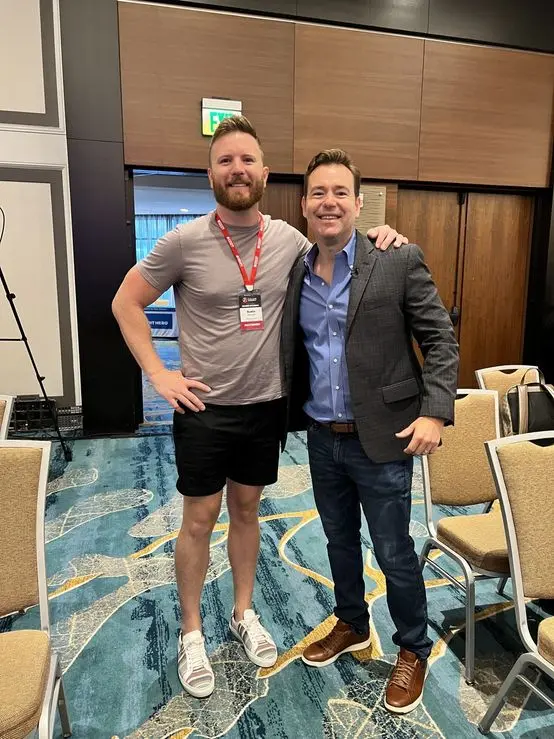
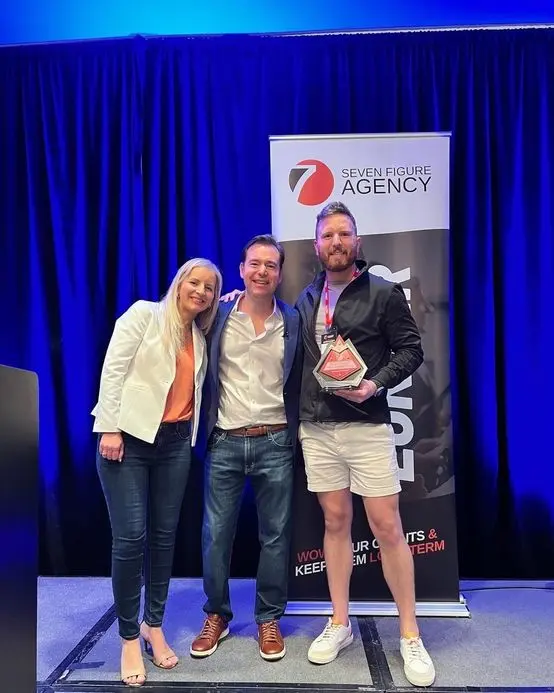
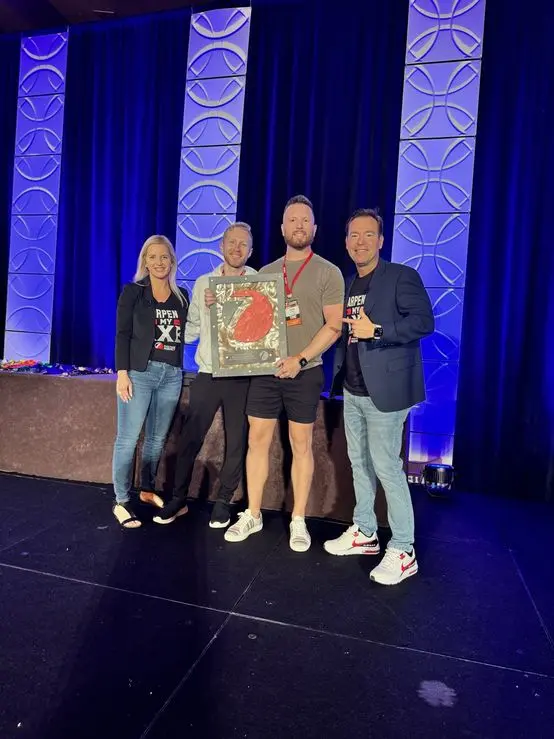
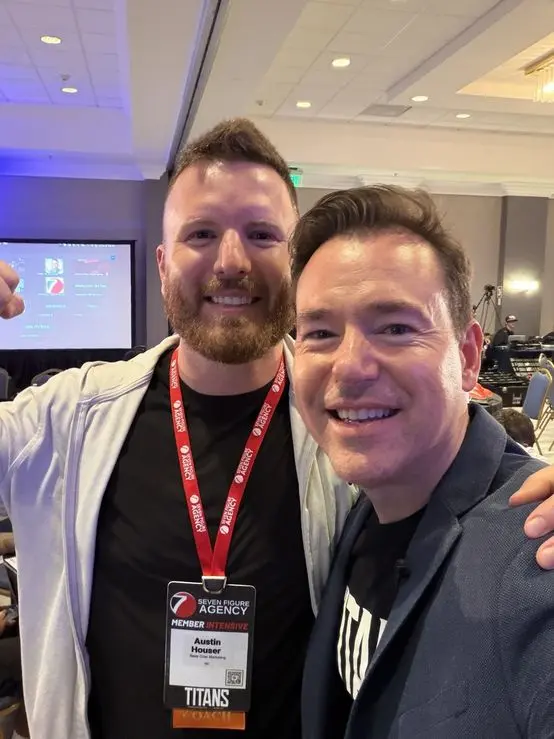
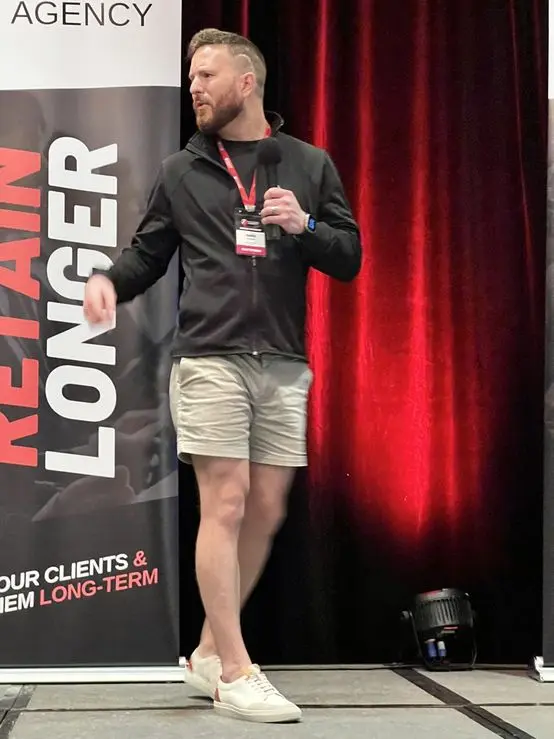
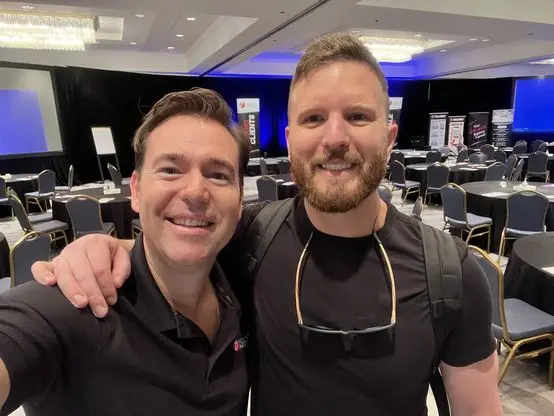
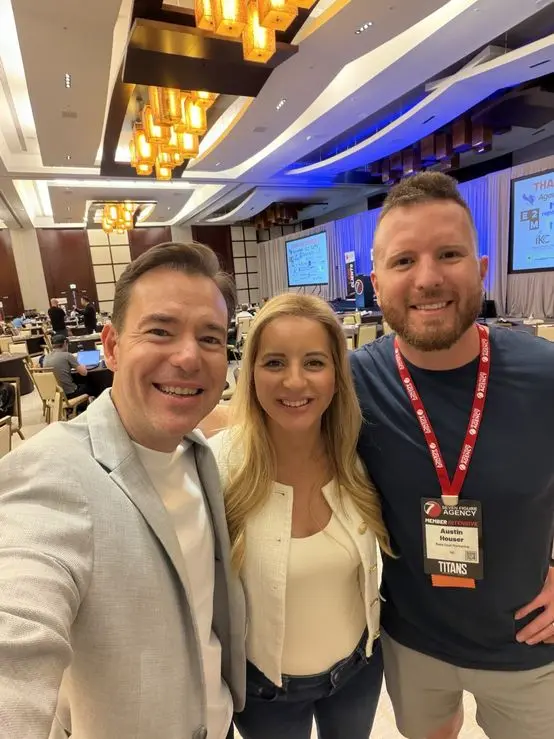
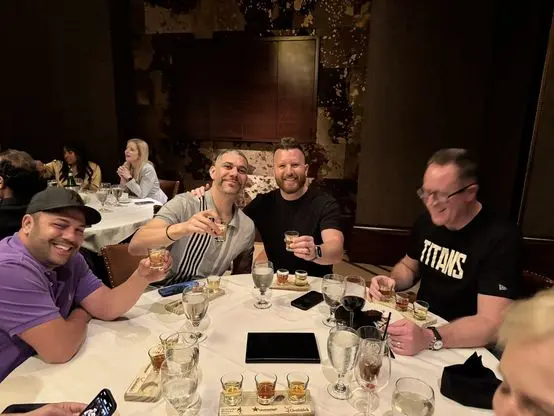
Austin has been a fixture at Seven Figure Agency events, on the stage as often as in the audience.
The short version
Prefer the two minute recap? Here is the same story in his own words.
Austin Houser on going from minus $2,000 to $92K a month in 11 months
Read the testimonial transcript
Transcript of Austin Houser’s testimonial video.
Austin Houser runs an agency serving the painting niche. Started working with me about two years ago when he was making negative $2,000 in monthly recurring revenue in his agency. My name is Austin Houser and I run Base Coat Marketing. Before Seven Figure Agency, I was negative $2,000 a month in MRR. So before the Seven Figure Agency, we had no vision, no direction. We had a goal, but no idea how to get to that goal. So the Seven Figure Agency has really provided us with the means, uh, the drive, and the motivation to reach our goals effectively and quick.
Today, we are at $92,000 a month at MRR, and we achieved that over the last, more or less, 11 months. Today, life is very different for myself and our agency. We have a clear direction. We know exactly where we are, we are today, where we're gonna be a year from now, three years, five years from now. I cannot stress enough how vital the Seven Figure Agency has been to our success. A few things that we have implemented since joining the Seven Figure Agency has been EOS. It's helped us have a clear vision, accountability with every team member.
We now have daily goals, weekly goals, quarterly goals. We also know exactly where we wanna be financially, not only myself, but every team member. And not only that, but we can measure our client results. We have 100% client retention. I need to knock on wood somewhere after I say that, but we really focus on delivering results for our clients, everything that the Seven Figure Agency preaches. If you're considering joining the Seven Figure Agency, I cannot stress this enough, do it. Invest in yourself. It is my number one point of feedback with anybody that I'm speaking with.
The Seven Figure Agency helps you grow not only your company, but you as a person. I consider a lot of these people in this room behind me family members. I mean, they are people that I talk to daily, weekly. The Seven Figure Agency has helped get us to where we are today, hands down, period, end stop. Awesome. So I'll link Austin's socials in the description. And if you're currently running a digital marketing agency that's doing at least $10,000 per month and you're looking to scale to seven figures and beyond, just like Austin and hundreds of our other clients did, then make sure to click the first link in the description and book a free one-on-one agency acceleration session.
In that meeting, we'll explore your situation and see whether or not any of our programs might be a good fit for your agency. Again, click the first link below and apply now.

Editor’s Choice on TopMarketingAgencies.com
Base Coat Marketing is an Editor’s Choice pick in the Painting Contractor category on TopMarketingAgencies.com, the editorial directory of the best niche marketing agencies in the country. Listings are editorial, not pay to play. Agencies are scored on niche depth, tenure in the specialty, client retention, verifiable results, and transparency, then re-scored every year. You can read the full profile on the Base Coat Marketing listing or see how the category stacks up on the top painting contractor marketing agencies page.
Starting From Behind?
Austin launched at minus $2,000 a month and got a brain tumor diagnosis eight weeks later. What he had that he did not have in the previous fourteen years was a roadmap and a room.