
Lawn & Landscape · Lawnline Marketing
He Doubled Recurring Revenue by Firing His Own Project Work
Tony Ricketts spent years building websites for landscape companies one project at a time. Then he cut project work off completely, forced every client onto a full-service monthly program, and watched his recurring revenue double in a matter of months.
Tony Ricketts with Josh Nelson, live.
Read the full interview transcript
Full transcript of Josh Nelson’s interview with Tony Ricketts. Lightly edited for readability.
Josh Nelson: All right. Well, hello and welcome. Thank you so much for joining us on today's special session. This is part of our 7 Figure Agency podcast and our Agency Success Interviews series. We're interviewing highly successful digital marketing agencies from across the country on how they're growing and scaling their businesses. And today, I'm super pumped to have Tony Ricketts from Lawnline Marketing, formerly Lawnline Websites, with us today. Tony, thanks so much for coming on.
Tony Ricketts: Thanks for having me, Josh. Really appreciate it. Looking forward to it.
Josh Nelson: So just real quick, from a high level, kind of introduce yourself and your agency, you know, the types of clients you serve, and kind of the size of your operations as it sits today.
Tony Ricketts: Yeah, absolutely. So, again, my name is Tony Ricketts. I'm the owner of Lawnline Marketing. Most people knew us by Lawnline Websites. So we did do a name change to line up better with the services that we offer. We focus specifically on the lawn and landscape field, the green industry, and we are a full service agency. So we are doing website development, design. We're doing search engine optimization, pay-per-click management, social media management. We even get into some additional services like recruiting, as that's a major issue in our industry. So we are a full service agency, and we operate like that. We don't offer one-off services. When somebody comes with us, they are, forced to do all of our full service programs. So you can't just buy a website from us, you have to do everything all together 'cause it all works together to get the best result. We're about four and a half years in business. We started July 2016. I do run a US-based, on-site team, so we don't have any remote workers or anybody overseas. There's a team… We're a team of eight people currently, and we're gonna do around a million dollars a year, in revenue this year with, plans and strategies to have huge growth next year to skip all the way into the mid twos next year.
Josh Nelson: Amazing. And, and if you get to know Tony a little bit better, you'll, you'll learn that he is a operations ninja. Like, he's world-class when it comes to websites and content structuring and SEO and the results that he gets for his clients on that front. So we started working together a-as part of 7 Figure Agency about, I guess, eight, nine months ago. Just if we can re-rewind to that point, what were some of the challenges you were facing in the business, at that point that you were just looking to solve?
Tony Ricketts: Right. Right. So at that point, I was really looking to get myself out of operations. I didn't wanna do any kind of fulfillment. I wanted to make sure that my team can handle all the fulfillment, and we have all the people and processes and their roles defined on what it is that they're going to do. Because without that, we have no ability to scale. So at that point in time, I was, trying to remove myself from 100% of the fulfillment and make sure that team was perfectly in place. The other thing that I was struggling with was building my monthly reoccurring revenue, and that's really where I want to, throw kudos to you, Josh. Because when I first started with you, I had about half of my revenue in projects, and by projects, I mean one-time website builds. People who are just gonna pay us once, a couple thousand dollars to build a website and that's it, which accounted for 30, $40,000 a month of our revenue. It was a big chunk. And, we were only around 30, 35,000 a month in reoccurring revenue at that point in time. And since we've, more than doubled our reoccurring revenue since February. We cut off all of our project work, so we're no longer doing that. And I tell you, life has been so much better when we got rid of that project work. So those were the two things, removing myself from fulfillment operations and getting away from project work and focusing on full service MRR.
Josh Nelson: Excellent. And I know that that was a little bit of a struggle 'cause it was such a big amount of revenue you got from the web design stuff. How has that impacted your business? Like, how is… Are things better now that you're more recurring revenue based- Right… As opposed to so heavy on that other side?
Tony Ricketts: Right. Yeah. The biggest thing is staffing. So you've gotta have the right people in the right places, and when you're doing so much project work, that's not consistent work. That's work that you have to go out and resell every single month, and you have to staff accordingly for it. Well, especially in my industry where it's very, seasonal based, where there's parts of the year where people are, building their websites more often than others. That means that I ran into serious staffing issues in those times of the year when I was understaffed to be able to do those projects. So that's one thing. The other thing was is when we did shift into only MRR, subscription services and got away from the project work, we still had things set up where it was kind of a la carte. So you could do just, a paid advertising or just the SEO or a combination of all of them. Now you get… We have two basic programs, and they include A and B, and the secondary program's a lot higher end and you're gonna get more with it. But you're going to have a full inclusive program on either one of those. So there is no just PPC, there is no just SEO or just a website. That allows us to systemize things and put, processes in place that every customer is going through the same path every month. But… And the results work really well. So both operationally and results for the customer.
Josh Nelson: That's awesome. A-and so, like, as you're listening to this, you hear, you hear Tony's doing a million dollars in landscape, you know, company business, which you'd often think, "Man, how could you do that much in that one space?" And he's poised to go to 2 million, and I have no doubt that he's gonna do it over the next 12 to 15 months. How did you wind up in the landscape niche? I'm, I'm just curious. Everyone likes to know kind of the genesis story of this- Right.
Tony Ricketts: Absolutely. So I'll back it all the way up and give you my whole story here of my progress. So I started, it actually started for me when I was a kid, about 10 years old. My father was a web developer, taught me how to build websites in the mid-'90s, and I fell in love with it. I was a code monkey all the way through high school, but I never really looked at it as a career option. So after high school, I, joined a landscaping crew and I worked on the landscaping crew for over two years in South Florida. And if you've ever been to South Florida and spent eight hours out there in that sun working, it's extremely hot. So I decided that this isn't gonna be for me. And after two years I was like, "Well, maybe I can do something with this skill that I have for coding." And that's when I decided to go back to college, got a degree, so I could, you know, have a formal degree on that, in that particular, skill. Worked in, marketing agencies and web development firms, did all of that, then I decided to start my own generalist agency, in Tampa, Florida back in May of 2007. And I ran that business for nine years and we would do everything, website development, software as a service, development. We would do marketing and paid ads, SEO, all that kind of stuff for anybody who wanted it. Now, we would have to relearn everybody's business over and over and over again, and it was a nightmare. Different strategies for different companies and, ev- it was just a complete nightmare. It was completely unscalable, didn't work at all. I did well. I mean, I was at six figures with that, with that agency, but it couldn't go any further than what it was without the major issues I was facing. So that's when I decided that this has to be more, call it productized, but, something that could be easily scaled and resold in a way that's easy to digest for the end consumer in this market. So I looked how I found a niche. I knew I needed to choose a niche. So how I landed on lawn and landscape were two ways. One, I already knew the industry 'cause I worked in the industry. I had done a website in the past for the landscape company I worked for when I was, just out of high school. And the other way that I found it was we did research. We went and looked at various different industries, and the things that we looked at was, one, how many companies were in that space? How many pr- how many, potential customers do I have? We looked at their revenues and then we looked at specifically how many agencies are already specializing in that indus- in that niche. And in the lawn and landscape at the time, there was hardly any of us that were focusing on it, at least that had any kind of presence anyway. So when you look at the experience I had plus the research we did, put that together, it was a easy choice to land on lawn and landscape.
Josh Nelson: Nice. So I mean, interesting there. So you… I didn't realize you had worked in the landscape trade at some point. So from, you know, landscape worker to seven-figure agency owner, that's a pretty exciting journey. And, and you know, it's interesting how we all arrive at a niche in a different way, but I think a lot of smart thought went into that, right? And a lot of diligence in terms of who, what's the right niche for me to enter. Right. The next que- I mean, the next question that always comes up is, okay, so now you've decided I wanna shift from generalist to specialist. I've done some websites in this space before. How did you get your first clients in the, in the landscaping world?
Tony Ricketts: Right. So I got my first clients the same way I still get my clients today, and I've always been a big believer of drink your own Kool-Aid and that's exactly what we did. That's how we started it. So we are really good at SEO. We're really good at paid advertising. We're really good at social media. And when you take those skill sets that you have, the same exact services and strategies that you're selling to your customers every day, and you apply them in your business, then you will start seeing results from that. And I know there's lots of different ways to skin a cat and get new business as an agency owner, but following your own policies and procedures and strategies and implementing them for yourself is how we got there. So a paid ad is where we got our very first customer, which I actually ended up selling it over a live chat. Still to this day they're still our customer and I still have never had a phone conversation with them. Is that right? Absolutely.
Josh Nelson: Unbelievable. So, so there are a couple interesting things to unpack there. First of all, eat your own dog food, right? If you're gonna be a digital marketing agency, right, and you're gonna tell people they should be doing pay-per-click advertising and they should be creating content to rank and you're not doing that for yourself, shame on you, right? Absolutely. So first of all, kudos. You, you did that and actually did it for your first client. The second is sell by chat. Talk, talk to me about that.
Tony Ricketts: So with this particular customer, being in the lawn and landscape space is one, there's a lot of, there's a lot of the, Hispanic, people that own these businesses and their English is not always great. So live chat was something I implemented from the beginning. It gave a nice easy, outlet to where they wouldn't have to call us and speak with us. It gave them an easy way to reach us. So this particular customer, I'm not sure how well their English is or not 'cause again, I've never spoke with them on the phone, but, we simply described what we offered through the live chat because they felt that was an easier way and we made the sale all the way through live chat, including collecting the credit card number and everything. So- That's wild… It was really wild. Now that's how we got our first customers and we still get a lot of our customers that way today. The other big thing was the trade shows. Trade shows- Mm… Is how we landed all of our… I wouldn't say all of our best clients, but a big portion of our best clients have come from trade shows. And we just do one big trade show every year with about 20,000 of our prospects there.
Josh Nelson: Wow. So talk to me about that. I'm a big fan of, you know, once you've chosen the niche and you've got a couple of wins under your belt like you had, to then find the association and the events that happen within that association- Right… And participate, right? So talk to me about- Absolutely… Like how you've gotten participative and kind of the trade show play.
Tony Ricketts: Absolutely. So- we ended up at the trade shows. We, we started our very first year. We went to our first trade show just… It was October after we opened the business. So only three, four months after we opened the business, we did our first trade show. We just simply did a Google search for trade shows in the industry, saw that this was something major, decided to go ahead, and we had probably the worst booth of everybody there. It was a complete terrible thing. We were going to like Walmart and buying rugs and stuff like that. It was horrible. We all start somewhere, right? And, it… E-exactly. And, I think we sold like two thousand dollars worth of websites at that, at that trade show, and that was actually our second sale happened at the trade show. Hmm. And so we were on top of the world. Sold two thousand dollars worth. You're like, "Woo-hoo-hoo-hoo." Oh, oh, absolutely. Didn't even cover our expenses to get there. Decided to come back-… The next year because it was so busy. We had a… Still a crappy booth, but we wanted to make it better. Did it a little bit better. And then finally the third year that we went, we went all in. We spent ten grand on a, on a nice booth. We upgraded to a twenty by twenty island. So we have a huge presence there now, and, it paid off already. I mean, we did, we did our trade show last year, and we've already done over 100K in recurrent revenue from the, just from the trade show by itself. So that's gonna continue to pay us dividends going forward through the year.
Josh Nelson: You– but you also mentioned associations.
Tony Ricketts: In this particular, our association is also tied to the trade show that is being put on. So along with the association membership, which you can choose to do, they also give you a discount on the trade show floor space. So it was a nice perk to be able to join the trade show as a supplier, which we ended up going all the way to the top level as a consultant member with them. And, we get a nice sized discount on our floor space. So it helps a little bit because trade shows are very expensive to go to, which is probably one of the main reasons a lot of people avoid them. But it's what really got our business off the ground. And when you're there, people validate you more. You feel, they feel more credible because you're at this big event, you look very professional, and you're standing there next to all the biggest known brands in the industry that everybody knows. Hundred percent. You know?
Josh Nelson: I love it that that's how you landed your first couple of, you know, couple of clients and started to get the momentum. Similar path for us, like, as you know, right? We, we got into the trade shows. I was there with my laptop and that was it, and we got a couple-… Of our seed clients from it, and we've kind of built it up from there. So, live chat with me, guys, as we're doing this. Tony's already shared some really cool insights on how he chose his niche, on, you know, how he landed his first clients, how he got some momentum in the space. What are you taking away? What are you learning? Kind of chat with me in the chat as we continue through this. What else have you done, like, as relates to the association? Have you been able to do anything else to kind of further embed yourself in that organization?
Tony Ricketts: Yeah, absolutely. So with our particular association, there's a couple of benefits that you're gonna get. So we d- we do a webinar every year. We're actually getting ready to do a sec- second webinar for them next month. Nice. And what's nice when you get s- in with the associations, they're the ones that promote you, and it gives you tons and tons of credibility. So when I do this webinar next month with the NALP, which ours is the National Association of Landscape Professionals, when I do this webinar with them, they're the ones that are gonna promote it to their, their, member base, and they will sign it up, and I just have to really show up, and give them the good info. So that's, that's one of the major benefits. The discount on the floor space, other speaking opportunities, the ability to have your content published on their website, and then they run a magazine also to have your content published in their magazine. So those are a couple of the benefits that come along with it. Another major benefit that comes along with it is gonna be you get the list of all the members. So with our association anyways, they send us an Excel file, and inside that Exce- Excel file, we have the list of all the companies, when they started, how many employees they have, how many trucks they, have, what services specifically do they offer, where are they located at, who is the contact person within that company. So they give us all that. The only thing they don't give us is their email address, but we get their phone number, their physical address, which is what we're gonna be, building a list of, target people off of this year, and we'll be doing a lot of direct mails, gift baskets, things like that to really put ourselves in front of the other members that we have that contact information for.
Josh Nelson: That, that's awesome. I think this is one of the most overlooked strategies, right? We, we all think, "Okay, now I'm in the niche. I'm gonna start cold blasting everybody." But you get a bad list, and if you've got bad data and you're sending out hundreds of emails, it still isn't gonna connect. Like, one of my favorite plays, exactly what Tony's talking about here, chose the niche, got involved in the association, got the list of members. Didn't have everything, right? But at least now he can go to the events and be real face-to-face with folks, and he's got data that he can reach out. And the other thing you said there that I think is extremely valuable is it's not just about joining the association and getting the, the logo to say, "Oh, we're affiliate members of this," or, "We're," I think you said, "consulting partners of this organization." Right. There's other benefits. If they let you do a webinar, do the webinar, right? Show up, add value. That's gonna create more awareness in the space. You're gonna get the list. That's great. Now you can reach out to them. Send them a copy of your book or send them some useful resources. But if they let you publish on the site, now you're, you can publish, and that's gonna be a good link back to your website. So look at all of the benefits of being an affiliate partner or whatever it is in your particular niche and implement it to the fullest like, like Tony did. This is, this is awesome. Thank you so much for sharing.
Tony Ricketts: Oh, yeah. Absolutely. Absolutely. Once again, this is a little- And I'm not even, and I'm not even, – Using it to the fullest. There's a lot more I could be doing with it myself. It's not even about, don't think you have to do everything 100%. You know, give… Take all the strategies that you know and learn and implement 10% of them, 20% of them, and work your way up to doing more and more. Don't think you have to just jump right in and go 100% right from day one.
Josh Nelson: Yeah. So Lo- Lo- Lovedeep's asking, what's been your experience with cold outreach? I think you kind of bypassed it, but yeah, tell the story.
Tony Ricketts: Y- yeah. So the cold outreach that we've done. So when we first got that list from the NALP that I was just talking about, I actually did have some people do some cold calling, and we got some customers from it. And we used a very specific script, and part of that script was, that we are so and so, and we are consultant members with the National Association of Landscape Professionals, the NALP. And knowing that these people are associated with NALP, that gave us common ground. See, when you do cold outreach, to me, where we found the most success is when we found common ground with them first. So once we find that common ground, which in this case is NALP, and people hear what they wanna hear. Obviously, you have to word your script properly and make sure you're following all the rules of the NALP, 'cause we can't say that we are the NALP. But people hear what they wanna hear. When you tell them that you're a consultant member with the NALP, they just automatically think you're NALP. And obviously, they're gonna find out you're not right away, but the point is that they listen to you for at least another 30 seconds to a minute, and you get your chance to get through to, through the gatekeeper to the decision-maker. So we did that, and we got a couple of great clients from there, even still monthly, SEO and advertising accounts that we have still to this day. So we ended up getting a lot of good customers there. I would say that's the extent of, like, cold outreach. We never did any cold emailing. We never did any email blasts. A little bit of cold calling and that was it. But what I quickly found out is we brought, I think, three accounts on from cold calling, which over time generated a whole bunch of revenue for us over the couple of years. But the time that was spent there was, not as valuable as the time we spent in our own marketing and SEO to generate much better results.
Josh Nelson: Powerful. Powerful shares and insights. What's up, Jonathan? What's up, Lovedeep? Great question there. Chris asks a question that I think comes up often, and that's when you join the association, don't they think that you're, a marketing agency, you're just there to spam? I think it's important that there's a distinction. You're not gonna be able to join the plumbing association or the landscape association as a landscaper. You're joining as a, as a, in his case, a consulting partner. In our case, it was a- an affiliate member. Like, they have different classifications for people that join the association, to sell to the members than people that are just there as actual members. So- Correct… So yeah, I mean, they… You have full permission with that to, you know, to approach it in that way. You do. And I…
Tony Ricketts: And to add to that, Josh, you're very right. They're gonna look at you like a marketing agency, you're trying to sell them something. And that's how everybody, whether it's the agency, the guy you're calling on a cold call or whatever it may be, you know, that's the way people look at marketing companies. They look at them like… Look at us like plumbers. We're gonna do whatever we can to get, that sale. But what's more important is that you focus on the education aspect. You don't come out of the gate trying to sell people stuff. You first establish yourself as the expert through content, through webinars, through magazine articles, or any other types of sponsorships that you can do. Buy a paid ad and get your banner on the side of their website. That in itself will give you additional credibility. And once you've established that credibility as a expert in the space, then you can sell them something. And in that case, you really don't even have to reach out to them, they come to you.
Josh Nelson: Yeah. Powerful, powerful. And I think the most important thing he said there was the ability to draft on affinity, right? Because you joined the association, because you're an affiliate partner, you're not just blind reaching out. You're reaching out and saying, "I'm reaching out because we're affiliate partners of this organization that you're a member of." Right? And it just changes the dynamic, and it gives you, like, an implied permission to, to reach out and have a conversation, as long as you're doing it in a way that adds value. – Yep… Awesome. So, so that's kinda how you got to the place you're at today. You mentioned the goal was to go two million over the next 12 to 24 months. Can you talk a little bit about what you're doing to accelerate the growth at that level in terms of new client acquisition?
Tony Ricketts: Abso- absolutely. So we are doing a lot. We are actually going full force now that we have our team in place. It is now to the point where all I have to do is really just start duplicating positions and people as the volume grows. 'Cause I'm now 100% out of fulfillment. I'm not building any websites or running any ads or doing anything like that, so it's just a matter of piling in more customers, piling in the team to, be able to fulfill it. So what, we're getting ready to do to climb to that two million or more mark is we're gonna invest very heavily in ourselves. So over the next period of our, of our, busy season, which for us is December, January is where it starts, runs all the way through the end of May, we're gonna invest very heavily in a couple of different channels. So as I mentioned, we're gonna build a list of our perfect clients, and we're going to reach out to them in various different methods. I don't know how deep you want me to go on these various strategies, but we'll be doing that. We'll be spending a lot in our paid advertising, so through social media, search engines, things like that. We are working on some joint ventures right now with, some people through the industry, some other organizations, some of the software vendors, consultants, things like that, to… Again, we're not selling to those people. We're generating content with those people. We're gonna educate with those people. So when we work with the software companies or the consultants and we collaborate on topics that people are interested in, then- That in itself sells people. So we're gonna be creating a lot of content like that, video, a lot of podcasts just like what me and Josh are doing here, and then we're gonna promote the hell out of them. You're gonna see them on all the social media. You're gonna see them if you visit our website. I feel sorry for anybody who comes to our website over the next six months 'cause you're gonna see a whole lot of us after you visit. We're gonna be doing direct mail pieces, and not just direct mail like printed mail. We're gonna be doing things like mailing USBs. We're gonna be sending out fifty dollar gifts, gift baskets to, cold outreach people that will be able to get their attention. And yes, it's gonna be very expensive, and there's gonna be a cost to it, but I'm also not trying to add fifty or a hundred thousand dollars a year to our revenue. I'm trying to add a million and a half or more to our revenue this upcoming year. So it's gonna take drastic measures. So those are a couple of the things that we're going to be doing. We also have a new website coming out. We're getting ready to launch that in a couple of weeks. Our own content outside of the JVs, so we're gonna start doing content once a week at a minimum. So those are just a couple of the items that we're going to use to take us from where we are now to another million and a half in revenue this year.
Josh Nelson: Crushing. And I have no doubt that you'll, you'll, you'll hit that target or at least get pretty close to it, man, 'cause you're, you're doing great stuff. So let's talk a little bit about how you bridge that gap because this is a problem that, you know, a lot of agencies when they get to that mid six-figure level, they're the one doing the selling, they're the one doing the marketing, and because they know how to do the websites and the SEO and the pay per click and are really good at it like you are, it's hard to separate yourself from that. So let's talk about how you kind of made that progression from not having to do it all yourself to having the team in place so you can focus on growing the business.
Tony Ricketts: Right. Well, there's… I think there's really two ways you have to look at this, Josh. One is what kind of owner are you? Are you an owner that comes from understanding this industry? Are you a tech nerd like I am, or are you a business owner that doesn't really understand the technology and the under-the-hood stuff? So if you're the latter one and you, and you're more of the business person and don't really have a good grasp on the technology end of it, then look for great white label partners. That's gonna help you immediately. You're gonna be hiring people like account managers and people like that are, not as expensive, not as specialized, and you're gonna be able to scale much more quickly at that level. Now, if you're like I am and you were a code monkey and a, and a tech nerd, then what you can do is you have to hire… I started with specialists. So I went backwards. A lot of people who grow an agency, their first hire is an account manager. An account manager was actually one of my last hires. So when I started the agency, I was a coder, as you know, and, I did my own ads, everything. Very, very deep into it, very deep knowledge set there. So I hired a senior level, web developer. I hired a senior level paid advertising and SEO guy. I hired senior level content writers, and they're expensive. You gotta pay a lot of money for them, I mean, far more than you would any account manager. And when you look at your revenue for being a mid six figure, say you're three hundred, five hundred, six hundred thousand a year in revenue, you may look at it like, "I can't afford this person." In fact, I had a call earlier this week with another member, that was in that exact scenario. He was spending so much time in his own paid ads, and his response was, "I can't afford to pay somebody that." And my answer to him was, "Well, how many hours are you spending in your paid campaigns?" And he said, "About twenty hours a week." So if you took that twenty hours a week and freed up eighty hours every month and gave it to somebody else, a senior level that you don't really have to spend that much time training that can just take that off your plate, what kind of sales are you gonna be able to generate? And you should be able to replace that person's revenue, I think sixty to ninety days is a long span. You should be able to do that in thirty days if you got that kind of, free time up. So the team is critical. You have to have the right people, but what's also important is you can't hire somebody who's not a senior and expect them to take something off of your plate like that. So we have those special peop- specialist people that I just mentioned that are all senior level. Those people came in, I told them how I like some things done, showed them a few of my strategies, and then handed it off to them, and they can just take it. They know… They're, they're just as experienced as I am. Now, on the other hand, I do have some generalist positions. I call them digital marketing assistants or operational assistants, whatever you wanna call them. They help do a lot of the Facebook posts and putting together newsletters and all that kind of stuff for our clients. Those people don't have to be specialists. They can be more of your generalists that you don't have to pay an arm and a leg for every year to have, and you can train them up to be exactly as you want them. And that's where I got my digital marketing assistant, that's where I got my account manager and those positions. So the moral of my story here is I started as an engineer myself with the senior level specialists that cost me a ton of money and then worked down to the more generalist positions, after that.
Josh Nelson: Great stuff. So I mean, it– for those of you that are at that place, so you're like mid, you know, six figures or more and you're thinking about, "Do I try and continue to do this myself or do I start to build a team?" Really the, the choice is stay where you're at, right, and call it a day, or you have to build the team if you're gonna continue to grow and scale. I think he just gave you some great insights on how to do that. What's up, Jimmy? What's up, Jonathan? Great to have you here.
Tony Ricketts: – And I think also, Josh, if I can add one more thing to that, be patient. That's the biggest thing with your specialists that you're gonna pay a lot of money for. Each of those specialists took me six months to fill those positions. They… It takes a while. Don't take the first one that comes in, and make sure that you know how to interview them. Make sure you know what questions to ask them. If you don't, if you can't properly vet a PPC specialist, then you're better off white labeling it because you're not gonna understand what they're talking about and be able to properly vet them.
Josh Nelson: Yeah. Great, great point. Hire, hire slow, right? Hire fast. Do your due diligence, find the right person, and fire fast when you need to. Like that's a, that's a,…
Tony Ricketts: I live by that, for sure.
Josh Nelson: Okay. So we've talked about how to land the clients. We've talked about kinda how you, how you've morphed your organization in order to free yourself up a little bit so you can continue to focus on growth. Talk us through a little bit about what the deliverable looks like for your clients. Like, what is it that you do and kinda how do you charge for that type of stuff?
Tony Ricketts: Yeah, absolutely. So as I mentioned at the beginning of the interview here, we are full service. So you can't come to us and just buy a website. So we ha- we do have a paid ads only program, and I'm even considering phasing that out. We did it for the lower end entry-level people, and we've got maybe five or six accounts on it. But, we'll determine whether we keep that or not. But that's the first entry level. It's $1,000 a month, search or social paid ads, and what that includes is us setting up the campaigns, running them for you, setting up landing pages. We won't use your own website. And if you don't have one of our websites, we'll build you a, landing page website where that's all it really is. So they can then also add on search or social. So let's say, for example, they start at $1,000 a month for search ads. They can add on social ads for $500 more a month. So that's a total of $1,500 a month. With that program, your ad spend has to be equal to one month of our fee. So if they're on $1,000 a month paid ad program for search, then they need to put at least $1,000 a month on their budget to go to Google, Microsoft, or wherever we're running those. If they're doing 1,500, then it has to be, $1,500 ad spend for the search and social. However, our main programs are our second and third programs. Our second program is going to be, SEO, paid ads, and a website. So the website is free. We used to charge a separate setup fee for that, but I decided to get rid of that. Now, we do build them a standard, 12-page website, four service pages, eight, regular standard pages, and we'll build it out over time. So we have higher content in our ongoing marketing programs. So on our second program, it's a $3,000 a month program, and that's going to include your website build. That's gonna get you four content pieces every month, so about one content piece a week. So as you can imagine, we can scale that website very quickly. But we do it over time to avoid the huge setup fees. We're going to handle their citation for them. Now, we do manual citations. We don't use Yext or, the Bright Local or the other options that are out there. We actually manually create them ourselves. I have a whole strategy behind that. We do review building for our customers and help them get their online reviews. We have a great strategy for that. With each of their content that we create, we're gonna promote that to their Google My Business. We're gonna promote it on their social media, set up paid ads on it for their social media. Depending on the piece, we'll remarket that back to certain people. We're also going to be doing monthly upsell emails for you. So in our business, lots of companies are failing because they're not upselling the way they should be. Instead of earning $2,000 to $3,000 per customer, they're only earning $800 to $1,000 per customer, which, you know, something we should talk about is our sales process. But when I hear that, I can tell right away that this person doesn't do their sa- their upsells properly because they just told me they only earn $800 to $1,000 a year per customer. So when I tell them that I can take that to $2,000 per customer per year with just email upsells, that gets them very excited. So every month we use emails to upsell their other services. So in, let's say for lawn care, you got a guy that's doing mowing service. Well, they need to have their mulch, refreshed once a year. They need to have their bushes trimmed two or three times a year. They need aeration and seeding in the fall. You know, they need all these other services, fertilizer and weed control and all these other things that go along with it, and they're not just gonna come to you and buy it. You gotta tell them that that stuff's for sale and here's how you can get a price for it. So upselling our email newsletters. Live chat services is included, 24/7 live chat answering. So not for– We don't just put a live chat on our client's website and say, "Here you go. Make sure you man it." No. We man it for them. We have 24/7, availability for people to come onto the website. After 15 seconds, that visitor gets invited to have a chat with our team. They're gonna answer those questions that they have, and the whole purpose is to collect that information and pass it on to our customers so that they can schedule an appointment or whatever for them. So live chat services are gonna be included there. Then there's other general things that are– they're good, they're nice to have things, but they add more to our program. So things like visitor analysis. We set up Hotjar on all of our accounts to generate heat maps and see how people use the websites. Full automated reporting through agency analytics, rank tracking. We do, a unique and custom competitor analysis depending on what program you're on. It's either monthly or quarterly, so we can show you how you're comparing to your competition. So those are the majority of the things that's gonna be included in the $3,000 tier. Once you get to the higher tier, our $5,000 a month tier, which is our third program, it's gonna include everything I just mentioned, except you're gonna get an additional two content pieces a month. So you'll get six instead of four. You'll get more citations. You'll get more so- now you actually get full social media management. So regular social posts. We respond to your comments. We respond to your messages. We invite people to follow your page that like you. Or I'm sorry, that like your posts or comment on your posts. We do, link, or I'm sorry, group sourcing on Facebook for local groups that accept, businesses or pages to join and then allow you to post once a week or something like that on certain days to promote your local business. So we find those groups. We join it for them. We post on it on their behalfs. We will do bigger link, or I'm sorry, bigger content distribution. So we'll start pushing that content to places like Howls and other places around the internet that's going to have more of an impact. – I, I know I'm missing something else in there, but,… Oh, we'll do things like attributions. So a lot of our clients all use CRM systems, and there's certain industry CRMs that everybody really uses. And one thing that we will do is we will go back in their CRM system and attribute those leads to their original sources. Our customers love that on that higher end, and a lot of them find that that in itself is worth the additional $2,000 a month. Because when you generate several hundred or even thousands of leads per month, and somebody that's not on their team is gonna go through their, so all their customers and say, "This customer came from Facebook. This customer came from Google Ads. This one came from Google LSA. This one was organic." What we can then do with that is generate a report that shows them what their cost per customer acquisition is on each platform, which is great to tell them what their cost per lead is per platform, but when you can tell them what their customer acquisition is per platform, they really love that kind of stuff. So at the 5K level, you get a whole lot more. Oh, also you get our manual link sourcing too, where we go out and find local organizations, charities, things like that, where you can buy sponsorships and get great quality inbound links. So I know that was really long.
Josh Nelson: No, that was great.
Tony Ricketts: And then our last thing is our upsell. Our upsell for recruiting. Once we blow you up, you can't handle it, you call us, say, "Hey, you gotta slow this down some." We say, "No, let's not slow it down.
Josh Nelson: Let's throw recruiting on you, and let's get more people into your company to help you grow." And that, I think that right there is a super powerful insight, right? If you think about most of us in home services especially, and probably in any vertical, you get really good at generating the leads for the clients and growing the client base, but inevitably they get to a place where they're tapped out. "Hey, we can't take any more jobs," or, "We can't take any more patients," or whatever it is. If you can solve that problem for them, they will pay you an incremental, right? Yep. Plus, you're solving the problem, which makes it so they can continue to invest in the marketing and grow the business. So I think that's, that's brilliant on your, on your front to add that to your service, package.
Tony Ricketts: A-absolutely. And we just had a great example of that this week. We had a client call last week. They're on our $3,000 a month program. Things are going so well, they wanna upgrade to the $5,000 a month program to keep growing, but they don't have the staff. So I told them, "Well, let's wait a couple of months. Let's put you over onto our recruiting program," which is an additional $1,000 a month in our pockets, "and let's get you some people." So they agreed to that, and we've already started pushing them in several applicants. They're already in the review, or interview process. And, hopefully in another month or two, we'll bring them up to our bigger program. So good. So good.
Josh Nelson: So give me like a yes, or a this is awesome, or something in comments. Tony's just unpacked how he chose his niche, how he landed his first couple clients, how he grew to seven figures and his plan to go to multiple seven figures, how he transitioned himself from the, the operator in the business doing everything to having a team, so he doesn't have to do it all himself, and kinda what his service model looks like, what it is he actually does for the client. And I'd also like to hear from you guys, what are your takeaways? What are you learning that you can apply? A couple things that stood out to me as you were talking about the service model. First of all, recurring revenue, right? Tony's moved from doing one-off projects to charging a monthly recurring fee, and it's greater than $1,000 per month, right? Oh, yeah. His cheapest thing is $1,000 per month, and he's in landscaping, right? Lawn and landscaping, well, your immediate thought when you look at verticals on the, on the horizon, that that's a lower ticket. Like landscape companies aren't gonna spend more than 500. Did you ever, like, wrestle with that thinking they just didn't have the money in that space?
Tony Ricketts: I did. But when you look at the numbers, there's… Take the, take the niche out of the equation and look at the revenue of that business and what pro- projected profits they should have. And when you look at the numbers in this industry, there's about 15% of landscape companies that are over a million dollars a year. And when you look at what they spend in our program… See, I don't sell a program. It's not 3,000 a month, or it's not 5,000 a month. 'Cause when they hear three grand a month, hell, that's two mortgages. You know, that, that makes their brain tick differently. Companies that you wanna go after that are doing millions of dollars a year, they don't budget by the month. They budget by the year. And that's how I explain it to them. So w- it's not $3,000 a month plus a minimum $1,000 ad spend. You're gonna invest 50 to $60,000 a year, including your ad spend, all in a program like this. So when they think to themselves that, "Oh, well, we're doing a million and a half, $2 million a year," and they hear $50,000, then they're thinking, "Well, that's a very small percentage of my marketing budget," or, "a very small percentage of my revenue," and it's right where a marketing budget should be. So selling it in that manner is helped get people over the concept of this is a very expensive monthly program. But yes, to answer the question, I did think about, are we gonna be able to get these companies to pay this kind of money? Now, I don't know that I could get much more than what I'm getting now 'cause I'm definitely towards the top of the market. But I do have several people that are on $5,000 a month programs, and I have a handful that are on custom programs going up to $8,000 a month. Yep.
Josh Nelson: So, so monthly recurring, higher monthly fee. The only thing I think that I took away is a comprehensive service offering. You're not coming in piecemeal website, piecemeal app, piecemeal, "Let me do some emails for you." You looked at the industry as a whole and you said, "What can I do to really help these guys grow, to solve their problems, and to take their business to the next level?" And you're, you're coming to the market with a comprehensive approach as opposed to just one-off, you know, random things.
Tony Ricketts: E-e-exactly. We, we have a strategy that works in our niche. And if you want to get our results, you have to use this strategy. And we're not willing to put our reputation on the line for half a strategy. So if you want the results that we're known for, you have to do these things. And they'll say, "Well, I don't want you to do our email newsletters." And in those cases, we'll tell them, "Okay, we're not– we won't do them, but you're still gonna pay for them." And in that case, they're like, "Yeah, okay, then you might as well do them if I'm paying for them." So you– there is no piecemealing out. And also, too, that helps us scale the business. That helps systematize things. We don't have customers where this one gets this one gets that, this one gets that. No, they're all on the same level playing field. What's changes between them is their ask, their budgets.
Josh Nelson: Yep. So a couple questions in here. One that I think is relevant is do you– are you having them sign a long-term contract, short-term contract, month to month? How do you structure it in your world?
Tony Ricketts: Yeah. So they all sign a twelve-month agreement, and, recruiting is a three-month agreement. So when a company comes on and adds on the recruiting service, which you can't get independently, you have to be one of our customers, that only requires a three-month agreement. Everything else is on a twelve-month.
Josh Nelson: Yep. Good. Good.
Tony Ricketts: And then it goes month to month after that.
Josh Nelson: So the other critical insight that I think all agencies that are really successful, at least that I know in the seven-figure agency, the common trend is move to monthly recurring revenue, move to a more comprehensive approach, and then also, as you do that, move to the higher end of the market. So as opposed to thinking every landscape company is your, your target, I think you have specifically decided, "I'm gonna, I'm gonna, like, say no to ninety percent, and I'm gonna focus on the top ten." Yep.
Tony Ricketts: Yep, and that's exactly what we do. We turn away eighty to ninety percent of the people that call us. We do tons and tons of leads every single month, and almost all of them get turned away. And it's because why spend our time and efforts on a company that's gonna be more of a pain in the butt to deal with, and we're not gonna make nearly as much. They're gonna get overloaded. They're gonna get upset. They're gonna have to cancel service 'cause it's just way too much for them. There's no need to do that. But you have to know how to sell to those people. You can't come in as a greenie or a new person into the industry and know nothing about it and try to sell to these people and try and get them to spend fifty to a hundred thousand dollars a year with you. You've gotta know their business and understand it, which is one of the key ways I actually sell. You know, selling, even if they are an inbound sales, is much like the cold calling. You have to establish that common ground, and I explain their business to them. So one of the tricks I love to do is I will ask them, "How many crews are you running?" And based on the services they offer, I will tell them how many customers they have based on that answer. And when I tell them that breaks down that entire wall. Now, this guy obviously understands my business because he knows that if I'm running, one crew on a certain lead, that I only probably have less than three hundred customers. You know, which knowing that information in your niche allows you to connect with those people and better communicate with them and sell to them.
Josh Nelson: A hundred percent. Yeah. Great, great insights there. Jimmy Nicholas is on with us, runs a really successful, agency that, you know, multiple seven figures is, yes, love the high end of the market, and he loves the insights you're sharing here today too.
Tony Ricketts: Oh, yeah, absolutely. And he's, he's not wrong. It definitely go towards the upper end. And a lot of people have struggled with turning away business. That's one of the one things I've had to learn is how to say no to people. And when people come, you can't feel bad for them. You can't bend your rules because of it. You have to know that not every phone call is gonna be a sale. Right. It's not a fit.
Josh Nelson: And, and do you pre-screen at all o-on your end, or have you started doing any pre-screening based on size, revenue?
Tony Ricketts: A little bit. A little bit. Okay. So on our website, you'll see some pricing stuff buried in there talking about that we typically work with these types of companies. We did add, in our new website, how many employees do you have and things like that. But typically speaking, we do… I do the training or, I'm sorry, I do the qualification immediately on the phone. Now, that's one piece I still have to get myself out of, is some of the sales stuff, which I have a strategy and I'm working towards that. But one thing I do on my sales calls, I immediately qualify them. That's the first things I do. I ask them first, "What's your name? Where are you from? Your phone number, email, all that. How'd you find us?" And then comes the qualification questions. "How many employees do you have? Where are you working? What services are you, are you providing? Do you have an office staff to answer phones? Or if not, do you have a call center? Have you ever done paid advertising or marketing in the past?" And based on those questions, I'll let them know before I even get into pricing or anything, if they're a good fit or not. And I just tell them, "Look, you know, I really don't think you're a good fit based on where you are, and here's the reasons why. Because, one, it's gonna cost you a lot of money. Two, we're gonna overload you." And I tell them, "It's just as easy to destroy a business by getting too much business as it is not getting enough business. So that will get you bad reviews. It'll run your company to the ground. You don't wanna do that to yourself. Instead, let me go ahead and refer you over to somebody that would be a better fit for you. They also know the industry. They're actually one of our competitors, and I give them tons and tons of leads, every day." So find who you're a good fit for and then refer out the rest. And I don't take a referral fee or anything for that. I just wanna send them somewhere where they're not gonna get ripped off.
Josh Nelson: Nice. Powerful, powerful insights here. I mean, hopefully, you guys are getting this, like, live comment with me here, what you're taking away, what you're learning, 'cause Tony's sharing some tremendous insights. Let's, let's talk now a little bit about retention. So you've got all of these clients, you've got all of this recurring revenue. You obviously are extremely good at the execution and getting the clients results. What is the retention strategy look like? How do you keep these guys on board at these higher monthly fees?
Tony Ricketts: Right. So we keep pretty much a hundred percent retention. It's very rare that we lose a client. Now, occasionally, we will, and typically, when we lose a client, it's one of our legacy clients. And the reason that we lose them is 'cause the prices are increasing, because they can't handle the volume of what's coming in, and they're not on contract 'cause they're legacy. But what really keeps the people is two things. One, you gotta get the results 'cause if they're just wasting their money, they're gonna leave you. But two, you gotta have that communication And even when you don't have the results, that communication will save your ass. Mm. So if there's problem, we pick up the phone with our clients and, we'll pick their brains about things. "What about this area? What about this service? We're seeing this over here. Do you mind if we try this?" And we let them know that we're in their corner working for them all the time. Whether we may be having a down month and we're not getting great paid ad results, or whether the month is going fabulously well. You know, like for example, one of our, bigger clients, we, we made a mistake, the other day and didn't filter out his list of emails right, and then some people who should not have gotten an email about a specific upsell did get an email. And we resolved it and all that, but the point is at the day after that, I personally sent a message to this really large client via text message and asked them if everything is better today. "Are we not having any issues?" And when you follow up with them and give them that kind of communication, whether things are going well or not, they appreciate you and you create that, that bond with them. And that gives you a lot more leeway and a lot more slack if things don't happen to go your way. So what we do is monthly reviews at a minimum. Every month we get them on the phone, we go over their numbers, and we ask about their business. "What kind of revenue increases are you seeing? Or what types of services do we wanna focus on next month? Was there any really bad leads that you can think about that were way out of the geographic area or not part of a service that you offer?" So we dive in very deep with them every single month. So I think fulfillment and actually getting results, plus the communication together, you'll retain your clients for a very long time.
Josh Nelson: Great stuff. Great stuff. Marco, it looks like you had a question. If you wanna pop it in there, that's fine. Go ahead and, and put it in. So talk to us a little bit about how you developed yourself. Like, obviously you're good at programming. You've, you've developed some great skills in SEO. You're great with, you know, business development. How have you developed? Like, are there specific books that helped you along the way to help get where you are today? Books, trainings, things like that?
Tony Ricketts: No. Honestly, I learned by like throwing your kids into the deep end of the pool to sh- teach them to swim. You're- You can't teach a- you can't teach someone to ride a bicycle at a seminar, right? Right. Exactly. So, I now, I am, a member of Seven Figure Agency, and that is the first, group or training or coaching or whatever you wanna call it- Hmm… That I've ever been a part of. Everything from where I started to where I am now, I learned the hard way. You know, I take a bunch of punches in the face, fall down a million times, and had to get back up. But really, that's the best way to learn it, is to do it that way. I mean, I've found out about managing of employees to hiring employees to, management systems within the company and to specific strategies, how to talk to your team, how to do weekly meetings. You know, all of that was all learned the hard way by the consequence that happens if you do it wrong.
Josh Nelson: Hmm. So, so h- school of hard knocks. That's it. Yeah. That's it. Yep. Excellent.
Tony Ricketts: I did go to college to learn, or not learn, but I guess perfect- Mm-hmm… The programming and coding, but I n- never went to a business class, don't have an MBA, none of that kind of stuff. Josh, you were my first coach that I started, listening to eight, nine months ago.
Josh Nelson: Well, honored to have, broken you in into the, into the Gibson training-… And business development world.
Tony Ricketts: Moni- Monica's asking, "For a new agency owner, how many hours do you suggest you put in on a daily basis?" So as a new agency owner, I would suggest as many as you possibly can. Now work-life balance is definitely important, and you definitely wanna have time, but if you're a new agency, you're in hustle mode. You know, you're… Those who work harder get more. And those who, those who take shortcuts and those who, try to do things the easy way, those are the ones that never succeed. You know, you look at me doing well here in our agency, but I started my first agency in May of 2007. You know, it was… You know, I'm a overnight success after 10 years. Hmm. So I put in, still to this day, I probably still put in 50, 60 hours a week. But it's not on building websites. It's not on paid ads. It's on how can I improve this process in my company? How can I reach this per- specific JV? That's what I focus on. So I would say at least 50, 60 hours a week minimum is what you should be putting in your business at this current state. Now, as you grow, I'm, I'm, I'm a hustler. I'll never be able to stop. But if somebody was in my position, then they could probably cut it back to 40 hours a week or maybe even 30 hours a week. Take, take a day a week off during the day, things like that. But I'm a machine. I just keep going and going. So the answer is more than you probably think, right? Put, put as much effort into this as you can early on in the agency. Think of it like an airplane trying to get off the runway, right? The beginning, that airplane's putting out tremendous effort to get off. And, and of course, once it's off the ground, you can, you can, you know, count on the power of lift to keep you going, and you can, you can throttle it back a little bit.
Josh Nelson: Yep. I thought that was a great answer. Danny's asking, with an I, "How would you go about getting your first client as a beginner?" Like if you were starting from scratch.
Tony Ricketts: Right. So as a beginner, I'm sure you guys have all heard the term fake it till you make it, right? So one, set up the things that you have control over. So make sure your website looks good. Make sure your own marketing materials look good. Nobody wants to hire a marketing company where their own marketing looks like crap. So one, make sure that you have your, – Your service offerings, you have your own marketing materials, all that stuff in place. And then I would do what I did. I would run some ads. Paid ads are gonna get you instant results. You're gonna pay for them, don't get me wrong. But just like you do with your clients, I would say your first, your first month, you know, if you're the provider, so you don't have to pay another agency $500,000 a month to run it for you, take $1,000 of your own money and we would pay, when we run paid ads, around $200 per quality lead, right? That's a big thing to think about. See, on Facebook, I pay 10 bucks a lead. And you would think, "Oh, wow. Well then let's go to Facebook and let's blow all our money there." Not at all. I would much rather have those $200 leads from Google any day of the week than I would the $10 leads from Facebook. I don't even know if I ever even closed one single lead from Facebook. So I would run Google ads, and I would be very specific on your keywords, so whatever your niche may be. In my case, landscaping SEO, landscaping marketing. Stay away from the website keyword. Unless you, for whatever reason, you're pr- you're focusing on projects, which you shouldn't be, but if you are, then do websites. But websites, that keyword tends to show people who want a one-time service. So make sure that you're bidding on keywords like your niche SEO, your niche marketing, your niche advertising, niche lead generation. All of those types of things will get you your better quality customers, but you're gonna be paying 200 plus per lead for it. So be prepared for that. Yep.
Josh Nelson: So, I mean, there's a bunch of questions in here on some foundational stuff, like how did you choose your niche? How did you put together your pricing and packaging? All of that. I don't, I don't wanna spend another 45 minutes on that. Right. Right. He explained it at the beginning. If you haven't read the book, The 7 Figure Agency Roadmap, that book lays the foundation, right? Choose a niche. You should be in one niche. Somebody's asking, "Should we be in…" Yes. Choose one niche. Put together a program. Position yourself. Go out and land clients. The 7 Figure Agency Roadmap, it's, it's free if you wanna grab a copy, 7 Figure Agency Roadmap, 7figureagency.com/book. Tony, this has been phenomenal, man. Congratulations on growing to seven figures. Congratulations on the plan to go to the next level quick. What would you say to that agency owner that, let, I mean, let's, let's say specifically the agency owner that's, that's at, like, s- mid six figures, right? They're, they're at that level. They're grinding. They're trying to figure out how to go to the next level. What would be, like, one or two tips you'd say to that guy or gal that's looking to take things to the next level?
Tony Ricketts: Do a time study. That would be the number one thing. Keep track of every minute of your day and see what you're spending your time on, 'cause what you're gonna find is you're doing a lot of stuff that you can give to somebody else. So that would be the number one thing is- Powerful… Your time study. The number two thing that I would recommend is put as much as your effort and resources into building the right team as much as you can. That, you will not operate without a team. Trust me, I was a solo guy for many years, and have, now that I have a team, I don't know how I did it. You will not succeed without the right people. So find out where your time is going and get the right people in place. From there, you can do anything.
Josh Nelson: I love it. Powerful, powerful insights. Amazing information shared. Be sure to tag Tony on Facebook to thank him for his time. Thank you for all of the great insights. We'll, we'll wrap it up here. So thanks again for taking the time. Thanks for, thanks for sharing and your willingness to kind of expose, like, he's just giving you the roadmap here on how he grew his business and what he's doing and what his plan is. Not everybody has that generosity of spirit, so thank you so much for sharing. And, that's a wrap. Anything you wanna say as we close here, Tony?
Tony Ricketts: No. I just, thanks, for having me on here. You know, I would definitely recommend, to everybody to follow your strategies. You know, I was already, in business doing six figures when I joined 7 Figure Agency, but I did a lot of project work. So even somebody like me, who was already on operational, still found a lot of great value out of what it is that you teach and show us, Josh. So, definitely I think that that's a main thing that people should consider. The other last thing I would add is, we just touched the surface here. We just barely scratched the top. We didn't even dive deep on anything, I would really feel like. So if anybody has questions about how we do anything specifically, I'm an open book. Feel free to reach out to me, and I'd be happy to, dive deeper on anything specifically.
Josh Nelson: Yeah. Tony, you did an amazing session at our last intensive on how you create the, your content for your clients and how you structure it and kind of do project-specific content. And members, we're, he's gonna be doing a session at the December intensive where we're gonna go much deeper on that. He volunteered it, so I'm gonna take him up on it. So be sure to give a yes if you're excited about that session at the, at the December intensive.
Tony Ricketts: I know that, I know that I am. Oh, yeah. For sure.
Josh Nelson: Fantastic. Well, thanks again, Tony. Have an amazing afternoon. Thanks again. All right. And we'll, we'll talk to you soon.
Tony Ricketts: All right. Thanks, Josh. I appreciate it. See you later, guys.
Where He Started
Tony Ricketts learned to code from his father, a web developer, in the mid-1990s, and was what he calls a “code monkey” all the way through high school. After graduation he spent two years on a landscaping crew in South Florida instead, and eight hours a day in that heat was enough to convince him to go back to school and turn his coding skill into a career.
In May 2007 he started a generalist agency in Tampa, Florida, and ran it for nine years, building websites, running paid ads, doing SEO and software development for whoever would pay him. “We would have to relearn everybody’s business over and over and over again, and it was a nightmare,” he said. He got the business to six figures, but it could not go further without becoming, in his words, more productized and easier to scale.
He picked lawn and landscape for two reasons. He already knew the industry from his crew days and from building a website for the landscape company he had worked for, and when he and his team researched the space, they found few agencies specializing in it. That combination of prior experience and a genuine gap in the market was, as he put it, “an easy choice.”
The Shift That Changed Everything
By the time Tony joined Seven Figure Agency, roughly eight or nine months before this interview, Lawnline Websites (as it was still called then) was doing about a million dollars a year, but half of that revenue came from one-time website builds worth a couple thousand dollars each, and only $30,000 to $35,000 a month was actual recurring revenue.
Project work created a staffing problem specific to a seasonal industry: he had to staff up for busy stretches and then had nothing consistent to keep that staff working the rest of the year. So he cut it off. Every client now goes on one of two full-service programs, no a-la-carte options, no just-a-website, no just-PPC.
The company also changed its name from Lawnline Websites to Lawnline Marketing to line up with what it actually sells now: an entry-level paid ads program at $1,000 a month (which he is considering phasing out entirely), a $3,000-a-month program that includes a free 12-page website, four content pieces a month, manual citations, review building, 24/7 live chat, Hotjar visitor tracking and automated reporting, and a $5,000-a-month program that adds full social media management, more content, lead-source attribution reporting and manual link building through local sponsorships. A recruiting add-on, sold only to existing clients, runs another $1,000 a month on a three-month agreement, while the core programs are 12-month agreements.
How He Landed and Kept Clients
Tony’s first customer bought entirely over live chat. He never had a phone conversation with them, then or since. Live chat mattered in his niche partly because many landscape company owners are Spanish speakers who preferred not to call, so he built an easier channel for them to reach him, and it is still a channel he uses today.
Trade shows became the bigger engine. Lawnline went to its first industry trade show only three or four months after opening, with what Tony calls “probably the worst booth of everybody there,” bought at Walmart, and sold about $2,000 worth of websites. By the third year he spent $10,000 on a 20-by-20 island booth. Last year’s show alone generated more than $100,000 in recurring revenue that will keep paying out through the year.
Joining the National Association of Landscape Professionals as a consultant-level member gave Lawnline speaking slots, a webinar the association promotes to its own list, published content in the association’s magazine, and a member roster with phone numbers and physical addresses (though not email) that Lawnline used for direct mail and cold calling. The common ground of the association affiliation, he said, got a cold call past the first thirty seconds; about three accounts came directly from that cold calling and have generated recurring revenue for years since, though Tony found the time better spent on his own marketing and SEO than on more cold outreach.
Lawnline now turns away 80 to 90 percent of inbound calls, qualifying prospects on the first conversation and referring poor fits, sometimes straight to a competitor, without asking for a referral fee. Retention runs close to 100 percent, and Tony is candid about what it takes to hold it there even when a campaign has a bad month, including one honest slip: Lawnline sent an upsell email to part of a client’s list that should have been filtered out. He personally texted the client the next day to check in.
Building the Team and What Comes Next
Tony built his team backwards from how most agency owners are told to do it. Instead of hiring an account manager first, he hired senior specialists first, a web developer, a paid ads and SEO specialist, and content writers, because he came out of the business as a coder himself and needed people who could operate at his level without heavy training. Each of those senior hires took about six months to fill. Only after that did he add generalist roles like digital marketing assistants and, eventually, an account manager. Today he is fully out of fulfillment, running an eight-person, US-based team with no remote or overseas staff.
Lawnline was on pace to do around a million dollars in revenue for the year of this interview, with a plan to push into the low two millions the following year through heavier paid investment in list-building, joint ventures with software vendors and consultants in the space, weekly content, direct mail (including mailed USB drives and gift baskets), and a new website. Tony’s advice to an agency owner stuck at mid six figures: do a time study to find out where your hours actually go, and put as much of your resources as you can into building the right team. “You will not operate without a team,” he said. “I don’t know how I did it” as a solo operator.
What made it work
- He killed the thing that was working. Project revenue was real money, but it capped growth and created staffing chaos. Cutting it forced the shift to recurring revenue.
- One niche, deep involvement. A consultant membership in the industry’s own trade association gave him a stage, a mailing list, and instant credibility on cold calls.
- Trade shows compounded over years. A $2,000 first year with a bad booth became $100,000-plus in recurring revenue from a single show once he reinvested in it.
- Specialists before generalists. He hired expensive senior talent first because he needed people who could operate without hand-holding, then filled in generalist roles later.
- Communication protects retention even in a bad month. A personal check-in after a mistake, not just good results, is what he credits for near-100 percent retention.
Tony in the Community
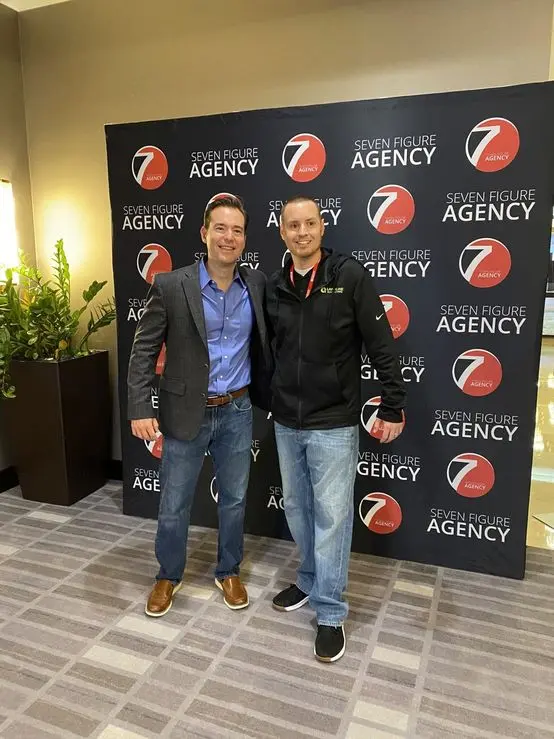
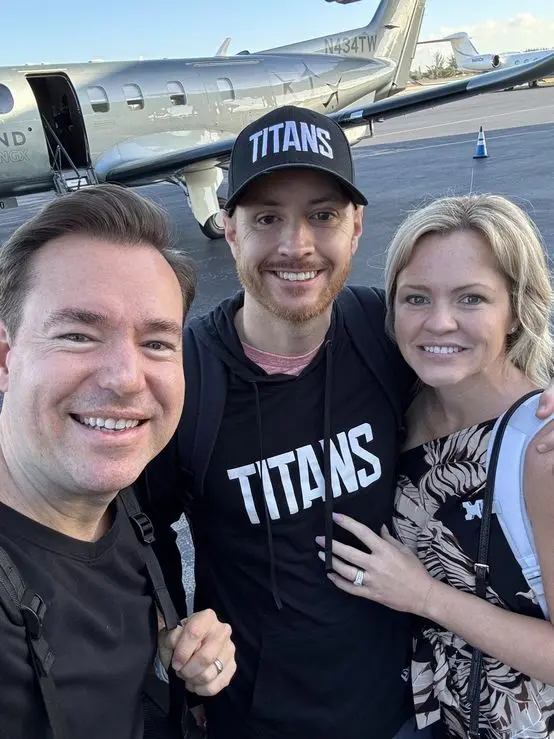
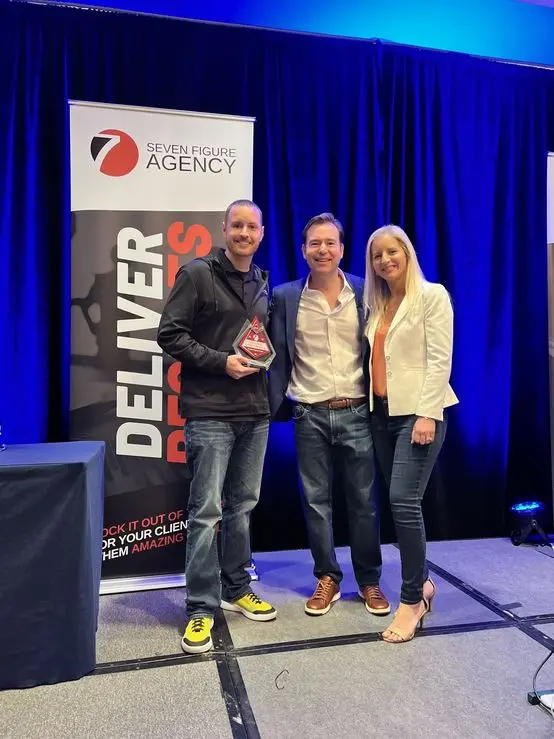
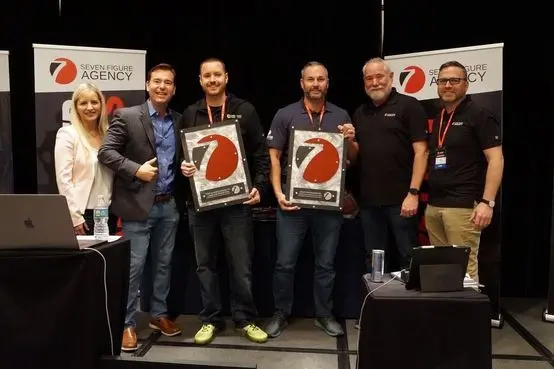
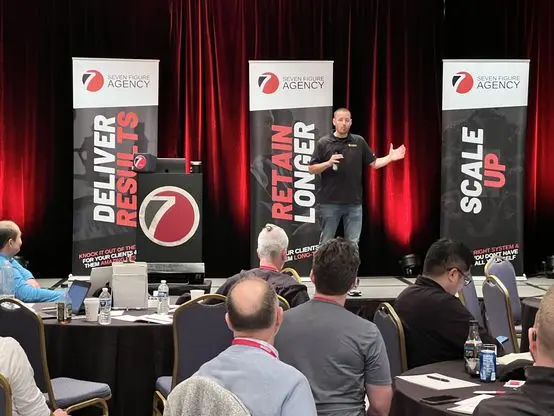
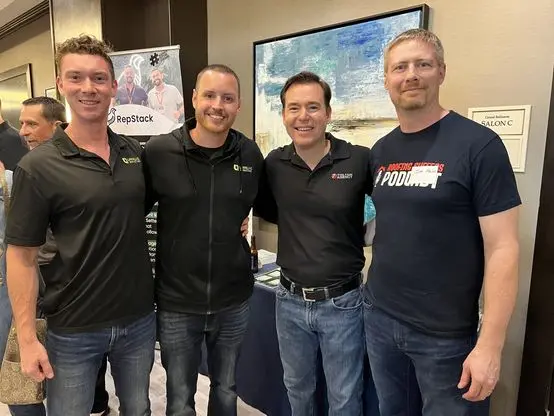
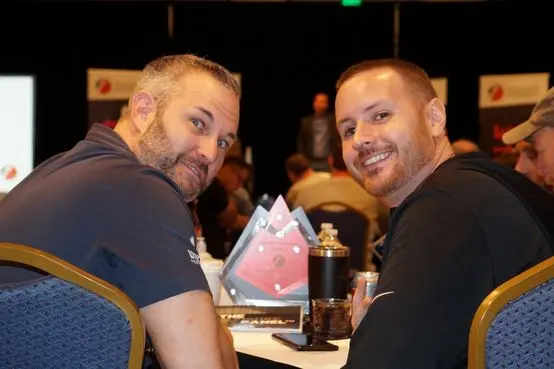
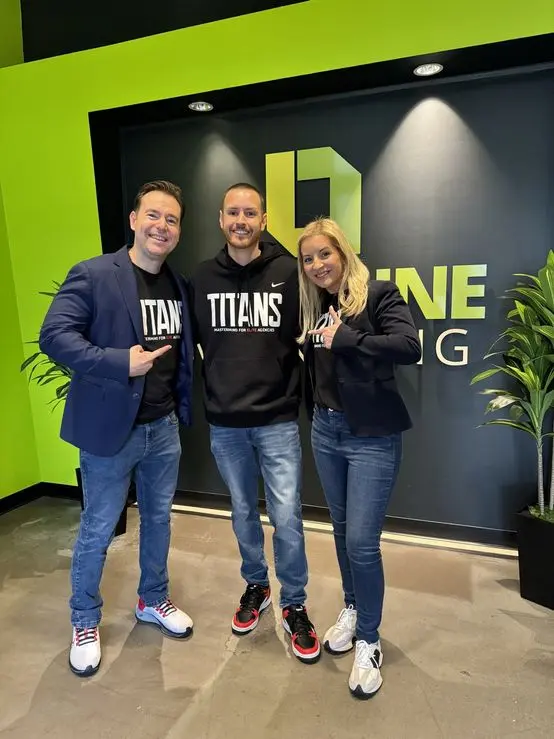
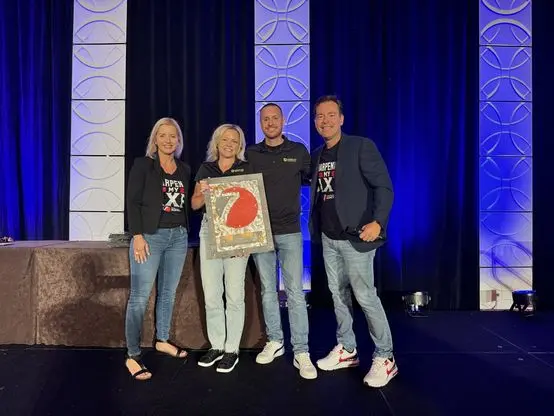
Tony and the Lawnline Marketing team are fixtures in the Seven Figure Agency community, on the main stage, at the awards, and around the table with the Titans mastermind group.

The short version
Prefer the short recap? Here is the same story in his own words.
Tony Ricketts on going from $30K a month to multiple seven figures
Read the testimonial transcript
Transcript of Tony Ricketts’s testimonial video.
Meet Tony and Angela Ricketts, powerful husband and wife duo. Tony and Angela Ricketts just grew their family to three this year in twenty twenty-two. Tony started with us as an invited guest on February twenty twenty at our seven-figure agency members intensive. They had a digital marketing agency doing about thirty thousand dollars recurring revenue when Tony and Angela decided to come as one of our guests. Their lawn line marketing company catered to lawn care and were highly passionate about getting to seven figures, but wanted to get there quicker.
By using the forged path from seven-figure agency that has worked with others in joining their community where they can be open, honest, and share his growth as well as his setbacks and wins, Tony and Angela soon realized they needed to be part of the seven-figure agency group to avoid many of the past pitfalls. He joined the group at the event and hasn't looked back since. He started with us that same week, paired up with an accountability partner at the event, got plugged in right away into the seven-figure agency Facebook community, connected to the coaches, mentors, and began to ask all the right questions, and soon began making some tweaks to his current pricing packaging, his brand, and other similar adjustments right away.
And by April twenty twenty-one, he and Angela reached their seven-figure goal in their agency. But they didn't stop there. By November twenty twenty-one, Tony and Angela reached multiple seven figures in their agency. Today, the Ricketts now manage a team of seventeen-plus US-based employees and are now headed to their next goal of reaching eight figures. If you would like to start your own success journey or are already at seven figures but are still unsure if we're a good fit, I'd like to invite you as my guest to the next intensive on July twenty-sixth and twenty-seventh.
Click the link below to get yourself registered as our guest. You're only a few clicks away from an agency transforming experience. I'm pumped to see you there. I'll talk to you soon.

Editor’s Choice on TopMarketingAgencies.com
Lawnline Marketing is an Editor’s Choice pick in the Landscape and Lawn Care category on TopMarketingAgencies.com, the editorial directory of the best niche marketing agencies in the country. Listings are editorial, not pay to play. Agencies are scored on niche depth, tenure in the specialty, client retention, verifiable results, and transparency, then re-scored every year. You can read the full profile on the Lawnline Marketing listing or see how the category stacks up on the top landscape and lawn care marketing agencies page.
Ready to Build a Program Like This?
Tony cut off the work that was capping his growth and built a full-service program clients couldn’t piecemeal apart. The system he used is the one we teach.