Alex Danner sat down to build his org chart and found his own name in about 80% of the boxes. His operations manager had the rest. Two people covering an entire agency.
His reaction: “Oh wow. We had no idea this was how big of a problem this was.”
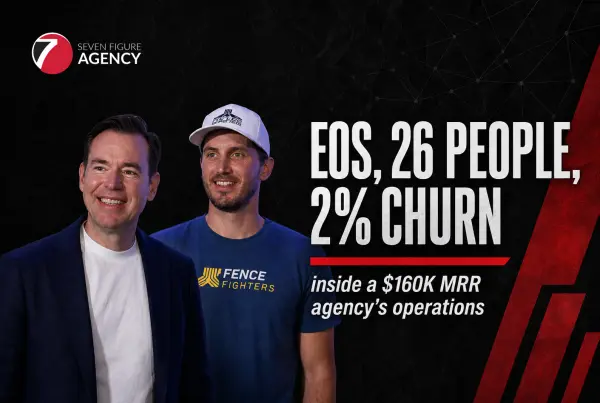
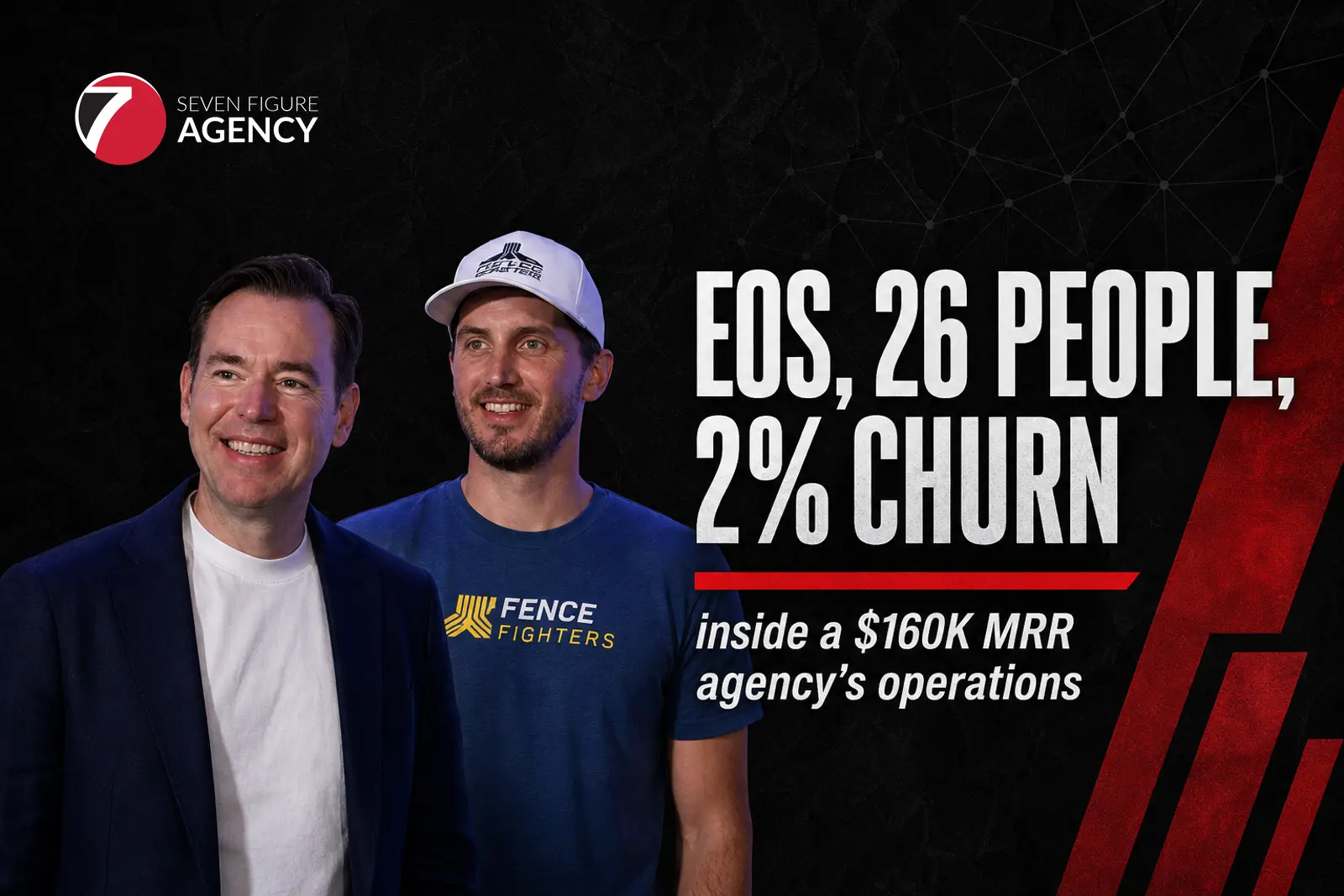
Today Fence & Deck Marketers does $160,000 per month recurring with 26 full-time team members, all virtual, no office, and client churn under 3%. Alex is not in the weekly team meetings. Most problems get solved before he hears about them.
Here is how the operations and retention side actually works, from our interview.
Alex's full story, from a $200 SEO client to $160K MRR, is here.
The EOS decision he almost skipped
Alex resisted the Entrepreneurial Operating System because it was expensive. Lynn Askin, one of his mentors inside Seven Figure Agency, kept pushing. Then the business hit a breaking point, which is usually how these decisions actually get made.
Roughly a year and a half in, he is direct about the outcome: without it, he does not see how they would have scaled. Or more precisely, “we would've had way worse churn.”
That is the connection most owners miss. Operating systems are not a productivity accessory. They are a retention system. You can always manufacture more sales. What you cannot manufacture is delivery quality that holds up while headcount doubles.
What EOS gave him specifically:
- An org chart that exposed how much of the business ran through him
- Real departments with real leaders instead of Alex as the default owner of everything
- A leadership team and weekly Level 10 meetings
- Quarterly planning
- Scorecards and KPIs, so problems surface instead of hiding
The hiring surprise: most people do not want to manage
When Alex started filling the boxes on the org chart, he assumed his best people would want to run their departments. He was, in his words, blown away by how untrue that was.
“I kind of assumed that people would just wanna be the manager of a department and was blown away by how that wasn't the case. I was just so wrong in that.”
That reset his hiring. He stopped promoting people into leadership by default and started hiring specifically for people who wanted the role. Great at a craft and wanting to lead a team are two entirely different profiles, and treating them as one is how agencies end up with resentful managers and neglected departments.
The structure he built over time, with plenty of trial and error:
- Operations manager over the delivery side. That is Oxa, who started out writing content in the early days and grew with the company through several promotions.
- Department leads for development, content, SEO, ads, and graphic design
- Sales handled by Alex and Matilde
He funded better roles as revenue grew, and he is upfront that he is not done. They want an HR hire next because hiring itself has become the bottleneck.
What the owner actually does now
Alex sits in the leadership Level 10 meeting. That is it, on the operations side.
Oxa runs the weekly calls with the full team. She holds the meetings when something breaks. Alex often has no idea an issue existed because it was already handled.
He is honest about the imperfections. They keep scorecards and KPIs, but he does not track individual performance as rigorously as he would like. His actual mechanism is that problems surface: websites running late, content running late, mistakes stacking up. A good team names the problem in the L10 and it gets discussed.
That is not a failure of process. That is what a functioning operating system does when the culture is right, and Alex credits the culture for the rest.
Hire for culture, because you built this for freedom
The best line in this section of the interview, paraphrased tightly: if you are hiring people who are excellent at a skill but a drag to talk to or negative, why did you build a business that gives you freedom just to spend your days working with people you do not like?
His team screens for friendly, supportive, and helpful. The practical payoff is that good people self-police. They come together, name problems, and weed out issues before those problems reach the owner.
He is not claiming perfection. He says “nothing's perfect” repeatedly, which is exactly why the process is trustworthy.
Fully virtual, 26 people, no office
Alex has never had anyone in his office. He has considered it and keeps deciding against it. The agency is proof, again, that a multiple seven figure agency does not need a building.
The engagement question owners always ask is how you maintain culture without seeing people. His answer is structural rather than social. EOS provides the meeting rhythm and the scorecards. The operations manager runs the weekly calls. Problems surface through the system rather than through management by walking around.
Sub-3% churn, and nothing flashy about it
Churn has been consistently under 3%, running about 2% this year. When I asked what he attributes it to, his first move was to downplay it: “I wouldn't say there's anything super flashy about what we do.”
Then he listed the things that actually produce it.
1. Deeply trained account managers
Alex held onto client-facing work for too long, then hired two account managers at the same time and over-invested in training them. So many calls and trainings that they were probably tired of him.
His reasoning is empathetic and correct: nobody wants to be on a client call where they do not feel like they know what they are talking about. It is embarrassing for them, bad for the client, and bad things happen from there.
So he brought both of them onto all the onboardings, taught them strategy directly, and had them learn the technical side from his SEO and ads teams. By the time they ran calls solo, they knew the strategy and could hold a real conversation.
2. Respond faster than everyone else in the industry
This is the least glamorous competitive advantage in the agency business and one of the most reliable.
Alex noticed a pattern: agencies just do not respond. People leave emails sitting. He caught himself doing it, batching replies to the end of the day so he could focus.
His conclusion: “If we wanna be separating ourselves, just get back to people quick, have good answers, have detailed messages, and do your best to explain things.”
Fast, detailed, well-explained responses. Client calls are monthly, not weekly, because the responsiveness in between carries the relationship.
3. Gifting that lands emotionally
Alex sends gifts when clients hit milestones, like their hundredth review. He also tells this story: when he had a new baby, Yesenia and I sent him a care package. He could not believe it. It stuck in his head for years.
His practical read on it: “You're not spending that much on this, and you just had this crazy reaction from me to the point where I was unbelievably shocked.”
Another example. He was on vacation in Scotland, texting a client who is into whiskey. The client mentioned the one bottle he loves. Alex bought a $200 bottle and shipped it to him.
He also admits the honest gap: it is not systematized. It happens on the fly and could be much better as a workflow. If you take one action item from this post, build the gifting system he wishes he had.
4. Actually get results
Alex almost forgot to mention this one, then caught himself: “You have to get good results. If you can't prove you're actually doing something well, none of this is gonna matter.”
He credits the network for that. Being in constant conversation with other agency owners doing different things let him carve out what works specifically in his niche. When you double a contractor's business in a year or two, people notice.
His warning is sharp: “You're gonna be in trouble if you're just marginally improving things forever. They're gonna get impatient.”
The sales-versus-operations balance he got right by accident
One more thing worth sitting with. Alex says he grew slowly in part because he does not come from a sales background, and then makes a point most owners never consider.
A stronger salesperson would have grown faster and probably gotten into trouble. Sales outrunning operations produces churn, and churn on a recurring revenue model is a treadmill you cannot sprint off of.
Growing at a pace operations could absorb is why 26 people and $160K MRR come with 2% churn instead of a revenue number that looks good on a slide and leaks every month.
The operations checklist from this interview
- Draw your org chart and count the boxes with your name in them. That number is your ceiling.
- Install an operating system. EOS worked here: leadership team, weekly L10s, quarterly planning, scorecards.
- Hire leaders who want to lead. Do not assume your best specialist wants a team.
- Hand the weekly team rhythm to your operations manager. The owner belongs in the leadership meeting only.
- Screen for culture, not just skill. You built this for freedom, so work with people you like.
- Over-train account managers before they own client calls. Onboardings, strategy, and technical fundamentals.
- Make response speed a competitive advantage. Fast, detailed, clear.
- Build a real gifting workflow with defined triggers. Do not leave it to memory.
- Prove results relentlessly. Marginal improvement forever loses the client eventually.
Retention is where seven figure agencies are actually made or lost. If you want help installing the systems that hold client relationships together while you scale, that is core to what we do inside the Seven Figure Agency coaching program.
Frequently Asked Questions
Is EOS worth it for a marketing agency?
Alex resisted it on cost and now credits it with making his growth to $160K MRR possible, saying churn would have been far worse without it. The value came from the org chart exercise, real department leaders, weekly Level 10 meetings, quarterly planning, and scorecards that surface problems early.
What does the org chart exercise reveal?
How dependent the business is on the owner. When Alex mapped his departments, his name was in roughly 80% of the boxes and his operations manager had the rest. That map becomes the hiring plan.
How do you get sub-3% client churn?
Four things, per Alex: heavily trained account managers who genuinely know strategy, response times faster than everyone else in the industry, thoughtful gifting at client milestones, and provable results that move the client's business rather than marginal improvements.
Can you run a multiple seven figure agency fully remote?
Yes. Alex runs 26 full-time team members with no office and has never had anyone work in person. Culture and accountability run through the EOS meeting rhythm and scorecards, with the operations manager owning the weekly team calls.
Should you promote your best specialist into a management role?
Only if they want the job. Alex assumed people would want to run departments and was surprised how many did not. He now hires specifically for people who want to lead a team, which is a different profile than being excellent at the craft.
How often should you meet with clients?
Alex's team runs monthly client calls and relies on fast, detailed email and message responses in between. Frequent scheduled calls matter less than being the agency that answers quickly with real answers.