
Garage Doors & Garage Solutions · Garage Door Domination
He Went From $5K to $93K a Month in the Niche Everyone Told Him to Avoid
Barry Nix spent 19 years running a direct mail franchise before he ever touched digital marketing. He tried four niches that went nowhere before garage doors clicked, then rebuilt his agency almost entirely in the last 12 to 14 months.
Barry Nix with Josh Nelson, live. Full interview.
Read the full interview transcript
Full transcript of Josh Nelson’s interview with Barry Nix. Lightly edited for readability.
Josh Nelson: Podcast. I'm so excited to have you listening. I'm really excited about today's session. We're gonna be interviewing, Barry Nix from Garage Door Domination. He's grown his agency to over seven figures, most of that happening over the last 12 months. And so I'm really excited to have Barry Nix on with us today to kinda share kinda how he's grown the business, how he's landing clients, what he's doing to deliver world-class results. So Barry, thanks so much for being on with us today.
Barry Nix: Yeah, thank you. I'm excited.
Josh Nelson: So I guess, guys, give me a yes in the comments for those of you that are on with us live if you're excited. I know I'm excited. I know there's gonna be lots of great insights here. Barry, kind of give us, start with like the lay of the land. Like, where are you guys at in the business today in terms of clients and revenue and kind of the current situation?
Barry Nix: Yeah. So we're at like n- a little over 93, MRR. Mm-hmm. And so, that is about 51 clients. Awesome. So I think our average client now is at about around $1,800 and change, you know, per month.
Josh Nelson: Fantastic. So a s- so a solid seven-figure agency. T- I think the niche, if I'm, if I have it right, is garage doors and gate companies. Is that right?
Barry Nix: That's right. Yeah. And we've, we've kind of, expanded within the garage, you know, world, because so many of our clients, you know, they'll do garage doors, but they also do other things that are in the garage, like garage floors, and so we have some of those clients. And then garage, you know, storage solutions with the cabinets and the, you know, for the, for the overhead storage, you know, things of that nature. And so, yeah. So either garage solutions, gr- storage solutions, garage floors. That's the majority of it's overhead, mostly residential, you know, focused on residential repairs and installations. But it's also, you know, some commercial as well.
Josh Nelson: Excellent. All right. So, and that makes sense, kinda, you kinda figure out where the pockets of service are within the niche that you serve, and you're like, "Hey, you know what? A lot of these guys also do this," or, "They are buddies with guys that do that," and they're all part- Mm-hmm… Of the same groups and associations, and so you kind of, your niche might expand a little bit in that way. – Right… Super interesting. Tell us a little bit about kinda your story and your journey. You know, and I know you didn't just in the last 12 months get into this. You've been doing this for a long time. So kind of walk us through kinda your journey to where you're at today.
Barry Nix: Yeah, sure. So, let's see what year are we in, 2023. 19 years ago, I bought a direct mail franchise, and I did that. And, you know, it was going very well up until the, when Google AdWords started and Facebook Ads started. And then after that, I started dabbling into, you know, SEO and small local websites and whatnot, trying to side hustle and start the process of building a digital agency one day. And so long story short, I really began that, journey about 2015, '16, and started taking courses and classes, and courses and classes, and getting my nose bloodied and learning all the ropes and how to sell it and how to lose money, and all of those things. And then, and then, had about $5,000 a month in recurring revenue. I wasn't doing a recurring revenue model until, I found Seven Figure. But, when, COVID hit is when I found you and read your book, started listening and trying to put the pieces of the puzzle together. And so, from when I started, and, and that's when the direct mail franchise, you know, went under and sold and reopened, and I did not re-up, re-up my agreement. I decided I'm gonna go into this full force. That's when I joined Seven Figure, and from… You know, it was kind of a slow go the first year. Most of our growth has come within the last 12 months, 12 to 14 months, I would say. We kinda quickly went from 5,000 a month to, you know, 90 plus thousand a month. So that came from exiting another business in the world of advertising. And at that time, I was taking anybody from any niche. You know, it didn't really matter. If you, if you, if you would let me do your digital marketing, I would, I would give it a shot kinda thing.
Josh Nelson: Love it. So, so 19 years of history, like, a- and you were probably big Dan Kennedy, big direct response, running, you know, local business 'cause kind of the direct mail business was all local- Yeah… Right? It was all in your local market. That's right. And so you had to make that hard pivot from, "I got this local client base that had been paying me something in order to get into my mailers and things like that," to a more digital marketing business. A- and you made the choice to say, "Hey, like I'm gonna try and go vertical specific national." Let's talk a little bit about how you chose the niche, 'cause I know a lot of listeners are kind of in that place. Like maybe they got a lot of local clients, and they're like, they've, they've heard that going niche is gonna be helpful and kinda streamline things. Talk to us a little bit about how you made that decision and why you decided on garage door and garage companies.
Barry Nix: Yeah. So it, it was perfectly clear that it's easier to scale when you niche down. And that was one of the biggest things that stuck out to me, and it was also kind of the most scariest in a way because I came from a world of you don't wanna be in one niche to diversify. But it's just so much more difficult. So when I first came across, your first book, it was like, "Hey, that's… I've got to find a niche." So I think my first niche was, like, senior living. Okay.
Josh Nelson: And that didn't work out so well.
Barry Nix: That was a slow go. And then I went into the dental or orthodontic niche and that, I was dabbling in that and decided I really don't want to be in that niche. I know it's a great niche, but it, it just didn't work for me although, I know we have people in the, in the group who do very well in that niche. And then I went into, I actually tried flooring. You and I talked about flooring marketing a- a- 'cause I had clients that were in flooring. And then finally, so after my fourth go at a niche agency, it took about a year to s- to, to figure that process. But I found garage doors just by, one client, that one client that we did exceptionally well with, and he referred us to someone else and then referred us to someone else, and then those people referred us. And it just be- kinda like a light shined down like, boop, you know, "You've got… This is your niche." And I'm like, "Okay, I'm gonna go with that." And it just took off from there.
Josh Nelson: I love it. I think it's such a powerful, testament to, like, a l- a lot of us go through this, myself included, where we're like, we're gonna go down the niche path, and we have a hypothetical niche, right? In our, in our case, it was, it was actually restaurants. In your case, it was, you know, what was the first one that you said?
Barry Nix: – The, the first one was senior living.
Josh Nelson: Oh, senior living, right? Yeah. And, and it's like, man, I'm struggling. I'm beating my head against the, you know, the door here. It's not working. I'm not getting any traction. Right. And at that point, you can either continue trying and get nowhere, you can give up and say, "Oh, niche agency thing sucks. I'm gonna, you know, do something different," or you can keep taking action until you find the right niche. And I really have found this to be true. There's gonna be a path of least resistance in this process where it's like for some reason all these verticals have potential, right? 'Cause all of the verticals you mentioned, we've got agencies doing seven figures in, but for some reason you've got a connection, you've got a personal background, you've got a specific client that you just do great for as a case study, and the doors open and this path of least resistance opens up, and you can really just go deep into that particular niche. Yeah. So thanks for sharing that 'cause I know that, you know, it's, it's easy to say, "I'm running this $90,000 a month thing and, you know, I'm, I'm crushing it." But you had struggles and, you know, that niche transition and really the generalist transition from serving anybody in your local market to really focusing on the niche was a, was a big challenge for most agencies. Yeah. Awesome. If you guys have any questions on this that are live on kinda that process and the transition, let us know. So l- I'd love to know kinda as you, as you think back on how you got the first five clients in garage, right? So you got this one client, and it's probably somebody you had done business with in the past potentially. Yeah. How did you parlay that into more than one? Like, I think you need to have at least five clients in your niche before you can really say, "This is my niche," right? Right. You've got some critical mass there.
Barry Nix: Yeah. It was mostly word of mouth. It just, you know, one guy to the next guy to the next guy. I think that's how the first five came along. We didn't really start doing any marketing to garage door. And it could… You know, honestly, I don't really remember the exact specifics, but it was somewhere in that range, Josh, where it was word of mouth, word of mouth, word of mouth. Maybe it was three or four, maybe it was five. And then we started doing the, one city campaign in GHL. Nice. And I just followed the s- you know, the modules. It was like, okay, check the box, go to the next one in the modules. And that was one of the very first… I don't know how it is today, you know, if you're starting from scratch. I'm sure it's changed some, but the one… Do you guys still- No, that's, that's pretty much the first thing, right? You choose the niche, you get the list, and then you start doing the cold outreach, and that's one of the suggested, you know, campaigns you can run. Say, "I'm looking to work with one garage door company- Right… In your market, you know, here's what I did for these other guys. Are you interested?" That's kind of the approach. Yeah. So we did, I, you know, I work with, an agency that more or less just kind of handles your GHL stuff, and so they helped me set that up. Nice. And we ran two campaigns at the same time so that I was double running. Yep. And that's how we got to the next, you know, four or five clients was through that, just one city campaign.
Josh Nelson: – Can you name the company that helped you set that up, or is that like an internal company that you work with?
Barry Nix: That company is, oh gosh, they're out of like Miami, I mean, Montana or Wyoming. Hold on. It'll come to me in a minute, and I'm happy to name them, and they do a great job. I'll have to remember who they are, and I, I just connect with them through Asana, and then we talk through Asana all the time. I can, I can message them- Yeah, that'll be a great resource. I'm sure, I'm sure the listeners are like, "Come on, come on, like let us know who it is." I swear I don't remember, but, – No worries… I, yeah, I, I will find out. And, and they sell like-… Pods of hours, so you can use them for 25 hours a month or 40 hours a month. I just use them for 25, and that's enough for me. But they set up all of our clients. When w- when we have new clients, they set them up in GHL. We get the Google review request tools set up for them and everything else that's done in GHL. But they handle it, and it's just hands-off. So they ra- they ran our Just One City campaign, did a great job. We followed… You would– just downloaded your scripts, changed it from plumbers and HVAC to garage door and went through every script and just changed what had to be changed- Yep… And followed the program. And that's how we got, after that initial, you know, f- maybe three to five clients got to the next probably close to 10, is through that.
Josh Nelson: So good. So kinda, you know, landed the one client, it was an infin- an influential guy that you got great results for. He kinda said some good things about you to some of his buddies. Then you had two or three, and you say, "Hey, look, I've got some case studies here." And that's kinda what makes the One City campaign work. It's when you reach out to all of the, you know, people in your niche in Orlando or Tampa, and you say, "Look what I did for these other guys. I'm gonna do it for just one in this market. Are you interested?" I'm curious 'cause a lot of, a lot of agencies are running that process now. How much was it just you sending the email and people replying versus you sending the email and calling and maybe connecting? I'm curious, in your scenario, like how much did you do beyond just letting the emails run?
Barry Nix: Some. So whenever the people would reply, I would then call them. Hmm. Personally reach out and make a connection and, you know, of course offer an SEO audit, record a Loom video, send it to them. So I was also doing, outreach, you know, individually e-emailing and contacting the businesses. I had someone doing that. Nice. Like on the phone calling them. I wasn't doing it. I was more or less recording the Loom videos. Got it. So, so through both of those, s- let's say strategies for outreach, I was getting probably like two a day of SEO audits. Nice. So I was, I was sending a lot out of Loom videos. And th- and then they would, either reply or not. And, and if they didn't, I followed up. If I really thought, okay, this is kind of like a good opportunity, like a really good client, not as much like a startup client who's got a limited number of reviews or, you know. If they were a bigger client where I, I could see,… Maybe not necessarily a Dream 100 client, but, either a Dream 100 or under that, just under that, I would personally reach out and make an extra effort to… Or I would even go travel and see them. I would go see them in person regardless. Mm-hmm. Like, I would g- I went to Oklahoma City, not having that client sold. I went to Atlanta to not having the client sold because I believed so much in I've gotta get, I've gotta get their business.
Josh Nelson: And- So there was a scheduled appointment. You just didn't show up in Atlanta. Right. Like you said, "Hey, I'm gonna be in that area on, you know, Thursday at 3:00.
Barry Nix: Let's get together." Yeah. And then sometimes getting it live and in person makes a big difference in the relationship and the conversion of the deal. Yeah. It's something that happens, I think, in your head and in theirs. Like if I'm gonna spend my time and the resources it takes to go, I'm gonna make it worth my trip. Right. And then, and that person from a different perspective feels the same way. Like, "Oh, it's important enough for this guy to come over here." I d- I have not done that with a lot of them, but I have done that, probably three times where it made sense to go do that.
Josh Nelson: Love it. So, so good. Lots of practical insights here. So, just out of curiosity, as we're talking about that, those first handful of clients, and kind of doing this cold outreach process, you got extra hands, and I think that's important because a lot of agencies, they try and run the GHL, get the list, send the emails, make the calls, and, you know, let's face it, that's very tedious work. And you can hire, I would think a, a low quality VA, to do some of the behind-the-scenes work, whether it's a service provider like you had there or a dedicated person making those calls, and I think that's a great insight that you shared. You didn't try and tackle all of that yourself while trying to serve the clients that you maybe already had in place. How did you get the list? There's so many list providers. We talk about cold lytics these days, you know, SIC code. Like, do you recall how you pulled your initial seed list of prospects that you were reaching out to?
Barry Nix: Originally, you guys recommended a source, sico- Yep… Codes.com maybe. Yep. I got their list- Got it… Originally, and then, we, you know, I have quite a few VAs. A-and when I started, I didn't have as many as we have today, but I h- I would invest in VAs to do, to help with the process of the marketing. So I had some– To answer your question, I had somebody going into Google and copying and pasting the information out of Google Maps for each city to hand create the list.
Josh Nelson: Mm-hmm. Okay.
Barry Nix: And I still have that list, and I think we have about 11,000 that we've accumulated To use for marketing. And so if somebody is,… You don't have to do that. We also use Outscraper, and it does it automated and it's much faster, and it's just as accurate. And I, you know, I learned that, trick from, Zach Winsit. Hmm. Yeah. Which is how we've gotten most of our clients, is because through the training in the module, it says, "Run a Facebook campaign. Watch how Zach did it for trees many years ago." Yep. And so I reached out to Zach, and he has been fantastic for us. And so honestly, most of our new clients have come through Facebook.
Josh Nelson: So that's where I wanna go next. That, that's awesome. So you made… You did make the transition from cold outreach, getting the list, to starting to do inbound and getting people to see you as an expert and kinda enter your funnel, which I think we all have to do, right? Once you've got five, six, 10 clients, you don't wanna constantly be just cold chasing prospects. You wanna shift to the, to the inbound portion. And so love to talk like as it sits today, like now we've got, you know, ninety thousand in monthly recurring revenue, what's it look like? Where are the clients coming from today?
Barry Nix: So they still come from the Facebook ad. I still run that.
Josh Nelson: So let's talk about, let's talk about that 'cause I think that was the next step. Like what does that look like? Custom audience with an offer?
Barry Nix: Yeah, it's a custom audience. We've gotten most of the data for that audience from Outscraper. Okay. So, some of it has come from the eleven thousand that we hand-built. Some of it is come, comes from the original lists that we purchased from SIC codes. There's another one too that we bought from, besides siccodes.com. Jeff, back in the day, referred somebody, and I don't remember. But anyways, with all of that data combined, it's probably about twenty-five or thirty thousand garage door companies that we target on Facebook. Okay. There's two different lists. One just for the phone numbers, one for the email addresses. That's how, Zach likes to do it. And, and so most of our, I would say probably fifty percent of our new business comes from word of mouth, maybe a little more than fifty percent. Nice. The rest of it, comes from either the Facebook campaign or from a combination of… You know, the Facebook campaign, is great because it gets people on the Facebook page. Linktree is our website address in Facebook on the, on the page. And from Linktree, they can go to the Instagram page, the YouTube page, my LinkedIn page, our website, case studies, the download of the, you know, the inter- digital marketing checklist. All of that is on the Linktree. And I kinda learned that from, Jim, Roofing Marketers. Yeah. Jim Williams. A holistic global… You know, I can't remember exactly how he phrased it, but it's that holistic- Omnipresence. That's it. Omnipresence. Yeah, that. I just kind of like decided, well, let's go do that. Let's emulate that whole idea, and it works. And so I don't know if people that contact me… I probably get a lead a day almost every day. You know, five days a week. Some days two, some days zero, some days three, some days one. It… You know? But it's a constant steady flow of leads, and I think that Facebook campaign sort of powers that. It is the fuel to that engine. But some people find us on, message me through Instagram. Some of it's directly from, I got one yesterday from the website, the little chat, GHL chat widget on the website.
Josh Nelson: Yep. Nice.
Barry Nix: So it's just a combination of those things. But honestly, th- to answer your question, a lot of it's word of mouth and some of it is, you know, that omnipresent, you know, just a combination of all the, social platforms along with the website.
Josh Nelson: So good. So m- so many great insights here. So kinda like, kinda recapping on the client acquisition side of the equation, chose the niche, got a client that you crushed it for, so you had the case study, parlayed into a couple of case studies, got a list, right? You– Like none of your marketing efforts are gonna work if you don't have quality data, and it looks like you went big with data, right? You know, where some guys are getting a thousand prospects, you've got eleven right out of the gates, and you're continually building that database that you can do cold outreach to, that you can upload as a custom audience, and then you've been really committed to being front and center where they're seeing you again and again and again and again and again on Facebook predo- predominantly with an offer to go in and schedule a time. On the Facebook ads piece, are you follow– I know z- probably Zach runs this for you at this point as well. Yeah. Is it testimonials where they're seeing your guy saying how good you are, and then, "Look, if you want similar results, come here and schedule a time"?
Barry Nix: Yeah. Here's exactly how that goes. Perfect. I just do exa– I did exactly what you put in the thing. I mean, it's pretty much a c- a carbon copy- Love it… Which I learned from Jim as well. I think when they came to you, it was like, "We just copied all your stuff." Just do it, right? Don't, don't reinvent the wheel. Like take the script. Yeah. I mean, it works. Right. It just works. You just have to do the work and implement all of the little tasks. But how it works is this: we run a video. Oh, well, we have a, like a warm-up, ad, or, you know, a s- a outreach ad and then a targeted ad, and on that ad, we had a video created And the video is a combination of five testimonials.
Josh Nelson: Have you– if– I'm sure you have, but, have you heard of or do you ever use VideoAsk?
Barry Nix: Yeah. Big, big fan of VideoAsk. Okay. So that's all I did, was I sent out VideoAsk requests. They sent me back the videos. I sent those to, somebody on Upwork to put… A couple hundred bucks later, we had a great video.
Josh Nelson: Oh, like a montage.
Barry Nix: Yeah. It's a, it's a great video. And, I think we have five. It's me talking, then it's five videos back-to-back, and then me talking at the end. So I think the whole thing may be sixty seconds. That goes, to, when you learn more, it goes to a landing page. And that landing page, once they, – Apply… Apply, it goes to an app- partnership application page on my website, which is not– you can't find that through the navigation menu, but it's on the website. That's where it's, it's hosted. And, that's whenever they fill out the partnership application form, it goes straight to my phone, on text message, and I get it via email. And you just reach right out and schedule an appointment. I found that you've gotta– when somebody reaches out to you, if you wait, the chances of you getting a hold of them and getting their attention just, I think with every hour it goes down.
Josh Nelson: – Speed to lead is where it's at, right? Right. You're like, fifteen minutes or less, gotta get on the phone with those people. Otherwise, you're, you're- It's strike while the iron's hot.
Barry Nix: And my process from there is once I get them on the phone, I answer their questions and, you know, basically it's, "We would like to conduct an audit. And once we have that data put together, I'll call you and we'll set up a time to meet. Let's just go ahead and set up that time now." And so we set up a time to do a thirty to forty-five minute Zoom call, and then we ha- we go ahead and do their audit. Instead of recording a Loom video, we do it then, and we record it that meeting. That works a lot better with conversions from, let's say, people who are interested to giving a proposal.
Josh Nelson: Love it. So, so good, man. And so many great insights. It's very actionable, guys. Give me a dollar sign in the comments if you got at least one takeaway here on how Barry has grown his agency to ninety thousand and kinda how he's landing clients. I'm curious on the omnipresent side. So we've got the list, we've got the cold outreach, we've got the outreach, we've got the Facebook ads. Are you doing anything to nurture the list with webinars or interviews or anything along those lines?
Barry Nix: You know, we started, I started doing that, and I have, several webinars we've done, through StreamYard. Mm-hmm. And they've gone out and, I've done a very poor job at continuing to push those. Honestly, I haven't done a lot of them. Like, my plan this year, twenty twenty-three, was to do one webinar a month. That was one of my goals. I think I've done one, maybe two. But the leads just keep coming in, and that's part of me being lazy. Maybe, part of it is, just being busy trying to keep up with all these Google updates that have happened this year- Yeah… Which have taken way more time than I planned. So I've been, we've been implementing platforms and strategies on increasing the quality of the product or the service we're providing, opposed to investing in marketing. And I don't mean money, I just mean time- Right… Like how much time is allocated. So we've put more people on the marketing side of the agency, but I'm doing nothing really on a consistent basis to nurture those lists. Not an email campaign that goes out. So I've really dropped the ball.
Josh Nelson: I want- Well, I think, yeah, I mean, again, looking at the path of least resistance, right? If you've got a strategy that's keeping the pipeline full and it's enough to meet your goals, that does the trick. It's nice to know that you've got that other arrow in the quiver if it doesn't start to continue, "Hey, look, let's start to do some webinars. Let's start to do some live events. Let's start to do- Yeah… Some podcasting," and you could probably, you know, triple or quadruple the amount of lead flow and positioning you have in the industry. Super great insights here. You know, really appreciate your willingness to share and be open. I'd love to shift gears a little bit now. We've talked about how you got the clients. Can we talk a little bit about, like, kinda what the program looks like, what you're doing to deliver and retain? I guess the best place to start w- would be, like, tell us a little bit about what your program looks like and what you're actually offering to these garage door, garage companies.
Barry Nix: Yeah. So it starts out, like our base package is probably similar to most agencies, I would assume. It's w- the website, consistent web development. So monthly, it's not just we build your website, but also web development. SEO on the website. Of course, we host the website if they want us to, which is most of them. And GMB SEO or GMB optimization, which we talk about as a different service than just SEO on the website. Both are important, but that's our package. It's GMB management, SEO, and website build plus web development yeah, that's our initial package. Then after that, it's, well, if you want lead generation services, then that's a different package or it's an add-on package, however you wanna look at it, but it's above and beyond the initial foundational… You know, the– to me, SEO, and website is, you know, obviously it's a slower way to get a client leads. So it is important to be able to have other, you know, services that provide quicker lead generation. It's not required that they do Google AdWords in the garage door niche for me to do business with them. Some niches that makes a lot of sense. It's not the case in this because garage door locksmith, electricians, I think bankruptcy attorneys, those are kind of like your top, most scrutinized, spammiest categories in North America- Mm-hmm… As your, let's say your Google Business Profile, primary category. And so in order for somebody to run GLSA or AdWords, they have to be advanced verified. And with garage door, that can take ninety days, it can take a hundred and twenty days, it can take longer. And they're limited or restricted campaigns when they do get advanced verified. So I tell people, you know, if you wanna do AdWords in your garage door and you're not advanced verified, plan on it start making sense in four to six months. But, you know, and that just doesn't– that doesn't– that's not a whole lot faster than when it takes to start getting results from SEO. Right. So, we also,… That, that's our base package is… And how we get more is if we're running, any paid traffic campaigns, if we're doing Facebook campaigns, for them. We also have clients who, in the garage door space, you know, just like plumbing, most of their leads or I would think the majority of the leads come from the Google Maps, unless they just have an extraordinary paid traffic budget. Right. So we hone in and go heavy on local SEO for them and developing just a killer, thick, wide, deep website, to get the reward from Google for the local rankings, which helps power the GMB or the GBP. And so we kinda hone in on that. We also have clients that get– want to get additional, Google Business Profiles within their service area. Hmm. And so if they have, a legitimate, place where they can claim as a, you know, another Google Business Profile that Google will verify, we'll help them through that process. So there are people on our team in the agency who, kind of specialize in getting Google Business Profiles verified for our clients, and it's hard to do with garage door. I'm sure, yeah. But if it's, l- legitimized and it's set up according to their guidelines, we can help them get multiple locations. Well, for each one, we charge an additional fee to manage that GBP. Yeah. And that's how we have clients that maybe have seven locations or eleven locations. I have one client with twenty-nine locations. Wow. And we charge for each one. So we scale their, increase their monthly rate depending on how many, you know, locations they have, GBP locations, or if they're doing paid traffic campaigns.
Josh Nelson: Love it. So kinda you got that base website SEO pay-per-cli– website SEO Google Maps, and then you can expand through l- more locations. "Hey, look, you're, you're here. We wanna get you on the maps all around town." Right. And you got a strategy for that. Or if you wanna run paid ads, it doesn't sound like that's a main focus for you, but if you wanna run paid ads, Google Ads, LSA, even Facebook, we can help support that. I'm curious, what percentage of your clients would you say are doing some type of paid? Or is it almost pr- almost all organic?
Barry Nix: It's probably mostly organic. Awesome. I would prefer it not be.
Josh Nelson: Right. Right. You're like, "Let's get a little, let's get a little bit of spend in here," you know, to kinda help balance things out and make life easier for you, I'm sure. Yeah.
Barry Nix: It's just w- with our non, let's say our garage door clients that don't focus on garage doors, so garage floor, garage storage- Hmm… Those folks, it's easy to get Google AdWords up and running comparatively. Right. But for our garage door clients, probably fifteen percent of them, so it's a very low percentage that run paid ads. It's just diffi-difficult. A-and, you know, they're paying, the fee, the monthly fee to have it up and running. Really, they're not– They're, they're paying initially to have us help them get advanced verified and to get them out of that limited, restricted campaign. Once that's done, man, it's like a- Off to the races… Double-edged, very sharp sword. But the, you know, the cost per click with garage door is also very expensive, so- Right… The majority of the clients can't afford to do it properly. Hmm. So- They need to have at least a five thousand dollar spend really even to play the game against the big boys. That's right. It's like, look, if you're not gonna play the game with the big boys, let me help you play the game organically over here- That's right… And help you win there v- via that path. Or run a Facebook campaign. Yeah. You know, and it's not gonna blow the world up, but it, you know, it can definitely bring in some extra lead generation. Nextdoor helps, as well. It's not a big spend, but it helps generate another couple of leads a week or whatever. Yelp can help.
Josh Nelson: But, ig- you nailed it. That's exactly right. Love it. So, so good. Lots of great details here on the program structure. Just out of curiosity, kind of going deep on the, on the program stuff, you talk about multiple locations. Just from your experience and kind of what you've found, can you get them ranked on the map, if it's from a home address, or, you know, or like a virtual office in your world? Or do they need to have a commercial location rented? Or do you… Have you found some… I'm not asking you to share the secret sauce, but have you found some, you know, backdoor channels where you can get a GMB listing ranked even if they don't have a physical, commercial location?
Barry Nix: So from my experience, if they– y-you can get, a visible address, a GMB or GDP, verified using a home address, especially after COVID. Mm-hmm. Because so many businesses transitioned home after COVID, and Google knows that. So it is… You just have to prove it up. And if you can prove it up with an ass- assumed name certificate, a DBA certificate of insurance, proper signage, doing a video, showing the pictures, showing the work truck or whatever, the tools, you know, you can… I'm sure you've been down that path or your guys have. Y-you can prove up a home address. A visible storefront address GMB works really well. Right. Yes, they work faster, Google verifies those much easier, but they don't get the pin drop in the maps. Mm-hmm. They don't work as well. They're much slower. You need way more reviews and posts and pictures and Q&As and everything else in order to get juice and productivity out of that Google Business Profile. So you don't have to have, to answer your question, they don't have to have, a commercial or industrial like office or s-storage unit or warehouse or showroom, but it is helpful. It– the Google Business Profiles get reported less frequently. Our– the garage door world is like a lot of them, very cutthroat. They just… We've had people drive around and report and take pictures and send, Google just to get them removed out of Google to get them suspended, and then they'll call and say, "Hey, I just got you suspended." I mean, it is it's awful. So- "I just busted you. You're out, bro." Yeah. And, and that happens. And so we… Like I had a call yesterday with a new client, or a new potential client and then who was a word-of-mouth referral from another garage door guy, and he doesn't have a Google Business Profile. And he's like… I said, "The only way we'll work with you is you have to go get an office. You have to get a verified office. Like it has to be a real place, and then we'll, we'll work with you." And we're leaning more that heavy in that direction because those don't get reported, and they don't get suspended. And they… If they have a visible storefront and the Google Business Profile shows the address, we know we can get that ranked and working for them to where they're making enough money fairly quickly, depending on the city and, you know, the population and amount of competition to where they're making more money than what we're charging them.
Josh Nelson: So good. Lots of great, lots of great details here. I love it, Barry. Thanks for filling this in. Daniel says, "Love the authenticity, Barry." Appreciate it. Let's talk, let's talk a little bit about operations and scale. So ninety thousand dollars a month in recurring revenue and growing. What does the team structure look like? How are you able to deliver the goods? Especially like you're doing a lot of content, a lot of web dev, a lot of GMB optimization type work.
Barry Nix: Yeah. We have… It's somewhere around twenty-five to twenty-seven people on staff. Excellent. Most of it is Philippine-based. My bookkeeper's here, and I have one person that helps me, you know, manage accounts who's based here. Excellent. Everybody else is Philippine-based and so, we– I have it broken up into buckets or departments and so we have our content writers, SEO, or web developers, SEO, and then, you know, support, whether it be marketing or, account management support. And, and so the main… From– If, if we're doing PPC, any type of PPC, that's white label. And for me, that just kinda has worked. So as far as our team goes, it's really those main departments: content, which is very important. I've, I've, you know, I've, I've kind of follow, Tony Ricketts, his model. I mean, they're so big on content. Yeah. And, and so we've put a lot of emphasis on that. Web development, you say world-class websites in your, you know, training and when you talk. We've put a big emphasis on trying to make websites better. Our goal when we have a new client is, and we tell– I tell them this, is you're gonna have the best website in your city for any other… Garage door company. It will be the best website found on the internet in your area for garage door. That's our goal. And I hope that that happens, but we're constantly trying to reinvent ourselves and have a better quality site but, product. But to answer your question, it's about 25 to 27 people, split up between SEO, web dev, content writers, and then miscellaneous.
Josh Nelson: Love it. So you're still doing the sales in the organization. You've got a US-based account manager that talks to the clients and helps with the relationship along those sides. Any tips for the agencies that are kinda going to that seven-level mark and they're trying to figure out, "How do I, you know, 20 employees, how do I keep track of all of this? How do I manage, you know, the scope of this type of thing?" Yeah.
Barry Nix: So, I have help with that. And the person who works here, she does help manage accounts, but she also helps manage the team. Hmm. And we have systems of accountability. So whenever, let's say, a ticket is created, which is many of them all day or tasks, she tries to keep them organized and stay on top of who's responsible to get what done, and then she's constantly following up with th-the person assigned to the task. It is a lot of work. I mean, that's kind of like a full-time job almost.
Josh Nelson: Yeah. And so, you know, I think Asana or what is it that you use? You use- ClickUp. ClickUp is the kind of the go-to that most of us use.
Barry Nix: But, you know- Yeah…
Josh Nelson: A system o-of Asana or ClickUp or Monday or something- Right… Helps you manage. Yeah.
Barry Nix: And so those are helpful, but we found that, in addition to that, Asana, having somebody on top physically communicating and engaging to get the tasks and to answer questions and to just be on top of it, to get things done quicker, more efficiently. There's sometimes, you know, a breakdown of communication when you're internationally set up. – Right… And cultures are different. You know, priorities are different. Sense of urgency. You know, y- it's hard to express sense of urgency through ClickUp or through something like that. But, I think, I think that you're, having somebody in, on top of that and m- personally managing it is extra helpful. So it is a lot to manage that many people. But, the, every time we bring on a new client, I evaluate, do we have enough people? Do we need to bring somebody on? And I have leadership roles. Like, I have one person who's in charge of SEO over all the SEO people. I have one person kind of over all the web dev. I have one person over the content writers, and I don't meet with all of the content writers. I don't meet with all of the SEO people. I don't meet with all of the web… I meet with one person from each department, and then I have one person that helps me kind of oversee the whole, the whole system. It's not so big that, you know, it's, it's not so many people that it's, like, unbearable, right? But, if I'm going to be over sales and, you know, working on the business, I c- you know, I just, you can only have so many hours in the day.
Josh Nelson: I think that's a powerful insight and a powerful takeaway, right? So what Barry's done, he's got the $90,000 a month agency that's growing, right? He talked about being in the niche so he can systematize the process and kinda keep a lot of the consistency with what he delivers. And then he's got a virtual team, which is awesome, with a US-based… It seems inter- you got the US-based person that's kind of operations management as well as account management, so they can help on both fronts. And then there's a leadership team for each of the different departments. That's right. So you're able to manage the complexity. It seems like you've got a, probably a great US-based person that's helping to manage all of that. There's been a number of questions in here about where you found your team in the Philippines. Any insights you can share on that, like kinda where you posted, how you hired, on that front?
Barry Nix: Yeah. Initially, I used Onlinejobs. Onlinejobs.ph, yep. And that's how most people, I think, just go to that website. They are the leader. I think they were the first to market. That guy does a great job. I found my first couple of folks through Onlinejobs. I got really lucky. And the second person I hired after I joined seven-figure agency, the first was a content writer. The second person was an SEO guy, and we farmed out the web dev at the time. Hmm. And the second guy, has been a, you know, like the superstar. A total godsend and one of, become one of my, like, best friends. Never still met him in person, but just a great guy, and he is over, a training agency- Hmm… In the Philippines. So he works for us full-time, but he also is in charge of an SEO training academy in the Philippines. And that training academy does SEO, web dev, SMM web dev, all sorts of, you know, internet marketing training. But they put them through in batches. So in each batch, there might be twenty trainees. So if we need at any time, to answer your question, like, okay, well, we need one more person for SEO. We need one more pers- to add another person for content. He's got like the pick of the litter from each of these batches, and they all know each other. I can't remember the last time I hired someone from Online Jobs. From outside of his, from outside of his, pool. Yeah, outside of that pool. A-and I still am a member, paying member of Online Jobs, and I still like to run ads. I have three ads running on there right now. I think I do all the time. But, they all know each other and like we've got husbands and wives and sis- like, you know, I think within one family, we have three people that work here. We have two sets of those. Two sets of three family members. So it's– it– what I've learned is we hire based on their character, their work ethic, and a positive mental attitude. Mm. We can train or teach them to do anything else. So we kinda have like this in-house training where we are constantly making videos about how to do this task, how to do that task, how to do this task, how… And if they can just watch the videos and learn and ask questions. You know, we have them broken up into groups. If you're in web dev, you content, you communicate with your department, and they teach each other. And so it's been a real blessing and, and I've just felt totally lucky to have developed relationships with these people. Our– kind of our mission, and we say this, on a regular basis, is to employ a hundred Filipinos, one day. And we're about one-fourth to almost maybe close, getting close to one-third of the way, but that's something we like to think about, talk about to, you know… Be-because without that, w-this agency wouldn't be what it is today without, you know, that one guy and everybody else that's a part of our team. So I, you know, we just wanna give back, and that's part of, our mission.
Josh Nelson: So good. I love that. I love the, the thought process of this international team not being, "I hired low-cost VAs because I could have better profit." It was like, "Where can I find good talent, people that are hungry to work, that have the aptitude to step in, where I can make an impact as my business grows?" I think you're coming from it, your heart is in that place, not the place of, "Oh, let me get the cheapest labor and just maximize profitability." Even though that's obviously a byproduct of having an international team in a place like the Philippines.
Barry Nix: It is a byproduct. And initially that was the thought, to just- Mm-hmm… Be honest and- Yep… Be transparent. It's like, well, you know, that makes sense. I know other guys that do that. You can save money, but that has completely a hundred percent shifted. I would rather pay these people more, so they never leave. And they also, you know, word-of-mouth referrals, if you do a good job with your clients, it just sorta explodes and grows. Yep. And it, word-of-mouth referrals from within your agency just explodes and grows. And there's a lot of guys a-and gals in this, you know, in the group that do that. That's the way they grow their business. It's the way they grow their team is through word of mouth. So, yeah. Hundred percent. Take care of your team, make it a great place for them to work, and they're gonna wanna stay, they're gonna wanna bring their friends and their family- Yeah… That have similar core values- Yeah… Which is awesome.
Josh Nelson: A quick question here, follow-up on, this from Robert Thompson was, "How do you develop all the SOPs for the VAs to follow internally, or do the SEO VAs have their own that you approve?" Both.
Barry Nix: Yeah. It's developed over time. We have our own SOPs. Sometimes people will bring in suggestions that we test and we'll implement, sometimes. So to answer that question, our SOPs have developed over time. We've taken some from other agencies. That's why it's cool to be in Seven Figures because you can reach out to people and ask and say, you know, "Josh, how do you guys do this?" Or, or whomever, "How do you do this?" and I ask those questions, at the events or from, you know, later on and from people you synchronize with and connect with. But the SOPs have come from trial and error and from getting advice people. You know, not all niches are created equally, so what works for one niche doesn't necessarily work for another based on how Google sees that. So you just kinda have to, you have to get in, get your fingernails dug in the dirt and get dirty and put in the work. You know, I probably still work fourteen, fifteen, sometimes sixteen hours a day, sometimes six days a week, sometimes seven days a week, sometimes four days a week. Most of the time it's six days. Most of the time it's minimum twelve hours. It– you know, because the VAs work, some of them work on US hours, some of them work off. But it's like I have a little window between like the hours of four to seven o'clock in the afternoon. But from eight AM or seven thirty AM, all the way up until like four or so o'clock, I'm slammed. And then from like seven o'clock p.m. Till midnight, I'm slammed. But that's by choice. And I'm not saying that that's the right thing to do, but I really wanted to scale this business, and I wanted to get it up and prove it to myself that it could be done within this niche, which m- I had many people say, multiple people say, "Don't do garage door." So, – There you go, right? Yeah. Well, it, you know, now that we've kind of gotten to, seven figures, it's like I want to hire more people so I don't, you know, have a heart attack, you know? And I can kind of enjoy more, me time or family time. Yeah. But I love working, and I love, you know, being in the mix of it, so…
Josh Nelson: So good. So good, Barry. And, and guys, give me a yes in the comments if you appreciate him elaborating on some of this stuff, right? He's not surface level. He's really giving you some useful details here. So Barry, thank you. You know, we talk about to grow a seven-figure agency, right, you gotta land clients, deliver world-class results, retain and scale. And we've talked about those three key pillars. The one thing we haven't talked about is retention. And like you said, garage door niche is very competitive. There's lots of people in their ears from the big companies to the local guys. Like, what are you guys doing in order to maximize client retention? Any cool insights on what you guys are doing on the retention side of the equation?
Barry Nix: Yeah. I would say, for retention, it's all about results and communication, right? So you have to deliver results. Some of the things that you do aren't tangible. Like, the customer can't feel that in their pocketbook. But it's a service that you're providing that allows the potential for success. So you have to do a lot of setup. Along the way, if you're not communicating, the clients don't know what they don't know, right? They don't understand every little, you know, piece of the puzzle. Some clients wanna be more involved or be communicated with more than others. So I would say, to answer your question, doing the work for each client and then communicating that to them. And so when we have a client that's new, within the first, say, month and a half to three months, I communicate or someone on the team communicates with them more than, after that initial- Mm-hmm… Setup phase. Yep. We have a fella in the Philippines that communicates with all of our clients on a monthly basis via put… We talked about putting a report together. Mm-hmm. So we manually put a report together of how they're doing, like with Local Falcon heat maps or Rank Tracker, like Semrush, just to give them an idea, okay, what we're doing, here are the results of what we're doing, metrics-wise. We also give them a Google sheet of all the SEO tasks we've done every month. So every Google task, every… I'm sorry, every SEO task or whatever it is, it's, it's documented. And so we're providing that on a monthly basis with a video. So we create a video and take them. Like I try to make it like a three-minute video where I don't do it. A guy named Mark does it, and he walks them through and says, "Here's the link to all the tasks we did for the month. Here's the results. Here's a link for that, and here's a Google slide to show you what we've done." It takes a lot of time. It's very difficult. N-not very difficult, but it's difficult in terms of getting all of those done every month on time. Mm-hmm. But that communication on a regular basis where we talk to them, from, on the phone, via text message, via email, Zoom. It's a combination of touches on and how often. Some require more than others, right? Some clients call me once a year. Some of them are like, "Don't send me a report. I don't care. I just want the phone to ring." Learning what each client wants and, you know, that's not a way to systematize or to scale it. So we send out that report once a month anyways. It's just that's at minimum what we're doing is sending out a monthly report. I like to personally talk to the clients, which can't go on forever, which is why I've brought people in to help communicate. So as we grow, I'm trying to, you know, break away from that so that, you know, people don't constantly always call and talk, but it still happens, and that's okay with me, at least for now. But, delivering the results, I like to… That's first, and I like to make, tr- our goal to be, we wanna deliver more results than what they expect and what they pay us for. Love it. And then we have to communicate with them and answer their questions and take the time that you really don't wanna take because you're like, "Ugh, I need to be doing this," or, "I need to be doing that." But we've gotta keep them happy to keep that w- retention and the word-of-mouth referrals.
Josh Nelson: So good. So kind of the healthy balance. Maybe in your case, even more balanced on like, "Let's make sure we crush it. Let's make sure we're delivering world-class results, and let's also make sure we create a great experience, and we're communicating, and we're keeping them in the loop." And when you've got that balance, retention stays high. Clients are happy. They're well-served. They stick around long term. So good, Barry. So many great insights. So thank you so much for coming on and sharing your journey, sharing your story, sharing some of your struggles, right? It hasn't been, you know, a straight path to seven figures. Like so many agencies, you decided to go down the niche path You got into the wrong niche, you didn't get traction, but you kept pressing through, you kept trying, and now you're at 90K and growing. And I have no doubt we're going to multiple seven figures and beyond, and you're gonna hit that mission of 100, you know, full-time members i- in the Philippines. Any other last nuggets or piece of wisdoms y- you would share with that agency that's trying to get to the next level?
Barry Nix: I would,… I would just say, I mean, for me, and I know this sounds like, you know, I'm on this thing with you today, I just followed what you've taught. And that's, that is… I- I've, I've told you that before. I just followed the process. I think first you have to find the process that you trust, that you really trust in, and then you just gotta hit it and go after it and be relentless. And the… You know, you're right. It's been ups and downs. We've, we've lost clients. We've, learned the hard way. We've lost money. We've got our nose bloody. But you learn what to do and what not to do. It's, it's kinda like if you buy a franchise, you're buying like a turnkey model of do this, this, and this, and you'll get, you know, better results than doing it on your own. For me, when I found, the seven-figure model and just started going through the modules and the training, eventually when you do enough of the right things, the right things happen. What you can't do is give up. Hmm. And you can't use a failure as an excuse to quit. For me, this– I intentionally, like, I didn't torch any relationships, but I burned the bridge. Like I… When I left my old business, it was like that bridge is no longer there. I don't wanna ever go back to it because the wave of the future is not newspapers and direct mail and, you know, stuff of the '70s, '80s, '90s. And so this is, this is a much better business model for me personally. I just followed the plan and I would suggest anybody trying to get to that next level or scale their digital agency, whether it's seven figure or something else, d- whatever you believe is the right fit for you, dive in and go after it and just be committed to it and don't give up.
Josh Nelson: So good, man. So many great insights. Guys, if you got value from today's session, be sure to tag Barry. He's got an abundance mentality, just sharing out of the abundance of his nature, right? He, he's, he's had success he wants to share with others. So be sure to thank him for sharing. If you have follow-up questions, regardless of where you're watching this, maybe you're watching this on the YouTube channel or maybe you're watching it in Facebook, and you got follow-up questions, post them in the comments. I'll be watching and I'll try and fill in the gaps for you or get G- Barry to fill in the gaps for you. Thanks so much for tuning in. Thanks for listening. Can't wait to hear what you accomplish as you continue to grow and scale. And, and Barry, congratulations, and thanks again for sharing.
Barry Nix: Thank you, Josh. I appreciate it, buddy. Thanks everybody.
Four Niches Before the One That Worked
Barry bought a direct mail franchise 19 years ago. It worked well until Google AdWords and Facebook Ads arrived and started eating into it. He began dabbling in SEO and small local websites on the side, trying to build a digital agency one day. Around 2015 or 2016 he started taking courses, “getting my nose bloodied and learning all the ropes,” as he puts it, but he was not running a recurring revenue model yet.
That changed when COVID hit and he found Seven Figure Agency and read the book. He decided to go all in, did not renew his direct mail franchise agreement, and joined. The first year was a slow go. Almost all of his growth came in the 12 to 14 months before this interview, when he went from about $5,000 a month in recurring revenue to over $90,000.
Getting there took four tries at a niche. His first pick was senior living, which “didn’t work out so well.” Next he moved into dental and orthodontic, decided it was not for him even though he knows others who do well in it. Then he tried flooring, since he already had flooring clients. It took about a year of trial and error before garage doors found him, through one client he did exceptionally well for, who referred him to someone else, who referred him to someone else.
The Cold Outreach That Built the First Ten Clients
Word of mouth carried the first three to five clients. To get past that, Barry ran the One City campaign taught inside the Seven Figure Agency program, using GoHighLevel automation built by an outside agency he still works with today. He downloaded Josh’s scripts and swapped “plumbers and HVAC” for garage door language, then ran two campaigns at once.
He built his prospect list the hard way at first, using siccodes.com and a team of VAs who copied business information out of Google Maps city by city. That hand-built list eventually grew to about 11,000 companies. He later added Outscraper to speed the process up, a tool he learned about from Zach Winsit, the ads specialist who now runs his Facebook campaigns.
Barry was hands-on with the highest-value prospects. He personally recorded Loom videos with SEO audits for warm replies, and for the accounts he really wanted, he flew to meet them in person before the deal was ever signed. “I went to Oklahoma City, um, not having that client sold. I went to Atlanta to not having the client sold because I believed so much in I’ve gotta get their business,” he said. He estimates he did that three times, and it worked.
From Cold Outreach to an Omnipresence Machine
Today most new business is inbound. Barry estimates over half of new clients now come from word of mouth, with the rest split between Facebook ads and a mix of channels he describes as omnipresence, an idea he borrowed from Jim Williams at Roofing Marketers.
The Facebook ad itself is simple: a roughly sixty second video built around five client testimonials collected through VideoAsk and edited together by a freelancer on Upwork for a couple hundred dollars. It runs to a landing page and a partnership application form that texts and emails him the moment someone submits. He calls within minutes and books a Zoom audit on the spot rather than waiting to record a Loom later.
The audience behind those ads is built from the same 11,000-company list plus additional data from siccodes.com and Outscraper, roughly 25,000 to 30,000 garage door companies in total, split into separate phone and email custom audiences. A Linktree link on the Facebook page fans traffic out to Instagram, YouTube, LinkedIn, the website, case studies and a downloadable digital marketing checklist, so a prospect who finds him once keeps finding him again.
Barry is candid that he has not kept up his own advice everywhere. His goal for 2023 was one webinar a month; he had done one or two by the time of this interview. “The leads just keep coming in, and that’s part of me being lazy,” he admitted, while also noting how much time went into keeping up with Google’s algorithm updates that year instead.
A 25-Person Team Built on Character, Not Cost
Garage Door Domination runs on roughly 25 to 27 people, almost all based in the Philippines, plus a US-based bookkeeper and a US-based operations and account manager who helps run both the team and client relationships. Departments are split into content, SEO and web development, each with its own lead, so Barry only has to meet with department heads rather than every individual.
Most of his hires trace back to one person he found on Onlinejobs.ph, an SEO hire who also happens to run an SEO and web dev training academy in the Philippines. New team members now largely come through that academy’s training batches, and Barry says he hires for character and work ethic first, since skills can be taught. His stated goal is to eventually employ 100 Filipinos full time.
On retention, Barry’s approach is results plus communication. New clients get more frequent contact for the first month and a half to three months. Every client also gets a monthly report built from Local Falcon heat maps, Rank Tracker and Semrush data, plus a Google Sheet listing every task completed that month and a short video walkthrough. “I like to… make our goal to be, we wanna deliver more results than what they expect and what they pay us for,” he said.
Delivery is not purely organic. About 15% of his garage door clients run paid ads, a low number because most garage door companies are not advanced verified for Google Ads or LSAs, a process that can take 90 to 120 days in a category Google treats as high risk for spam. Some clients hold multiple locations, one with as many as 29 separate Google Business Profiles, each billed as an add-on. Barry works those hours hard himself, typically 12 to 16 hours a day, six or seven days a week, a pace he calls a choice rather than a requirement, and one he is now working to hire his way out of.
What made it work
- A niche found on the fourth attempt. Senior living, dental/orthodontic and flooring all came before garage doors clicked through a single client’s referral chain.
- The One City cold outreach campaign. GoHighLevel automation, Josh’s scripts adapted for the niche, and a hand-built 11,000 company list scraped city by city off Google Maps.
- Facebook ads built on that same data. A 60 second testimonial video run to a 25,000 to 30,000 company custom audience, managed by an outside ads specialist.
- An omnipresence hub. A single Linktree link connecting Facebook, Instagram, YouTube, LinkedIn, the website and a lead magnet, so one touchpoint leads to five more.
- A 25-27 person Philippines-based team hired for character. Departments with dedicated leads, sourced largely through one trusted training academy, plus monthly reporting to keep retention high.
Where He Is Now
Barry Nix took roughly 12 to 14 months to go from $5,000 a month to over $93,000 in monthly recurring revenue across 51 clients averaging around $1,800 each, a seven figure run rate built on a niche four other tries did not prepare him for. His advice to anyone chasing the same result is simple: find a process you trust, commit to it, and do not let a rough patch talk you out of it.
Barry in the Community
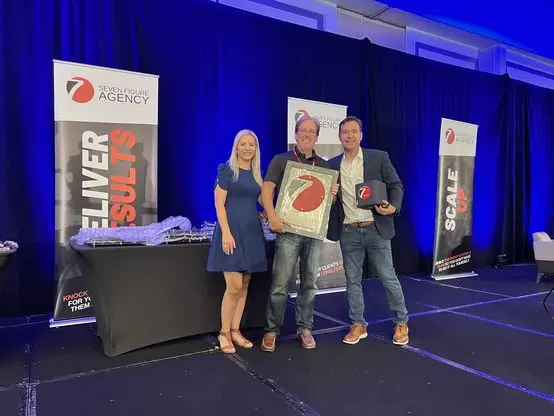
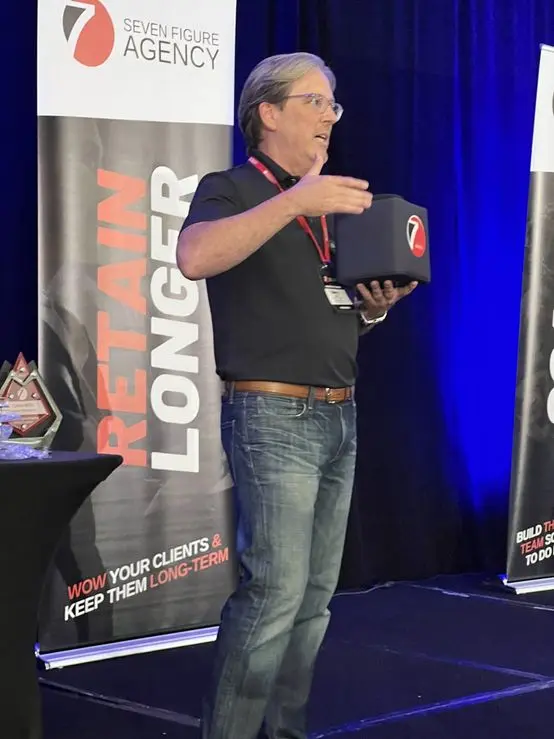
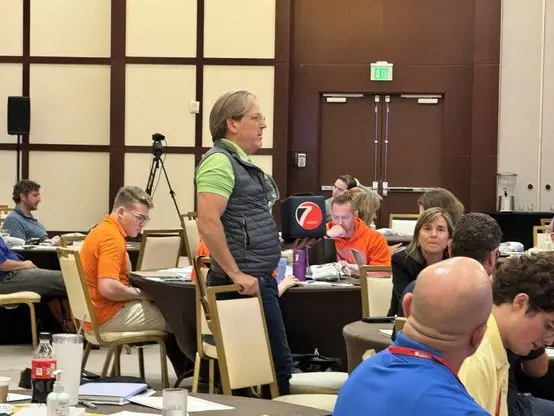
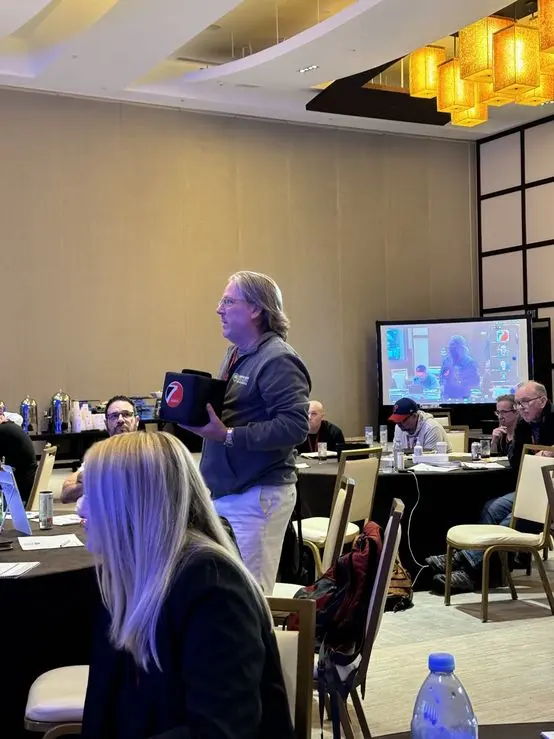
Barry has been a familiar face inside Seven Figure Agency events, from Member Intensives and mastermind rooms to the awards stage.

Editor’s Choice on TopMarketingAgencies.com
Garage Door Domination is an Editor’s Choice pick in the Garage Door Repair category on TopMarketingAgencies.com, the editorial directory of the best niche marketing agencies in the country. Listings are editorial, not pay to play. Agencies are scored on niche depth, tenure in the specialty, client retention, verifiable results, and transparency, then re-scored every year. You can read the full profile on the Garage Door Domination listing or see how the category stacks up on the top garage door repair marketing agencies page.
Ready to Build a Niche Machine Like This?
Barry took four tries to find the right niche, then built an outreach, ad and team system that turned it into $93K a month. The system he used is the one we teach.