
Roofing & Home Services · Hook Agency
Three Slow, Scared Years to a Niche That Prints $500K a Month
Tim Brown went to school for web design, cut his teeth at somebody else’s agency, then spent three years hedging on a niche before he finally committed to roofing. Hook Agency has since crossed $500,000 in monthly recurring revenue serving roofers, HVAC and plumbing companies across the country.
Tim Brown with Josh Nelson, live. Full interview.
Read the full interview transcript
Full transcript of Josh Nelson’s interview with Tim Brown. Lightly edited for readability.
Josh Nelson: Hello, welcome to the Seven Figure Agency podcast, where we're interviewing highly successful digital marketing agency owners from across the country on how they've grown and scaled their agencies. I'm super pumped today to be joined by Tim Brown from Hook Agency. Has grown to multiple seven figures, recently crossed the 500,000 in monthly recurring revenue mark. Just crushing it in the roofing and home services space. Tim, thanks so much for being here.
Tim Brown: Thank you, sir. I appreciate you very much for having me on. I was excited to be on this one.
Josh Nelson: So good. So I guess you get this amazing agency, you're thriving, you're growing, but probably haven't always been there. Tell, tell us a little bit about the journey and how you got into the digital marketing game.
Tim Brown: Yeah. So I went to school for web design, Minneapolis College, it's called now as, Minneapolis Community and Technical College when I went through it. And, yeah, I tried to join a couple agencies in college, and they were like, "Your work is trash." I just started. You know, I thought, you know, I'm a, aesthetic designer kind of- Mm. I had bands and so we'd like design the like logos for the bands and do videos and graphics design. I did it for, you know, Photoshop since I was teenager. Made my first website when I was like 12 or whatever- Mm… On like Homestead. I don't know if any of you remember Homestead- Oh, yeah… But back in the day. And so then when I got out of college, I f- I did get a f- agency job, and I needed that to kinda like feel like it was real. Mm. You know? I did a couple internships before that. Lots of learning from th- these situations, and I really didn't kn- like, if I would've gone out on my own at that point, it would've been pretty… I mean, it would've been pretty bad. So it was good to have those like two and a half, three years where I was just at that agency kinda going up a little bit and learning. Mm. Learning from the other people. But I kinda knew I wanted to have this agency. So then when I left, I did it. I did it in a classy way. I said, "Hey, it's a month." I was actually the marketing director by that point at that… And I figured out how to make leads, so I kinda like… Once you figure out how to make leads for your agency, and you know how to do that to a certain degree, like that's pretty crucial. Mm. So started in the web design- Yeah… And like actually got the degree in web design, which is rare- Mm… In the digital marketing game. Yeah.
Josh Nelson: Worked at an agency, cut your teeth, got some experience. Did you jump right into the roofing niche or did you have a generalist agency? Talk to us a little bit- Yeah… About that in the, in the early days.
Tim Brown: So I was really trying to rank for Minneapolis terms. Yeah. So it was totally local. Mm-hmm. And I was pretty good at it, like, because I learned from the people that I was working at, and I was like, "How do we do this?" And then I learned how to do it. And I, I… When I started to rank on the side, 'cause I did the overlap technique where I worked for somebody else for a while until I got some money, and I even brought some of the clients over that I found, that I got through my own SEO efforts- Mm… As a, as a freelancer over to the agency. So I was trying to contribute, but I was trying to learn this, and they were cool with me freelancing, like, I got permission. Mm-hmm. So there was a lot of like… I went totally generalist at first. In Minneapolis-focused terms, I was ranking for like Minneapolis web design, Minneapolis SEO, and that's a good amount of business. Like, there was really leads coming in from that. That and social. And then, as time went on, I got a coach, one of my first coach… You know, you get like… I have had like five coaches. Yeah. And it was like a guy that used to do sales for another agency, and he was really pushing me to niche. So at that time, he said, like, "What are your best customers?" I had like 20, you know, and like I had five contractors. So he was like, "Hey, what about this?" And we kinda pushed into it. And I was hedging the whole time. The whole time I was like, I was so scared because you only… 5 out of 20, where are the other ones gonna go? What am I gonna do? Mm. And it was… Like, I did. I was so slow on it. It was the slowest niche of all time 'cause I was like, "Okay, I'm gonna be contractors and financial and medical." Like I like…
Josh Nelson: All right, buddy, that's not a niche. Tag, tag me in the comments if you can relate to that. Yeah. You know, if you're like, maybe you're there or you've been there. Yeah.
Tim Brown: So it was kind of a crazy, niching process. Took me like three years. And then finally in, 2021, we had a client leave that was like two clients, and they were… They'll never watch this, so I'll just say it. Medical insurance auto adjudication, you know? Okay. It was the most niche-y thing of all time, and we were trying to do SEO for them. So you're, you can imagine, like, before everyone was writing everything with AI, like there was like two writers sitting around trying to write for medical insurance auto adjudication. And we realized that by d- doing these topics that we actually couldn't relate to and couldn't understand… I mean, it's lucrative, right? They were good, but we were like, "We're sick of this. We're sick of doing this bad work." Mm. Like, what we felt like was bad work. And I think that at a certain point you start to say, "What if we were the best at something?" Mm. And so we, my wife made the final decision, and sh- we were walking along the Mississippi River over here in Minneapolis, and she said, "We have to set a date to turn down other clients." Mm. "We don't have to like get rid of all the ones we have, but we need to start turning them down. Otherwise, we're, we're not doing our best work, and it's really unprofitable, and we're getting distracted and confused by all these different niches." Yeah. And we had a good chunk of roofers at that point. We had had a… There's a lot of going, there's a lot going on, but we had a YouTuber in the space start recommending us, and that brought in a good chunk of leads, and we had a couple really good case stu- studies in roofing. So at that point, July 1, 2021, we did a big party. We called it Niching Day. Nice We had balloons, we had all these- I love it… The niche, niching day, balloons up on the wall, and we took a bunch of pictures, and we still have those, and it's a, it's kind of a beautiful thing that we took a m- took a moment to celebrate- Yeah… What was a scary, a scary moment. Right. And I think people need to recognize how scary it can be, but then I think the real niche starts when you start to turn down other customers, when you really actually start to turn them down. Love that. And- So made a big- Yeah… Made a big party about it, said, "All right. We're, we're focused on roofing. This is where we've got experience, we've got expertise. So, so actually there's a double step there, 'cause we said contractors. Okay. All right. And then, and then six months later we decided to go all in on roofing, because we realized when I… We were saying contractors, no one hears that, 'cause it doesn't- It speaks to anyone, right? Not specific enough. So we had to go more specific six months later, and that was, I think, a pretty bi- Maybe it's r- that's the real, when it really started to take off. 'Cause then- Mm… Not long after that we just kept on saying roofing on everything, and that just, the sound went so much further. Our message just started to, like, travel by ear, and word of mouth, and referrals, and ex- et cetera.
Josh Nelson: So good. And that's a massive takeaway for those of you that are still generalists and still kind of playing in the niche pond. Like, be specific. Home services i- is kind of specific.
Tim Brown: Contractors is, you know, we did the contractor thing for a long time, doesn't really resonate with anybody. But when you speak to plumbing or HVAC or roofing or chiropractors or, you know, dentists, right? You can be very specific, and it just attracts the right kind of clients in a different way.
Josh Nelson: A- approximately how much was the recurring revenue before you doubled down on roofing? Just kind of when you made that pivot and had the party and, and kind of- Hmm… Started that transition.
Tim Brown: So 2020 our revenue was 1 million. Okay. And then I think it was 2021 when we made that… I think it went up, those couple years, I don't know. It was, you know, like one, 1.6 maybe, and then- Mm-hmm… Like two… And then the, when we niched, it was like, kind of took a little bit of a jump, 2.6 or something, and then 3.6. You know, it just started to like- Yeah… Started to go up faster. So I definitely felt the like And I, you know, that's really… We just had a couple good years, so I wonder what, I wonder what happened.
Josh Nelson: So the niche thing definitely helped, right?
Tim Brown: Yes. Yeah.
Josh Nelson: And I think it helped from a positioning perspective, but, talk to us a little bit, 'cause a lot of people don't re- realize doing your best work, you mentioned that, and kind of feeling like we were getting clients- Mm…
Tim Brown: Having to reinvent the wheel and not feeling great about- Yeah… What we were delivering.
Josh Nelson: Talk to me about the benefits of just becoming world-class in the, in the roofing space and operationally how that impacted things.
Tim Brown: Yeah. There's an opportunity for everybody in the company to get good at something when you niche. So there's people in the company that are trying to write or design or whatever, and there was actually a moment where we thought the designers would hate it, 'cause they had to keep on making- More of the same thing over and over… Roofing websites. But we got really good at it, and you don't have to like… And by now if you told them they had to make like a lawyer website or something like that, they'd be a little confused. Right. I think there's an element of you want those people to feel mastery, and what did, Bruce Lee say? It's like, "I d- I don't fear the man who did 10- a thousand kicks. I feel- I fear the man who's done the same kick a thousand times." Yeah. And I think that that's where you wanna be, 'cause it's like people feel it. People feel it when you know their thing, and it's so good. Even down to like, let's say our, like, we do a conversion rate optimization upgrade- Mm… Every single quarter. That would be much harder to do across clients if we had, you know, lawyers and f- we had like investment companies and all these different… It's totally different call to actions, totally different life cycle, totally different average ticket. So it's, it's confusing.
Josh Nelson: Yeah. I, I love it. I think one of the great takeaways here was your wife Bay saying, "Look, we got it. Like, this is gonna get real when we start turning down the other deals." Mm-hmm. And that's a hard decision to make. And, and when you're already at a million dollars per year and you've already got a bunch of clients in a bunch of different verticals, so you've done it that way to that point, it's hard to shift the boat. Mm-hmm. I think it was really cool that you guys set a date, and I think for some of you that's- Mm… That's a big takeaway. And make a big stink about it, right? Do, do a party. Yeah. Celebrate, hey, this is where we're going. This is the direction. It's a hypothetical, like maybe it's gonna work, maybe it's not. In Tim's case, it seems like it worked out really well, and he's continuing to see growth and momentum. We've got a question here from ASP Branding, which is- Mm… What's the offer? Like, what is it? So for the roofing home service companies we work- you work with today, and- Yeah… I know you have expanded it again, talk to us a little bit about what the program packaging looks like.
Tim Brown: Yeah. So we kinda had a little h… Like, we were on the higher end for roofing. Like, Jim Olean is also a coach in the space, and we would compete against him. We were usually more expensive, but we were actually doing less items. Mm-hmm. So we were trying to do like two or three things, and we were really aggressive on those two or three things. There's benefits to both, right? The like more like, all right, we're doing it all and we've got two or three things we're specializing in. We're kind of loosening up on that a little bit now. Mm. But like, so offer is we're offering search engine optimization, Google Ads, and website, and we've since added LSA and Google Maps as a separate kind of standalone local SEO. – Mm… But there's package, packages within that. And- You know, we've kind of got our own messaging around that, but I don't think the messaging or what you call them is as important as like, what's the blend? Do you really believe in it? So we have, so we have like a silver, gold, platinum, and enterprise. Mm. And, and we've had different things at different times. A lot of times we were doing a la carte. Mm. So we were doing a la carte here. You could have the SEO, we can have the PPC, you can have the website. What, what one thing that really did help us is we were doing… We have fairly expensive websites, and I know that, you know, seven-figure agency, there's a lot of different variety of people doing things in here where they tuck it into the overall services. We did standalone. They're expensive though. They're 21,000- Wow… Which I know it's like some people would almost like roast me for that, but- Right. No, that's great… We just really wanted to make the best thing. I came from web design. We wanted to make like best in class websites. And then, but what was helpful even for that, if you're doing like a packet, like you're doing website, we were doing half upfront, quarter after desi- quarter after development or design, and then a quarter after launch. And when we just started to say, "All right, you can pay us over 12 months," that was a big moment, an inflection point for- Mm-hmm… More people deciding to do the website. Right. So even if you do the full website, I think breaking it down, kind of offering a financing option. And, and I basically, we don't even call it financing. We just say, "This is the cost. It's a monthly cost. It's, you know, in our case, 1750 a month or whatever." And I mean, obviously there's much lower. But it allows them, people to do more- Mm… Because then they can, they can start out the gate with more because… So that's what we want. We want more people to start out the gate with more. The, now we have like the lower stuff. We have like we have a starter SEO, which is like half… Our, our SEO's very aggressive, our normal SEO, and then we have a starter SEO or a- Mm-hmm… Maintenance SEO that's lower. And I think I saw bigger agencies doing that. It's scary to me because people still always beli- you know, are, like have high expectations, right?
Josh Nelson: You can't, you're n- Yeah.
Tim Brown: They, they're used to this from you- Yeah… And seeing those results. Yeah. And if you come into the lower thing- Yeah… They're gonna still expect this, right? Yes. So those are the drawbacks. That being said, we kind of figured out, you know, AI helped us to do things more efficiently, and so really our starter SEO is as much deliverables as our SEO, what our normal SEO was three years ago, which is interesting. It's cheaper than it was three years ago. So because of AI, right? Right. Because of the help that we've gotten. So interesting. Yeah.
Josh Nelson: I think how you- So, so program- Yeah…
Tim Brown: The program really is, website and then optionally- Yeah… SEO, Google Maps, local service ads, Google ads, and doing it at a really, you know, top class level for the agencies you serve. Yeah. And it's, exactly. And just a little bit more expensive than some people. But we're really, I think of us, you know, customer service is a big deal.
Josh Nelson: You know, like- Mm…
Tim Brown: We're, we're very heavy on customer service. I think that that's just a choice we made. We like wanted to push into that. Now we have AMs.
Josh Nelson: Structuring ads, he mentioned that. I just…
Tim Brown: So we do it so that it's their credit card on the ad account. They can take anything that we do with them when they go. We're just on the easy come, easy go- Mm… Side of things. Like I, I get… And we have contracts. We have contracts, and we do year commitments. But I just hate trying to like, you know- Hold a hostage.
Josh Nelson: You don't wanna hold anybody hostage.
Tim Brown: Yeah. We don't wanna lock them in. You want them to leave on good terms one way or the other.
Josh Nelson: Yeah. Yep. Yeah.
Tim Brown: And then, yeah, I think lifetime value, I think that that's, you know, it's hard to like get into every little detail on that. Totally. I think no matter what agency you are, even if you're like high-end, like I think of us as high-end, more expensive, super high cut- touch customers, it's, we want it to be higher. We're shooting for two years, you know, retention. It's not there yet. And, and I think like that's the hardest thing to talk about. Like, 'cause some of my clients will see this, et cetera, right? Like- Mm-hmm… It's hard because no matter what agency you are, I think it's generous to talk about these things. Yeah. Whatever agency you are, it's so hard to get that up and to like stick with it 'cause… And if some of them see this, I almost, I just need to like backpedal for one second. It, it is, you're with somebody for a long time, like the, no matter what, people leave because they got bought out by a- Mm-hmm… A private equity company. They, they leave because you did too good of a job and they have too much business. Mm-hmm. They leave because a marketing manager leaves. You, they- Right… You could have the best case study in the world and they could leave. And they still leave. Like this is just the world we live in. Par for the course. And I think one thing is that we've, it doesn't come easy, and this is not me preaching, but like we have to just get a little bit more relaxed about when people are leaving. It's okay. It doesn't mean you're not good as a person or as an agency owner. It doesn't mean that your agency's not good. Now, do you use it to get better? Yes. We have postmortems when people leave, and those like learnings get captured. And every single time, if there's a negative experience by a customer, we think of that as generous, 'cause if they're gonna give us that information, we're gonna use it to actually sharpen ourselves. And so I've got a postmortem on Wednesday that I just, I'm like trying to understand what we could do to improve based on this particular client leaving. So I think… But yeah, that's, it's, it's a weird, hard thing. We're all hoping ours was higher- Yeah… And trying to get it higher, right? I think at the, at the end of the day, like we all care about our clients. We wanna get them amazing results. We'd love for them to stay forever, but like you said, there's reasons people leave, and, you know, it happens.
Josh Nelson: As long as you and your team are doing the best you possibly can, you're giving 110% for those clients, you care about the results and their outcomes, which is 100% the case with you guys. So we've talked a little bit about the program. We've talked about the niche. Let's talk a little bit about how you, how you land clients. You know, I think you're really great with branding and positioning. Yeah. Talk to us about how you, how you get the deal flow and the clients in the door.
Tim Brown: Yeah, I knew this was gonna be a big topic of conversation. Anybody growing an agency needs this, right? This is… If you can figure this out, it's so big. But it's very hard to copy. So I'm gonna give you a bunch of stuff, and I'm gonna try to give you my best stuff, but it's very hard to copy, and you have to look at your own strengths. Yeah. What are your best strengths? Where do you have clients coming in now? Double down on those avenues. And if y- if it's referrals, there's ways to double down on that avenue, right? Like, that's something people need to know. The, for me, it is… And we're getting better at attribution now. I'd say even though we talk to our clients about that constantly, we don't have the greatest attribution, right? Like, we're getting it better now, and it's hard because there's so much last touch attribution, just like our clients deal with. Like where it's so, Google gets a lot of credit, you know? And, so website and Google is a big one for us. We have, we have created some traffic on our website. We've pushed into it. Now, it's always, it's been going down. Like, I think B2B, it's hard. But I, some of the stuff we lost, if you looked at HubSpot recently- Yeah… They lost this great big chunk of traffic. Massive drop-off, right. And then, and then they kinda got on their social channels and were like, "Hey," and I watched the video. It was like, doesn't really matter 'cause most of that wasn't making us money anyways. Yeah. And you gotta recognize when stuff's not making you money and it wasn't a big deal. Like, if you're, if you lost a bunch of traffic and it wasn't actually getting you customers, don't worry about it. Like, keep on looking for what's getting you customers and stop focusing on the glamour metrics. So even though we've had some drop-off in organic traffic on our website, leads have been going up. Mm. So, but Google and website have been number one throughout the lifetime of the company. Secondly, personal brand and, in my case, Facebook. Mm. And I have two personal brands. I have Tim Brown and I have Tim Hook. And I'm sure it weirds some people out, but I have two different Facebooks. It beca- it came from one of mine getting algorithmically devalued. Mm. So how you respond to challenges may end up setting you up for future success. So I responded by making a new one and seeing how it worked, and it worked really well. Mm. And so it was about the time I was trying to get into HVAC and m- home services more heavily, and it worked, and I d- I kinda use that one s- I use them separately. So I'm running two Facebooks. Personas.
Josh Nelson: Two personas of yourself.
Tim Brown: Yes. And this is not me making a recommendation. However, it has worked really well for me. So I'm just saying, for me, the amount of leads I've gotten, and even when they come through the website, a lot of times they reference that to our salespeople. So we ask, obviously, like, "Where did you find out about us?" And that gets noted, and a lot of times they'll come through the website, but they'll say, "We just… Well, we see you ev- everywhere," right? Mm. And that's YouTube and that's Facebook. So YouTube is, like, the third one. So okay, anyways, Google, website, Facebook personal brand, and referrals. And then fourth, with like about, you know, starting to be a little bit more than a quar- like maybe it's like 15 to 20% right now is YouTube. Mm. So we pushed into YouTube. But that one's so much work, so that w- I don't know if I'm recommending everyone push into that. It's a, it's a massive effort and the attribution- Yeah… Is really hard to see and improve from. Yeah. Right? Yeah. So you'll hear it 'cause they'll say, "We see you everywhere. I watched a bunch of your videos." But then sometimes that could've come from the website. Anyways, it's very complicated. Yeah. But usually it's the not, it's not a one fit… It's like, I think when you're early you're like, "What is the one?" You know? Mm-hmm. Like, I just- Right… Okay, Facebook, all right. There's some guy taking notes right now. He's like, "Facebook personal brand." But it's like so much of that, like, intertwined- Mm… Brand, like, with all the different methods. So, and like on the referral side, I also lump a little bit of events in there. Mm-hmm. We have pushed hard into events, and when I say that's related is because we treat, when we go to these events, we talk to the other vendors. Mm. And we say, "Hey guys." You know, like we've even like g- had giveaways specifically for the other vendors at these events 'cause we're like, we're trying to get in with the other vendors 'cause who talks to your- Right… Possible customer more than anyone? Mm. And if there's a good reputation of your company amongst other vendors, it really helps spread the word. So that's, that's the whole strategy. Hard to do, right? Like it's a lot of work.
Josh Nelson: So, so a website that ranks really well. I see you do some really- Yeah… Cool things with content and lists- Yeah… And listicles and things like that that- Mm-hmm… Bring organic traffic. Yep. Very consistent with short form, long form videos- Yes… On like Instagram, Facebook, as well as like sounds like YouTube now. Being present at not just other people's events, but running some of your own events. Kind of all that mixed with building the brand and the authority for Hook Agency and Tim Brown under both personas, in a, in a nutshell. Yes, exactly. Can you talk a little bit about your content strategy? Like, I see you're posting a lot of stuff. Are you batching that? What's the thought process around how you get your content done and get your content, you know, syndicated?
Tim Brown: Yeah. So we have a content, a very basic like spreadsheet content calendar where we try to put out blogs, videos, and posts, social proof, a lot of social proof websites as, testimonials. Mm-hmm. So I like even tell our, like we now have a marketing manager, tell her to like use the screenshots sometimes, just the text from a client. Yeah. Like make it f- like it's, it's, it is more organic. Mm. And kind of mixing up the things. So sometimes it's nicely designed, sometimes it's chill. A lot of personal brands. Once again, personal Facebooks. 'Cause you can connect so much to other people on there. So I'm connecting, I'm maxing out my 5,000 friends- Mm-hmm… On each of those. I'm cheating, dude.
Josh Nelson: You double, you doubled your reach.
Tim Brown: Yeah, I- That's, that's, and to different audiences, right? And it works, it works. So it's like, it's kind of a, it's a whole thing. And people sometimes think, and I know you asked about content and content strategy, but- Mm-hmm… A lot of people think you can just create the content and then boom, p- they will come. But it's so much work to create all this content. You have to be building audience at the same time. So every time- Yeah… You create a video, make sure you're doing stuff around building the audience too, like- Mm… And make sure you're sharing it everywhere. Like, in my case, I do YouTube now. I'm making sure I put that on Facebook, on Instagram, like everything's, everything's connected so that it's… Otherwise, you're, you know, just, the, getting YouTube to see you is hard. Yeah. You know, like, and it's starting to see us a bit more. We're starting to get some momentum. But the content is generally around, we have, we have two… This is, I also not recommend- I'm not recommending this, okay? So we do a bunch of stuff that's like hardcore, but I don't know if I can tell you to do it. I don't know that I'd say- Mm… "Go do this," 'cause the amount of effort may not always be worth the squeeze, and I have other things that I'm doing. It's not just about content, it's about r- relationships and, getting really in with different industries. So we have two podcasts every single week. We have a roofing podcast on Tuesday, we have an HVAC and plumbing podcast on Wednesday. And, and what, that one's about to hit 100. Wow. And the roof- the roofing one is like at like 350 or something. So we've been doing it. We've been very consistent. We also have sponsors for those podcasts. Once again, I don't think I would recommend that 'cause it does distract you. Un- unless you're gonna get like a bunch of money from it, like it… And that's a different thing. But, in our case, we kinda did it more as like a partnership, and we are giving money, but, or we're getting money, but not a lot, and we're just kinda doing it for the social proof. Hmm. And then there's usually about three to five blog articles that go out every single week. There's usually, there's examples of design, there's testimonials, there's s- on Instagram and LinkedIn, there's highlights of people. I guess they go out on Facebook too, but it's like a little bit more for the employee branding side of things. Mm. And just a little bit more like cultural stuff on LinkedIn, Instagram. And then we do TikToks. I mean, we break down, it's that age-old like Gary Vee strategy of like the like pillar piece of content and then break it all down. So- Mm… Every, generally every single week you've got a couple clips from the HVAC and plumbing one that go out on… That we have a s- we… God, this is all so complicated. I understand why my marketing manager's like, "Dude." Like what? And you're like… Yeah. Then the, so we have a separate HVAC and plumbing Instagram, and then we have, like we have a bunch of niche Instagrams, which is a strategy nowadays, by the way. Mm. It's like doing more of like hub for the industry type Instagrams and then, and then collaborating with your main brand. So we do that. So when people say they see us everywhere, it's hard to track it back 'cause we are, we've been… And I think of it as a glamour thing, but every once in a while I think it's maybe bigger than I think. We get millions and mill- millions of views on social. That's amazing. And I looked back at the spring, this spring, and we had just tons of like 100,000, 500,000, a million view videos, like 20. And if anyone's tried to go viral before, you know how hard that is. It's hard. It's super…
Josh Nelson: Yeah, yeah, you could post every day and still not have any that do that, right?
Tim Brown: There's a, there's a specific approach to it. So pursuing that has been part of our strategy, but it wouldn't be recommended. Mm. Like that was something that wouldn't be recommended. I wouldn't recommend to an early person to pursue that strategy. It's kind of a glamour thing in certain ways. I don't know how much that really affects our actual bottom line. I pursued it because I like to learn marketing. Hmm. I like to learn how to get attention and how… And I have had this, I have this simple brand, and I try to get it in front of as many people as I possibly can, which is a fundamental component, I think, of our success, which is like, I want the niche to see our brand. So as we've done this, I'll just kinda like encapsulate the strategy and then we can move on. But- Mm-hmm… It's to get this brand on viral videos and to get in their niche viral videos. So most of the people commenting and interacting are like HVAC people or roofing people, and so you're seeing this brand- It's the right people.
Josh Nelson: Yeah. What's that?
Tim Brown: It's the right people seeing it and- Yeah… Engaging with it. Yep. And when I'm doing less well, I think I'm wasting my time, and when we're doing well, I'm like, "It works." Right.
Josh Nelson: There's so many things like that, right?
Tim Brown: Like sometimes I lose my confidence, and we had a weird couple quarters this last year where like I was halfway knee-deep in HVAC, but I, it wasn't winning yet. Hmm. And the election year stuff came up. Yeah. And I was like, "I don't know if this is the right… I maybe have just wasted a bunch of time." Hmm. And then all of a sudden we've had like the best two quarters in a row. So, you know, we all go through that, right? Like some days I'm a genius, some days I'm an idiot.
Josh Nelson: Right. I think you planted a lot of seeds, right? Yeah. And sometimes those seeds take a while to take root and for the, like for the tree to grow up and actually start to bear fruit, and now you're in that fruit-bearing season and, you know, it's, it, it has those ebbs and flows. When you look at the videos that you have posted on s- on like s- like Instagram and TikTok that have gone viral or viral-ish, whatever you wanna call it, like, a- any common trends or threads to those videos- Mm… Versus the standard run-of-the-mill, like syndicated content that maybe only gets a couple thousand views?
Tim Brown: Yeah, I think this one's so fun to pursue. Like, it is fun. So I know whatever I say here, people will actually do it because-… When it's fun, we all do it, right? Yeah. Like, when it's fun, we're all gonna pursue that method 'cause it's so fun. The, the easiest one to, like, duplicate, and I see people already copying us, which is fine. Well, and maybe they aren't. Maybe I just, like, have it in my head that they're copying us. They're definitely, they're demo- definitely imitating at some level, I'm sure. Yeah. There's, there's the, I do the, like, the logo on the mic at trade shows. Mm. Mm-hmm. And then I ask a provocative question or, like, something that would matter to our ideal customer, and then I go around and get answers. So understanding your ideal customer and, like, the niche enough to ask that provocative question. Like for instance, HVAC, took me a while, but I know, I now know the topics I could ask, and no matter what, it would go, it would get some views. Glove or no glove on the- Mm… On the HVAC unit, right? Like, and the… I haven't even done that one yet.
Josh Nelson: You could go do that one. You know what I mean?
Tim Brown: Like- I'm gonna steal it. I'll, I'll get out there first.
Josh Nelson: Good. Let's go. You got the brand, though, you got the brand- Right… And you got this interesting question. So they're, they're seeing you in niche context. Right. And they're hearing their peers share something that's kind of fun and interesting. So kinda like the man on the street slash- Yeah… Per- you know, hot take question. Yeah. And it feels very organic, and it's like- Yeah…
Tim Brown: That's gonna catch your attention.
Josh Nelson: You're gonna watch that- Yes… Versus just you at the trade show saying, "Hey, I'm here at the Roofing Expo, you know, come see us at Booth 113," or whatever. And I… Yes, exactly.
Tim Brown: And I spend a lot of my time doing that 'cause a lot of these trade shows aren't that good, right? Like- It's… We know that. Right? They, they… We're the product. The, the vendors are the product. That's the truth, and you could waste a lot of money.
Josh Nelson: So I to- I told people that in seven-figure agency that I'm talking to, I'm like, "Go visit." Before you b- spend a bunch of money on these tra- these…
Tim Brown: You have every right to go to them and to scope them out. Mm. And if you're the product or if you're the moneybags of these, trade shows, go walk the floor the year before. Mm. But yeah, so r- running around with the thing and talking to vendors and talking to contractors. The other component of this, I… 'Cause I see people trying to, try to do this, and you, it's not working for you. So here's what you gotta do. You gotta get people that they care about on the video, and interesting characters. Yeah. So we use influencers, right? Like, we talk to the people that are entertaining, and sometimes it's not the guy that's necessarily gonna be the coach or the super buttoned-up guy. Like, in our case, we did Mr. Fat Cheeto at AHR. We've done Best Damn Roofer at- Mm… I- International Roofing Expo. And, like, we bring… We have them go around and ask questions, right? Mm. Like, so s- I don't have to be the main guy all the time. Right. The other thing is you kinda gotta make 'em high energy. You gotta run. Mm. Like, I know it sounds stupid, but like- The movement catches attention, right. You gotta, you gotta run, and you gotta, like, put it… You gotta kinda, like, confront people sometimes. Like- Mm… And that's what makes it interesting. It's not fun 'cause you're sitting there and you guys are buddies and… So it's, like, uncomfortable. So you gotta embrace the cringe, and you gotta use influencers, and you have to use visuals. So when there's something behind them or there's something going on- Mm… Or the person goes, "Ah!" Like, that's the type of stuff, for whatever reason, that works. I… Once again, none of this stuff is like… It's hard to, like, put it all together. Mm-hmm. But that is the strategy, and I think, like, I've seen, several people that kind of, I know, see ours, and then they try to do it, but it didn't… It gives them a couple thousand views, but it doesn't, like, go off. Right. It's 'cause you gotta do these things too. Like, and I d- like, even if you learn it completely, I don't know if it's good. Right. I know, I know it gets views, but I- You post it and see what happens, right? It's like, let's, let's see- Yeah… Where it goes. Let's, let's see if it, if it leads to anything. But what you should do is you gotta work your logo into it somewhere. 'Cause I've gone viral enough times where I didn't have my logo, I didn't have anything on it, and I'm like, "Dude, why would, why did I do that at all?" Mm. So put the influencer in your hat. Put the influencer in your shirt. We had m- Mr. Fat Cheeto and the giant brand, and so every single thing was niche. It went, you know, a lot of s- a lot of these videos got a lot of views and the logo. So now a bunch of HVAC people know the logo. So then when they see you later, and this is all, like, branding kinda 101, but, like, they've seen the brand five times. They don't even know why they've seen the brand five times, but then when they come to you, they're like, "Okay." I've seen you. I feel like I know you. I recognize your face. Yeah. I recognize that brand. Yeah. This seems like… Let's give 'em a shot. Yeah.
Josh Nelson: Love it. Hey, thanks for breaking this down. So we got a high level, concept here. You know, content, content. Thinking about the hook, thinking about the angle, building up the brand. Talk to us briefly about the sales process. So all of this leads back to your website. Mm. They schedule in at some level. Like, talk to us about that sales process in your organization today. Yeah, that's good. We got another question here too. I wanna- Oh, absolutely. I don't wanna spend a ton of time on it, but it's the economic uncertainties thing. Mm. The, there's an HVAC guy, Rick Picard, who says, "I never participate in a bad economy." Yeah. And I think that I've thought about that a lot. We, we push anyways, right? We do our, we do the leading indicators anyways in good and bad economies, in good and bad situations. And, so don't, don't let it fool you. I mean, sometimes people need more leads more if the economy's bad. So, like, don't think that just because something's going on in the macroeconomics that that has to, like, decrease your business. What if it, what if it actually is gonna increase your business? You don't know. Just keep applying effort. We'll see. Yeah. Could've said the same thing during COVID for, you know, in home services especially. Yeah. Oh, it's like, "Oh, I'm gonna cru- shrivel up into a little ball COVID is here, businesses are gonna go by the vine. Or we say, "Hey, let's be ever present. Let's keep going after it." And, and we all saw explosive growth during that time. So just choose to focus on what you want more of and not what you're afraid of, and you're gonna get the outcomes. – Yeah… ASP, thanks for asking these questions. This is great. If you're live, we've, we've got, you know, 40 or so of you guys watching live, post your questions so the team can answer them while we go. So talk to us about the sales process and- Sales.
Tim Brown: Sales process. Yeah. So we get a lot of warm leads by creating all this content and getting people in the door. We don't have any outbound anything. It all comes, and I'm not proud. I frankly would like something like that in the future. But based on what we've got now, we just get the leads that come in. Our sales people, sort through the junk. I mean, they do an intro call. So it's a 20-minute intro call. We try to understand, you know, it's, it's kind of qualification, BANT, budget, authority, need, timeline. Mm-hmm. Trying to understand. What we also, we really do talk about the fact we are selective. Mm. Selective for people that could invest the amount of money that we require, but also relationship-wise. Is this person going to be reasonable? We talk about calm, not agitated clients because if you… And like literally we're filtering for calm, not agitated. Mm. Because if somebody comes in agitated and you think it's such a good deal because you're like, oh, they hate their last five agencies and we're God's gift to agencies- Yeah… And we're gonna fix this all for them, it's such a te- like I know a lot of you have already tried this and you already know, but like if you're early, it, you think you're gonna fix it all, but they hate every agency, by the way. Yeah. And so kinda looking for people that are good clients, like we look at it that way. And we get enough. We get about 13 leads a week or whatever. So we get enough that we can sort through them and- Yeah… You know, it's higher ticket thing, so. Yeah, we sort and we qualify, and then we do a second call, which is we call the strategy call. We use Engage, which is actually a little bit more for home services, but it's like a nice proposal software with like- Mm… Video backgrounds and interactive elements. But I think it really comes down to the visuals we're offering are really like kind of f- a lot of the stuff is literally just showing what we do. Mm. Showing what we do, and a few things are like expectations. We have like a, like timeline to website kind of thing that's really good. Mm. Your, your responsibility, our responsibility. Clarity, right? We're trying to give as much clarity as we can, and here's what it looks like when we report. Here's what the deliverables are gonna look like. So we're just trying to give as much evidence and the fact we know what we're doing, mix in some testimonials, and then we send them, a proposal if appropriate at the end of that call. Mm. And we do kind of like ask them, "What do you think? We're… Wanna do it?" and by the way, our close rate isn't like magical or anything. It's 22% on sales qualified leads. Mm. So we have a lot of leads, and somehow 22% still does pretty well for us. Oh, yeah. So I think just giving some, clarity on like what we're… We're not like this hard-charging sales organization. We don't… We're really, we're trying to attract a lot of business and then sort through it, and I think like it would be higher if I didn't, if I told my salespeople, "It doesn't matter. Just sell them," you know? Just get whoever, yeah.
Josh Nelson: Yeah. Sell the world.
Tim Brown: I like- So we don't do that…
Josh Nelson: You're more concerned about getting the right client- Yeah… That you're gonna be able to impact, that's gonna stick around long term- Yes… Than just trying to close 40 or 50% of the deals on- Yes… On a table.
Tim Brown: Because one of my weaknesses is that I care very much about my reputation sometimes. Mm. And I say weakness 'cause I think it's fun to say it that way. 'Cause it is true though, because it does scare the shit out of me to get bad, press- It does… So to speak. Yeah. So 'cause because you're, when you're hyper niche, that is the drawback is like- Yeah… You're kinda sensitive to the like loud, voices in the industry that will occasionally, that will occasionally have problems with your service.
Josh Nelson: Mm-hmm. It's okay. You will have somebody post a Facebook thing or do a bad review, and you're gonna be alive. Mm. And everything's gonna be okay, and you might even grow a lot.
Tim Brown: Yeah. We got our first real bad review at the beginning of Q4 this last year. First real one. Mm. And I did my absolute best to talk to this person. I, you know, I'm scared. I'm so scared. I do everything I can. So I run up. I'm like, "Dude," I run to the roar. I run to the fire. I try to f- I'm like, "Hey, dude, please let me talk to you. I wanna fix this. What can we do to fix it?" And nothing. Mm. Couldn't get ahold of him. No one would talk to me. Still to this day, I've tried to like make it right. I try. I do my absolute best to make it right, but the person said what they said on the review. Go check it out. I said what I said, which is like, "We did everything we could to fix this." We had $160 cost per lead for roofing, which is pretty good actually. We had, you know, like, anyways. We did everything we could, but we were, we had the best quarter ever. Mm. So it didn't- Yeah… It didn't kill, it didn't kill- Yeah…
Josh Nelson: Your ability to close deals. Yeah. It didn't kill the momentum.
Tim Brown: Yeah. Everybody knows, you know, there's always gonna be a rogue, you know, bad experience- Yeah… Or bad client or somebody that's just impossible to please. And then the next quarter we had the best quarter ever again. Mm. And so what I'm saying is like, don't get… Like, we just get so scared. And I think that like people like me, you know what I mean? Like, some people are too loose about that. Like, do improve your services all the time. Get, get concerned, but to a certain degree, like don't beat yourself up. If you do your best to fix something and the person will not talk to you and whatever else, just don't… I think that that's, the people like me, and I think there's a lot of agencies own- owners out there like me, like we just beat ourselves up too much. You're doing the best you can. Please get better, but- Like, don't beat yourself up too much. Like, we're in a service business, people will always want more.
Josh Nelson: Hmm. So good. So lots of great feedback here on kinda like how you chose the niche, how you packaged your program, how you've landed clients and gotten this business to 500,000 or more in monthly recurring revenue. Let's talk a little bit now about the delivery side and the retention side of the equation, which we know- Mm-hmm… Is as important or more important than how we get the clients. Like what does the operational infrastructure look like, in– to retain clients at this level?
Tim Brown: Yeah. So we've gone the very in-house route- Mm-hmm… Which we're trying to learn, we're trying to learn a little bit more about like Columbia and a few other places, like to find some remote full-time employees. But we're, and we're learning that in Seven Figure Agency. So if you're not in- Mm-hmm… Seven Figure Agency, there's such good knowledge. Check it out. We're talking to people that we wanna be like- Mm-hmm… And we're learning from them. And even if you're a little bit bigger, you learn from people on profit or whatever else, right? Like we're learning on different things. Remote employees is a big one, and they don't think of them as, you know, outsourced. They don't do it as outsourced. A lot, a lot of these people have remote employees, so. Mm-hmm. A- and the, but the delivery side, we have three AMs. We j- a lot of the roles right now, we have about three of them. So we have like, I think designers, we only have two. We just moved one to marketing manager, but, three, you know, SEOs, three PPCs, maybe it's four now. You know, it's like you know, it's, it's certainly, it's, we've got like 30 some people. It's starting to like, you know, it's a little up and down, you know, on headcount, and I'm not trying to get- Mm-hmm… Proud of headcount, but I think that that has allowed us to go a little quicker at the beginning here. I think of that we're still at the beginning. Yeah. I think to learn and kinda like amongst ourselves and c- share that information quickly. We have a lot of, you know, like I said, we have postmortems when somebody leaves. We have try to be in the office for the kickoff. And I'm not telling everyone to live like this, but this is what we're up to. The, you know, we have L10s every single week- Yes… On the s- The entrepreneur operating system- Yes… Level 10 meetings. Yes. Kind of your key, each department has their big meeting for the week and kind of to try to resolve things. AMs was, we waited until about a year ago, year and a half ago to add that. – Mm-hmm… Maybe I would've done it sooner. See, I know a lot of people in Seven Figure Agencies call 'em like CSMs. Yep. There's… All of ours came from Google Ads. Trying to think about it. Like we, every single one of those departments has a lead and is always improving the services. We separate out the people reporting on the work from people doing the work, but the people doing the work report, like kinda debriefs. I think that's something that I've said in a, in some of the groups in Seven Figure Agency that have been helpful to people of like, sometimes the AMs are super, they've got a lot of work. Right. And, and like a lot of communication. It's very intense, emotionally intense, emotional labor, et cetera. Whereas like sometimes the people doing the work, technicians, they have a little bit of extra time. What would we do with that time? Or there's a lot of work to do, but like they could do a brief, a one-pager, or here's the five bullet points for the account manager. This is what's happening in the work. This is what's working. This is the best news. Here's something that's not going well. We're working on it. So that person can kinda get up to speed very quickly and understand the work that's getting completed and make sure to speak accurately. Mm-hmm. 'Cause that was the thing I was so scared about with adding that layer of people reporting to the client, was like that it wouldn't be accurate. Mm-hmm. 'Cause I loved when it was the people doing the work, I felt like it was just making sure that we're accurate. 'Cause I hate when more things to cross-sell and like put 'em on if they didn't, you know, had, if it's a budget thing or those types of things. Let me see. What else do we do? Yeah. We have really good account… I think account managers all came out of that, like having- Mm-hmm… Good, like we role-play with the account managers- Yes… How to talk about challenging things. We, and it, that's all built in. Like that happens every month, role-playing and, that type of thing. We've also, I think what we're doing now is we're trying to coach them, the AMs, more on business stuff. They came from Google Ads. They're smart when it comes to marketing. They're all, each one of ours so far has been pretty smart when it comes to like marketing and like ROI and things like that, but thinking like a business owner. Like- Mm-hmm… Thinking like a business owner coaching. So they all, we made a curriculum. Basically, it's like almost like a coach's curriculum, like a business core fundamentals curriculum. 'Cause some of our guys don't even know what the right profit margin is. They don't know the benchmarks in the industry, those types- Mm-hmm… Of things. So we tried to create that, right? We're trying to create some benchmarking. I think that that's one of the best parts about Seven Figure Agency is the benchmarking. Even, even if we're smart on things, we don't know what it should be, what the numbers should be. So I think creating some of that vibe with our AMs too has been really good to like try to… So we created a cur- we had the chief of operations, Cody, we had a senior person create a business acumen curriculum. They all took it. It includes books, it includes videos, it includes business fundamentals and how to coach on those. And then we tested them each out on it. So they had to do the work and they had to test out, including role-playing and including tests, actual f- tests. So I think like that's the direction that we're gonna continue to go as far as… 'Cause I think part of it is people don't understand, like when we do great work And I would say even 70 to 80% of the people leaving our company that are getting good work- Mm-hmm… Is, like, partly 'cause they don't understand it, and they don't- Connecting the dots… I think there's a- Right. Connecting the dots- Yeah… Between what you did and the outcomes that they received. Yep. And I think, like, long term it'll be better dashboards- Mm… And better clarity around money. Mm. I think, like, I'm thinking a lot about Searchlight, which is a- Right… Like a, it's a nice, like, third party ROI dashboard. Like, a b- Mm-hmm. Something like that's probably in the future to, like- Yeah… Get better about clarity on, ROI. I think that that's what people need is clarity on ROI. So everything has been around, like, super comfy, good customer service and onboarding, and then clarity around ROI. And to the degree that we haven't done that, people have left.
Josh Nelson: Right. So, so good. Tim, congratulations on your success growing the agency to over $500,000 a month of recurring revenue. Thanks for coming on and your abundance mindset to share what's worked for you, how you've grown, how you've scaled. If you had one last piece of wisdom for that agency owner trying to get to the next level, what would it be?
Tim Brown: Hmm. Just find the people that own your audience's attention. Hmm. So, and niching is a great way to have clarity on that, right? But find the people that own the attention, run to them, collaborate with them, and be useful to them. Hmm. And if I could say one just more kind of selfish things here is, like, I really did… I was thinking about you, the early business owner, the guy like me five years ago or whatever that could use this, million bucks, or f- if you're at 200 or 300 or whatever. Like, I think some of these things are useful. Don't try to layer this all on at once. Mm-hmm. Go slow. Do the next right thing. Find one thing. Focus on business development. Push into sales. Get better at sales. I had to, that first year, I had to learn a ton on sales, and it was a lot of work, and I really mastered, I really got better personally at sales. But if this has been useful to you, we do, we're in roofing, in home services. But roofing, think about it if you got a customer, or, like, a prospect or somebody that makes sense to throw over to Hook Agency, roofing agency. So thank you guys very much for, referring us when appropriate.
Josh Nelson: So good. If somebody wanna connect with you further, Tim, what would be the best place?
Tim Brown: I would love to connect with you on Facebook. You can follow Tim Hook or Tim Brown. – Either one… Tim Brown, and then you put Hook Agency. You'll find me.
Josh Nelson: Awesome. Tim, this has been great. Guys, if you got value, be sure to drop some love. Thank Tim for sharing, and we're gonna wrap here so Tim can get to his next meeting. Thanks everybody. Thanks, Tim.
Tim Brown: Thank you. Bye.
Where He Started
Tim Brown went to school for web design at what is now Minneapolis Community and Technical College. He had been building things since he was a kid, designing band logos, editing videos, making his first website on Homestead at twelve years old. When he tried to get into agencies straight out of high school, he was told his work was trash, so he went and got the degree instead.
After college he took an agency job to make it feel real, and stayed two and a half to three years, learning from people ahead of him. On the side, he freelanced local SEO work with permission from his employer, ranking for terms like “Minneapolis web design” and “Minneapolis SEO,” and eventually brought some of those clients into the agency as he built toward going out on his own.
When he finally left, he did it the classy way, gave a month of notice, and went generalist. Local, Minneapolis-focused, a mix of web design, SEO and social. It worked well enough to build a real business, but it wasn’t a niche. It was a location.
The Slow, Scary Niche
One of Tim’s early coaches, a former agency salesperson, pushed him to niche down. He had roughly twenty clients at the time, five of them contractors. The coach’s question was simple: what are your best customers? Tim knew the answer and still couldn’t commit to it.
“I was so scared because you only… five out of twenty, where are the other ones gonna go? What am I gonna do?” is how he describes that period. His compromise was to call the niche “contractors and financial and medical,” which is not a niche at all. It took him three years to actually narrow it.
The push finally came in 2021, when Hook Agency lost two clients doing SEO for medical insurance auto adjudication, about as far from a niche as work gets. The team was burned out writing content they didn’t understand or care about.
By that point Hook Agency already had a solid base of roofing clients, a YouTuber in the space recommending them, and a couple of strong case studies. On July 1, 2021, they held what Tim calls Niching Day, complete with balloons on the wall, to mark the decision to start turning other clients down. Six months later they narrowed further, from a vague “contractors” label to roofing specifically, because contractors didn’t mean anything to anyone but roofing did. That is when Tim says the business really started to take off, with the message spreading by word of mouth in a way it never had before.
The revenue curve backs it up. 2020 revenue was $1 million. It moved to roughly $1.6 million, then jumped to about $2.6 million as the niche took hold, then $3.6 million as it compounded.
The Program and the Attention Machine
Hook Agency’s offer today is SEO, Google Ads and website design, with Local Service Ads and Google Maps local SEO added as standalone options. It comes in silver, gold, platinum and enterprise tiers. Websites are sold standalone and are expensive by design, $21,000 for a build, because Tim came from web design and wanted to make the best websites in the category. Letting clients pay that over 12 months instead of in three lump payments was, in his words, a real inflection point for how many people said yes. He also built a lower-cost starter SEO tier, and points out that AI has made it cheaper to deliver than their full SEO service was three years ago, for the same volume of work.
Leads come almost entirely inbound. Website and Google rank first, personal brand second. Tim runs two separate Facebook personas, Tim Brown and Tim Hook, each maxed out near 5,000 friends, after one of his original accounts got algorithmically devalued. Referrals and events are third, where the strategy is less about the trade show floor and more about building relationships with the other vendors in the room, since vendors talk to prospects more than anyone. YouTube is fourth, roughly 15 to 20% of the mix, and Tim is candid that it is a massive time investment with attribution that is hard to prove.
Underneath all of it is a genuine content operation: two weekly podcasts, a roofing show on Tuesdays near 350 episodes and an HVAC and plumbing show on Wednesdays approaching 100, three to five blog posts a week, and a deliberate push for viral short-form video at trade shows using a logo-branded microphone, provocative niche-specific questions, and entertaining industry personalities rather than Tim himself. One spring they had roughly twenty videos land between 100,000 and a million views. Tim is upfront that this level of content effort “wouldn’t be recommended” to someone earlier in their journey, it worked for Hook Agency because he personally enjoys the game of getting attention.
With around 13 leads a week coming in, the sales process is a 20-minute qualification call for budget, authority, need and timeline, followed by a strategy call built around showing the work rather than pitching hard. The team explicitly screens for “calm, not agitated” prospects, since clients who arrive furious at their last five agencies tend to churn no matter how good the work is. Close rate on sales-qualified leads sits at 22%, which Tim admits isn’t magical, but the lead volume makes it work.
Delivery, Retention and the Honest Parts
Hook Agency runs roughly 30 people, almost entirely in-house, with three account managers, three to four PPC specialists, three SEOs and two designers, organized around weekly EOS-style L10 meetings. Account managers were added about a year and a half ago, later than Tim now thinks he should have, and every one of them came out of Google Ads. To turn marketers into business advisors, the leadership team built a business-acumen curriculum covering profit margins and industry benchmarks, complete with role-playing and tests, because Tim found his AMs didn’t always know what a healthy margin should look like.
The technicians doing the work write short briefs for the AMs so client conversations stay accurate, and every client departure triggers a postmortem to capture what went wrong. Tim is honest that this part of the business is still unfinished: Hook Agency is targeting two-year average retention and is not there yet, and he estimates 70 to 80% of clients who leave despite good work do so because they never connected the work to the results, which is pushing the team toward clearer ROI dashboards going forward.
His closing advice to agency owners chasing the next level was not about a channel or a tactic. It was to find whoever already owns your audience’s attention, and go be useful to them.
What made it work
- He set a date and made it public. Niching Day, balloons and all, turned a scary decision into a real one the whole team had to honor.
- He went narrower than felt comfortable. “Contractors” didn’t travel by word of mouth. “Roofing” did, and that specificity is what let the message spread.
- He priced for the work he wanted to do. $21,000 websites financed over 12 months let clients say yes to more, without discounting the work itself.
- He built owned attention inside the niche. Two personal Facebook brands, two weekly podcasts, and trade-show video built specifically for roofing and HVAC audiences, not a general business audience.
- He filtered for fit over volume. Screening for “calm, not agitated” clients on the first call kept a 22% close rate profitable instead of just busy.
Tim in the Community
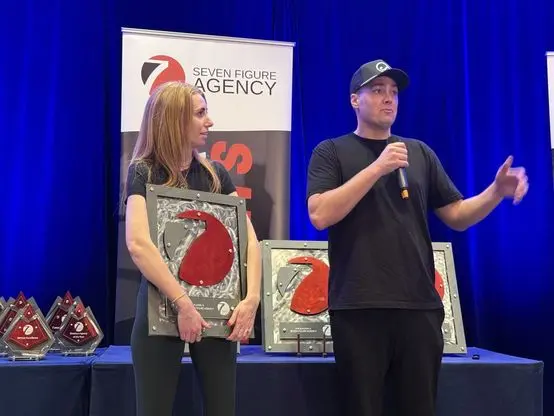
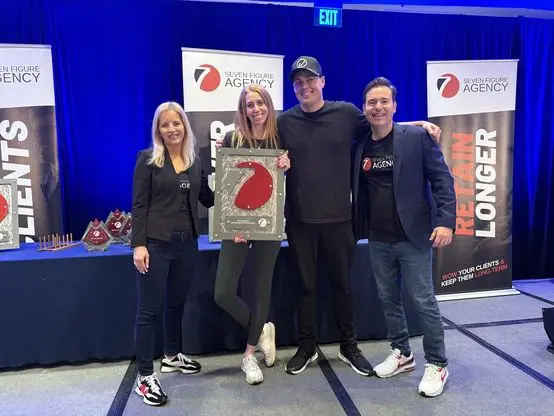
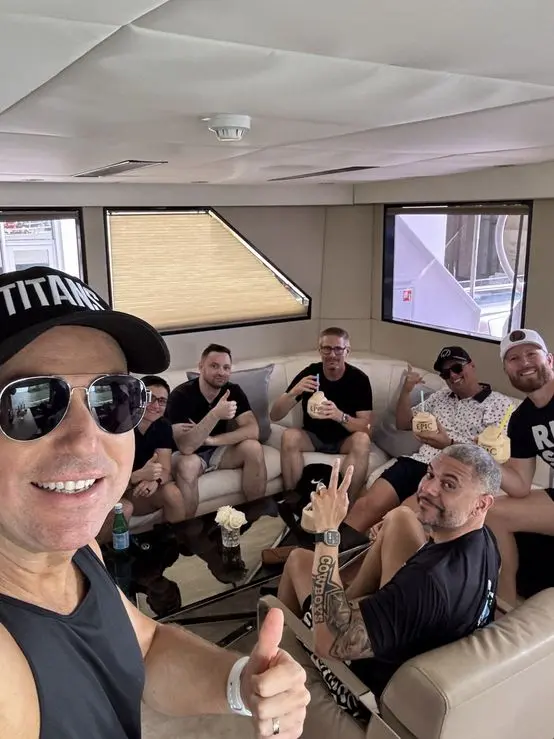
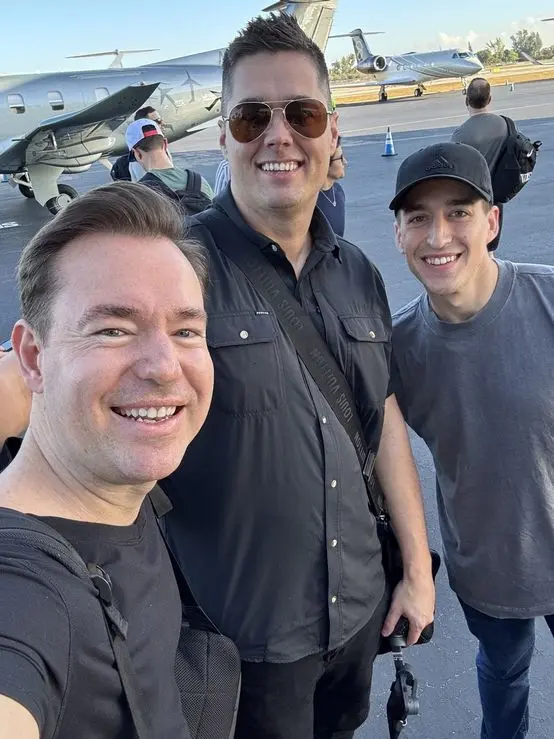
Tim has been a regular inside Seven Figure Agency, on the awards stage, in the mastermind room, and on the road with the group.

Editor’s Choice on TopMarketingAgencies.com
Hook Agency is an Editor’s Choice pick in the Roofing category on TopMarketingAgencies.com, the editorial directory of the best niche marketing agencies in the country. Listings are editorial, not pay to play. Agencies are scored on niche depth, tenure in the specialty, client retention, verifiable results, and transparency, then re-scored every year. You can read the full profile on the Hook Agency listing or see how the category stacks up on the top roofing marketing agencies page.
Ready to Pick a Lane and Commit?
Tim spent three years afraid to niche down. The system that got him from $1 million to $500,000 a month once he finally did is the one we teach.