
Real Estate · Platform Marketing
He Walked Small Businesses With an Empty Briefcase and Built a $300K-a-Month Agency
Tim Chermak dropped out of college his senior year, took a deal with one broke realtor who couldn’t afford ad spend, and turned that single relationship into Platform Marketing, an agency now serving realtors nationwide with churn most agencies would kill for.
Tim Chermak with Josh Nelson, live. Full interview.
Read the full interview transcript
Full transcript of Josh Nelson’s interview with Tim Chermak. Lightly edited for readability.
Josh Nelson: On Cassie Grocers, where we're interviewing highly successful digital marketing agencies from across the country. And today I'm super excited. We have a major treat. You're gonna hear from Tim Schumacher from Platform Marketing. He runs a digital marketing agency that specializes in the, in the real estate space, has grown to multiple seven figures. And so I'm always excited to get, you know, high growth, really smart guys like Tim on. Tim, thank you so much for being here.
Tim Chermak: Hey, Josh. It's good to be here. I'm excited.
Josh Nelson: So I guess before we dive in, kind of for the, for the audience, let's just let them know kind of what your background is and… Well, actually start with what Platform Marketing is and kind of where it sits today. Like how many clients approximately, how much revenue, that type of fun stuff.
Tim Chermak: Yep. So we are a digital marketing agency that just specializes in working with realtors. So we're all in on like residential realtors, and most marketing programs in our space are really built for like big teams. Mm-hmm. So like most of our competition, what we say even in our like sales calls and whatnot, it's kind of part of our sales messaging, is that our competition is like they're not really marketing agencies, they're software companies pretending to be marketing programs. Because what they're really selling you is like a website template and a CRM, and then everyone has the same website template, right? So they'll sell the same website to, you know, 50 realtors in the same city. The only thing that changes is your picture and your logo or whatever. To me, that's not really marketing, right? That's just you selling a website to someone. So what we do is actual creative marketing where we're coming up with ad ideas. Primarily it's all around, social media right now. So like, I mean, 90% of the ads that we do are on, Facebook, Instagram, that ecosystem. And a question we get asked a lot is like, "Why are you all in on Facebook? That's the most boring, old-school boomer social media," right? And it's like, yeah, totally. Like, what's more popular right now, of course, is like TikTok and Twitter and, you know, et cetera. But if you're a realtor, would you ra- all things being equal, would you rather have a lead comes in who's 52 years old and kind of like a prototypical Facebook user, or would you rather have someone who's young and cool and 23 years old? It's like, well, many industries would rather have the young people, but a realtor would way rather have someone in their 40s or 50s or 60s 'cause they have money and they live in more expensive homes, right? Right. So we're, we're all in on, we're all in on Facebook as a company. We work with one realtor per market. We're really strict on that, so that we can write really creative ads for our clients and help them stand out in their, communities. Right now we have, I think, 220 something clients, and our monthly revenue is like right around 300,000 a month. We're making a couple tweaks to our cost structure, like literally in the next 90 days that'll probably add $30,000 a month to our revenue. So like within the next 90 days, if we keep growing at the rate we are, our monthly recurring probably will be somewhere between 320, 330 to 350. And so we're, we're hoping that, you know, as, a- as we record this, what, it's like June of 2023, our goal for next year is to exceed $4 million in annual revenue. Yeah.
Josh Nelson: So good. So working with realtors, one per market, over 300,000 in monthly recurring and growing extremely quickly. Guys, give me a one in the comments if you're excited to unpack. We're gonna be talking about, you know, how he started in the niche, how he lands clients, how he's delivering at volume, and we'll be able to answer any questions that you guys have along the way. So what I'd love to hear now, kind of like we know where you're at and kind of like the scope of the operation, I really wanna get into some of the higher level stuff. But if we kind of went back to when you started Platform, kind of where were you? W- why did you decide to go after the real estate niche? Let's talk a little bit about that.
Tim Chermak: Yeah. So I mean, I started it right out of college. I was like 20, 21 or 22 years old. Can't remember. I was majoring in economics and finance in college, and I got to basically my senior year and just realized like, "Holy crap, I don't wanna be an investment banker. Like, I don't want to do this for the rest of my life." And so what I kind of just learned about myself is I like marketing. Like, this is what I really enjoy. And so I dropped out of college my s- basically senior year, which was just pissed off my parents to no end 'cause I was fortunate enough to where they were, you know, they were paying for my college. And so to drop out your senior year, they're like, they're like, "What the hell are you doing? Like, just finish. You have one more year." And I kinda, you know, I guess this is evidence of my salesmanship or persuasion. It probably was the reason I was meant to go into marketing, is I was like, well, that same logic can be inverted. If I only have one year left, I can always go back and I only have one year left, right? So like, that doesn't mean I should, finish now if I know what I wanna do. And so, dropped out and I had no plan to go into real estate marketing. Obviously, I was a young college kid. It's not like I had experience selling real estate. But what happened was I went, I went, door to door to small businesses in my, hometown. It was a small town in central Minnesota, right in the middle of the state. And I literally just door knocked. Like, I would walk in and I would ask, you know, ask the front desk person like, "Hi, can I speak to the owner or the manager?" And I would usually be carrying like a briefcase and there was nothing in it. But I learned like if I carry a briefcase, they'll think it's important, like I'm an important person and you should at least, you know, you should at least hear me out. And so I would always carry this briefcase to my meetings that I bought at OfficeMax, I think for like $30. And there was literally nothing in it. Like, if I would've opened it up, there would've been nothing in it. But I was, yeah, like 20, I think I would've been 22 years old. And I just, I walked into car dealerships. I walked into financial advisors' offices, gyms, staffing service, like natural health stores, spa, massages places, – even a gas station convenience store. I mean, like any type of small business you can imagine in my community back in, back in Minnesota in a small town. I walked in, I was basically like, "I have some marketing ideas. I'd love to meet with the owner and just share my marketing ideas with him." And, you know, half of them gave me a meeting, half of them didn't. There was a car dealership who actually yelled at me once 'cause I went back like three times and they're like, "Get out of here. You know, I don't wanna talk to you again." but it was like, you know, learning how to deal with like rejection right like that at a young age, I think was really important 'cause basically nothing scared me, you know? And so, I did this for, I don't know if it was half a year or full year. Like, it was over a decade ago, so it's kinda hard to remember exactly what the timeline was. But, they all said no. You know, some of them strung me out on meetings where I'd get to a second or even a third meeting. I remember this, financial advisor invited me back for multiple meetings, and I typed out like a 10-page marketing plan for them of, "Here's what I wanna do for you." And, they eventually said, "No," you know, "We're not looking to move forward, you know, with you at this time." And I was like starting to get really frustrated, right? 'Cause I thought I was maybe way smarter than I was. I had dropped outta school and it's like, you know, if you drop out of school because you're launching a billion-dollar company like Mark Zuckerberg or something, everyone thinks you're a genius. But when you drop out of school and you're like, "I'm gonna start my own business," and then no one hires you kinda look like an idiot, right? So my friends and family are kinda like, "Wow, we always thought Tim was the really smart one." 'Cause I was like, you know, got straight A's in high school and gave like the, you know, valedictorian-type speech at my high school, and my parents were all like, "Oh, he's gonna go off to law school and be some high-powered lawyer or whatever." And those were kinda the expectations that were set for me when I was young. It's like, "Tim's gonna be successful," and then to see him drop out and then just this business thing isn't working out, "Oh man, he's really making terrible decisions," right? And I got introduced to this realtor, after all these like string of, you know, failures and trying to get other small businesses to hire me. I had a couple that had said yes, but it was like they were paying me like $600 a month, right? So it wasn't like I was even making enough to pay my bills. I was still living at home at this time with my mom, right? And so like, there was no money coming in. And, there, there was a realtor I got introduced to, and she agreed to meet with me, and she's like, "Well, if you can help me grow my business, I'll definitely hire you, but I have no business right now. So the reason I'm willing to hire you is like I have nothing to lose because I have no business coming in. I can't afford to pay you anything right now. So like if my business grows, I'll pay you out of the profits." And I was in a situat– like I would obviously never say yes to a deal like that now, but at the time I was like, "Well, I have nothing to lose, so yeah, let's do this." And then I, you know, asked her, "What's your advertising budget? Like, how much money do I have to work with every month?" And she's like: No, I don't think you understand. I have no money. Like, so if you're gonna do this, you'll have to front the ad spend and everything. Like, I have no money. And she wasn't joking. Like I, you know, filmed a couple videos with her to put on social media. One of the first houses she promoted was her own house because like she was behind on her payments and didn't wanna lose it to the bank. Hmm. So she was having to sell her own house. Like, that's how bad this agent's business was, was going. But the deal that we eventually agreed on was I would take 25% of all of her business in exchange for be-being her full-time marketer, basically. And it didn't matter if I, if a deal came in that I got or she got, I said, "I want 25% of everything," because if I'm paying for the ad spend and fronting all this, you know, like I'm not gonna differentiate between if a lead came from one of the ads I did versus, you know… Like, I just want 25% of everything. And she agreed because again, it was like, well, right now that's 25% of zero, right? So she, she agreed 'cause she was as desperate as I was. So it was kind of this interesting business partnership where both parties had absolutely nothing to lose. And, within about a year, you know, year and a half of that, something like that, I mean, like I had added six figures to her business, where her income went from essentially zero to 100,000, 150,000, eventually 200,000. And so here I am at this like young age, college age, and you know, she, for example, hits 200,000 in GCI, gross commission income. That's the phrase that realtors use. And like I have a quarter of that, so like if she makes 200, I'm making $50,000 a year. And as a young kid that still is literally living at home at this time, I'm like, "I'm wealthier than kings," right? Like, I'm making $50,000, you know, a year. This is fantastic. And then I get reported to the state board because, someone finds out that that's our arrangement, and I didn't know this. I'm, you know, like 22 years old. But if you're not licensed as a real estate agent, you can't technically take a percentage of commission from deals. And it happened to be that her broker was actually the president of the Minnesota Board of Realtors for that year. So he didn't, he didn't like lay down the hammer with any fines or anything. He just kinda said, "Hey, you need to find a different way of doing this 'cause this isn't kosher." and so what we eventually did is I would just send her invoices like every month that just happened to equal, 25% of her GCI every month. So some months I would send her different hours and invoices, and that's kind of how we creatively got around it. But eventually even that, they're like, "Hey, you can't be doing that anymore. You either have to get licensed or you need to figure out some sort of consulting fee that you're gonna charge." And so that kinda became the genesis of what became Platform, is I got a couple referrals from her, did really great work for those realtors, grew their businesses a bunch, and then they referred people to me. And so eventually it's like I had 10 clients that are, you know, what I stumbled on charging was $1,500 a month 'cause that just sounded like a nice round number to me. And so, they kept referring. Eventually, I had to hire my first employee and, you know, there was no business plan. It's not like I wrote all this down ahead of time and said, "Here's what I wanna accomplish in the next three years." And, you know, it just kind of all organically happened from doing good work and creating marketing campaigns that brought in business, and then you get referrals from that and peop- you know, like, that's the way a marketing agency should be. You almost… When, like, especially when you're starting out, you shouldn't have to advertise yourself or promote yourself because, like, you should be getting clients such obvious results that they, like, want to refer business to you because, like, you're clearly doing such a, you know, such a good job. And we got our first, I don't know, 10 or 20 clients that way before we ever spent money on advertising. And you know, now it's like 10 years later, and we have hundreds of clients, and a, you know, big team and, you know. I'm not gonna say the business runs itself. I'm still involved, but, like, we have a whole management team in place that handles probably 99% of the day-to-day operation stuff. So I can kinda just focus on really big picture CEO vision, long-term strategy because I'm not necessarily directly managing accounts anymore or doing any of the fulfillment. Like, I get to come up with just the big picture ideas. You know, like, if I wanted to, I could take a two-month vacation and have complete confidence that when I came back after eight weeks, we probably would've grown the business because we have a full-time salesperson in place, and we have a CMO even, you know, on the team now that I think is actually smarter at marketing than I am. And, yeah, it's, it's, it's really grown into truly being a business, where, you know, at a, at a, at a young age, I'm not sure who, like, who, recommended it to me, but, you know, I read the book "The E-Myth," you know, by Michael Gerber. And, like- Yeah… So many small business owners have read that book and said, like, that book fundamentally changed their mindset around owning a business, you know? The, that's where we get this phrase, own a, you know, own a business, not a job, right? And work on your business, not in your business. And luckily, I stumbled upon that book when I was, like, you know, 22, 23 years old. So I didn't have to learn the hard way, kind of I started the business building even at that young age with the intention of, like, I don't want to be tied to this business where if and when it ever becomes really successful and it's making a million dollars a year. 'Cause at that age, if I, if, like, you would've told me, "Hey, you'll one day eclipse $90,000 a month and thus be a seven-figure-a-year company," I would've been like, "That's never gonna happen. We'll probably never get more than 30,000 a month. But that would be amazing if we ever did get 30,000 a month," because I thought that was just major dollars. And obviously, all these years later, we're at, like, $300,000 a month, and I think we're gonna keep growing substantially beyond that. But, early on, I guess I had the philosophy of, like, I don't want to make this business dependent on me. Like, I don't wanna just have a high-paying job, right? Like, I truly want this business to exist independent of me so that, you know, if I wanna take a two-month vacation or something or work on other interesting projects that are just intellectually fulfilling to me, that I can do that. So one major way actually that Platform Marketing is very different than most agencies is I don't own 100% of it. Like, we've brought in partners, and they all work at the company, so it's not like we have outside investors. But, our senior leadership team all owns equity in the company. So, I own, 55% of the company. My wife is actually one of our senior partners, and she independently owns 12 and a half percent. And you might think, "Oh, that's weird. Why don't you and your wife just own the equity together?" But, like, she was born, into a really poor family. Her mom was an immigrant from Panama, and so she grew up actually, like, homeless for a while in high school, and they never had any, you know, any money at all. Like, she grew up without hot water in her house, like hadn't taken, like, hot showers and things like that. And so when we built this business together, my wife, my wife was there from the beginning helping build it, and she's like, "You know, just for my personal pride, like, I would like to know that I own some equity in my name so that I can just, like, have this sense of accomplishment that, you know, like, I helped build this business." And she did. Like, it's not one of those situations where the, you know, the wife just manages your Facebook page or pays bills, and then you say that she's a business partner or whatever. Like, no, my wife is probably, like, arguably the most important employee we have. She's, like, our CFO and runs our entire fulfillment team, so she has, like, I think almost 20 people that report directly to her. If she was an outside employee, we've, we've joked about this, but we're also, like, dead serious. Like, if my wife Bella were any other employee that wasn't married to me, and she came to me tomorrow and said, "I need you to double my salary or else I'm leaving," like, we would have a very serious conversation about maybe doubling her salary 'cause, like, we– that's how instrumental she is to the business. Like, it's not one of those situations where, "Oh yeah, he just added his wife to the payroll, and they pay her a six-figure salary." You know, it's like, no, she's absolutely an important part of making the company work. I bring all that up to say that she owns, you know, 12 and a half percent. Our GM of the company owns 12 and a half percent. We have a CMO. I think right now the CMO owns nine, 9% of the company. I can't, I can't remember what the exact cap table looks like other than I know I own 55%. And so, because of that, it's not like if we have a month where we, you know, net $100,000, like, I'm not personally keeping $100,000. You know, of that 100,000, I might keep 55,000. But I would rather build a business Where the return on my time investment, if I'm only working in the business, let's say truly 10 hours a week, I'd rather make, you know, 55% of our net income for working 10 hours a week than make 100% of it working 50 or 60 hours a week, 'cause that frees up my time to do other things. And sometimes those other things are I just wanna go to the beach and read a book for the day, right? And a lot of business owners are tied to their business in a way that they can't do that. And so I'm grateful I read books like "The 4-Hour Workweek" or "The E-Myth" by Michael Gerber at a young age because I built the business and had this mentality early on that I w– I want to bring in really smart, driven business partners to partner with. And I say partners because they legally own equity in the company, right? It's not just like I'm paying them generous, profit bonuses, you know. Like, they own equity in the, in the business, so they're incentivized to make decisions that grow the company. And I, I tested this a couple years ago. I actually took like a sabbatical to Alaska where I just disappeared actually for… I think it was eight weeks. I drove up to Alaska, like driving from Montana all the way through like the Yukon, and it was like a six-day drive of like eight hours a day of driving. And rented an Airbnb in Alaska, stayed there for almost six weeks just to decompress. I put my phone on airplane mode, so I literally did not talk to anyone for those six weeks. I wasn't on Facebook, wasn't checking Slack, email, or anything. I was like off the grid for six weeks, just read a ton of books. I brought a ton of books with me and just like binged on all these books that I didn't have time to, you know, read before. 'Cause I– It was kind of a test. I wanted to test, can this company actually run without me? And like, what's gonna happen if I'm gone for eight weeks? And then my wife and I took, like a two-week Disney cruise at the end of this, so that made that six-week sabbatical actually eight weeks because we did, a Panama Canal cruise that started in California, looped all the way around and came up back. So it was like a two-week cruise. And so the total time I was gone was over eight weeks. And I came back, and we had actually grown the company by almost 10%, on a monthly recurring revenue basis. So I can't remember what the exact number was, but our monthly recurring had increased by 10% while I was gone for eight weeks.
Josh Nelson: It's like, that's pretty cool 'cause that- Yeah… You know, on an annualized basis, a 10% monthly increase is pretty huge.
Tim Chermak: And so I just realized, like I was hoping that it would stay the same or at least not shrink.
Josh Nelson: Not, not go down while you're away, right.
Tim Chermak: Yeah. And so that kinda got me hooked of realizing, 'cause this was actually before we had brought in these other partners, and I realized like, wow, we've really built this to the point that this business does actually operate without me. And so I've, I've just gone all in on that, on that philosophy. I don't think it's necessarily the right decision for everyone. There are some people who absolutely are gonna be happier, and it's the right decision for them to own 100% of their agency or whatever. But for me, I have a lot of other projects I wanna be working on that I don't wanna just be head down in, in our agency for 60 or 70 hours a week. You know, we had just launched a mortgage company actually, in the last, in the last month, and the goal is to build that mortgage company into being a $100 million plus company that'll actually be, end up being far larger than Platform, our marketing agency. And we have a CEO running that mortgage company and already employees on the payroll, and I'm just kind of like the main investor. I don't work day-to-day in that, but I advise all the marketing, right? So I wouldn't be able to do that and launch this mortgage company if I was working 70 hours a week in the, in the agency. And so, yeah, there's just all sorts of other things I wanna be working on. I wanna always have a little bit of time in my schedule, to say yes to interesting opportunities, you know, that,… So that's why we've set it up that way, so it's a lot different than most agencies, but it seems to, seems to be working. Our, our churn for most of the last couple years was only 1 or 2% a month, even at hundreds of clients. It was like, I mean, we had months where we didn't– we had 200-plus clients and didn't lose anybody. So if we got four random referrals in a month and didn't lose anyone, we have like, you know, net negative churn. In the last couple months, our churn has been higher because, you know, we work with realtors, and real estate transaction volume across the country at the time of this recording is down about 30% year over year. You know, the Fed, the Fed raising rates has absolutely, you know, put a brake on the real estate market over the last year, and that's exactly what Powell wants to do. You know, Powell has said, like one of our like explicit goals is we wanna cool off the real estate market because that's driving so much of the inflation. And so, like it's, it's working. Like the transaction volume is down 30%, which is a different way of saying if your town had 100 real estate transactions last year, this year it's only gonna have 70. And so the pie has shrunk by 30% in terms of the number of deals that are out there for realtors. And so it's a tough market right now for real estate agents. I actually just did the math on this, a couple days ago. I was doing a little prep before this interview so I could actually have specific numbers to share with you. And I was kinda feeling depressed the last couple weeks. I was like, "Man, I feel like our churn is just really elevated over the last couple months." And, and then I actually looked at it in perspective and like, no, I actually think we just got a little bit used to having like 1 or 2% churn every month, and we thought that that was like normal. And as of right now, the last three months in a row, our churn has been 5%, which is still like in the ballpark of where a lot of agencies want to be… Is 5%, and this is like horrifically high for us. But the– you know, when you're used to one or 2% or 0% churn a month. But the interesting thing is that we're losing, you know, more people every month than we've lost at any point in the last couple years, but we're selling more new people in every month than we're losing. Mm. So we're still actually– so even though our- Outpacing it. Outpacing the- Yeah. Like we– the average over the last 90 days has been we make 12 sales a month, but we lose nine or 10. And so it's frustrating to lose nine or 10 when we got used to only losing typically two or three clients a month for years. 'Cause when you go from two or three to nine or 10, it's like this crisis of like, "Oh my God, what are we doing wrong?" It's like, oh, no, the market is what it is. If you work in real estate and the market shrinks by 30%, frankly, if your business doesn't shrink by 30%, then you're doing something right. You know? It's almost like a financial advisor. I've used this analogy with our team of if you're managing people's assets and someone has invested whatever, $5 million with you, and the market takes a dump and the market goes down 20%, right? Like a true market correction. Like if you as the financial advisor can keep your client's portfolio just it even, like, "Hey, you didn't lose any money this year. We're not gonna have a good year. We're not up 10%, but like your portfolio stayed the same while the market is down 20%," you're a genius, right? That's no different than being up 20%. It's actually better than being up 20% in a flat year because the way math works, it takes more to earn back if you ever shrink from principal. And so that's kind of what we're telling our clients, and that's what I told our team is that, "Hey, if the market's down 30% and we're essentially treading water right now, like we're having elevated churn, but we're making more sales every month- We're winning. Yeah. Like we're just fine. We're gonna be just fine. And so even in like the real estate recession that we're in right now, we're growing, and Platform has hired over half a dozen people just in the last 90 days. Like we're growing. And so it's kind of, it's kind of exciting, like being in such a down market and we started a mortgage company in probably the single dumbest time to start a mortgage company in the history of the United States of America would be 2023. Like rates basically tripled or quadrupled, depending on what graph you look at over the last year. Mortgage, mortgage like origination volume just plummeted in the last year 'cause there's no longer a refi boom. Obviously, no one's refi-ing their mortgage when rates are at 7%. Just the dumbest time to start a, to start a mortgage company. I mean, even startup I saw in Q1 of this year, startup activity is down 55% compared to Q1 of last year. So like funding for new companies is just off a cliff in the last year. But that business is going really, really well, as well. So I'm almost grateful we're doing all this in a down economy because- When it comes back, you guys are just gonna have explosive- No. Yeah… Growth going forward. I- if your mindset and your operations and your company's systems and even how you train employees was forged in a time of like zero margin for error, you know, where it's like, "Hey, we really have to have tight systems because the economy is working against us, not for us right now." If that shapes your company's operating principles, when the economy comes back and gets healthy and vibrant again, it's gonna be like, you know, swimming downstream. You know? It, it, it just becomes easy. 'Cause right now we're swimming upstream, and we're actually figuring out how to do it profitably and we're still making money. So when that, when that tide turns, it'll just make us all the more stronger. You know, you think like Walt Disney launched his company in a recession, and he talked about that for the rest of his life. That he learned how to build a business in the late '20s and 1930s, you know, when he was working on Snow White all those years in the middle of the Great Depression. And so when the economy kind of returned, to somewhat of normalcy in the late '40s and obviously '50s and '60s, like it felt like business felt easy to him because he built the thing from scratch in the worst e-economy in the history of the United States, you know? So- So- I kinda feel like we're, we're going through that right now running a real estate agency when the market tanked 30% in terms of transaction volume. So that's been- Well, yeah.
Josh Nelson: I'd love to, I'd love to shift gears a little bit 'cause I think this is a great foundation of kinda how you started, kinda where you're at today, some of the new things that you're up to. You know, if you could, so like you kinda walked around with the, with the empty briefcase. You landed the realtor. I think for those of you that are kinda in that space, what Tim did that's powerful is he went deep. Like he worked with that client, he got the results, he figured something out, and it led to massive growth within the niche. If you're up for it, could you talk a little bit about kinda what the, what the package looks like and what you're providing to these realtors, and kinda what the, what the service mix is?
Tim Chermak: So we charge $1,820 a month, so $1,820 a month. And then that's plus whatever ad spend the client wants to spend. Obviously, we're managing all that for them. We usually recommend $1,000 a month of ad spend, but some of our clients spend $2,000 a month or more. We just say like, "Don't hire us for $1,820 a month to manage a $400 ads budget 'cause that just doesn't make any sense for you." So that's what we do. It's focusing on Facebook, I said, because I think that's where realtors should be spending their money right now. They're gonna get the most bang for buck with Facebook ads. We write custom ads for our clients, so it's not just lead gen ads. Like I found most agencies, at least in our space, are just automating a bunch of lead gen funnels, and then it's just set it and forget it and a bunch of leads come in. But agents don't want a high volume of leads. They'd way rather have fewer leads, but quality leads and actually have people like ideally calling them. Like they don't want homework. They don't wanna hire you and then have more work to do because they have to follow up with a bunch of leads. So we've structured the marketing strategy in such a way where, yeah, they're gonna get typically a couple hundred leads a month, but a lot of what we do is write kind of interesting, thoughtful retargeting ads, that will use a photo of the agent at maybe a favorite local pizzeria in town, and we'll write a little essay about why they love this pizzeria, and we'll actually do research about like, are the owners involved in the community? Do you know the owners of this pizzeria from church, or your kids play on the same baseball team? Or what's the story? What's like some interesting tidbit so we're not just making generic posts like, "I love Josh's Pizzeria. They have fresh ingredients and reasonable prices." You know, like your ads shouldn't look or feel like ChatGPT wrote them, right? Like do a little bit of independent research so it actually looks like a human wrote this ad. So our kinda tagline that we use with a lot of our clients is, "The best ads don't look like ads." So we really kinda specialize in this genre, I guess, of social media marketing where, yeah, we're gonna run some, you know, lead gen campaigns like any other agency would to actually get names and emails and opt-ins and stuff for our realtors. 'Cause at the end of the day, yeah, they need leads. But I don't think lead generation is synonymous with marketing, and too many agencies conflate those two terms as if they're the same thing. Lead generation is not synonymous with marketing. So most of what we do for clients is writing these really creative retargeting ads that almost on the surface have nothing to do with real estate. We had one ad that we wrote a couple years ago about the history of the vanilla ice cream cone and how it's kind of a miracle that like we can enjoy a vanilla ice cream cone today, 'cause vanilla is this incredibly rare seed that you either have to get from Tahiti, or Madagascar. So you're either going to like the South Pacific or you're going to basically Africa to get this vanilla seed and then to have ice, 'cause ice cream involves ice. You know, until the invention of electricity and modern, refrigeration, you'd have had to like truck down ice from high altitudes in the mountains. You'd have had to be wealthy enough to send a convoy up into the mountains to bring back ice and enjoy ice cream. Not to mention sugar. To make this all work, you have to import typically from the Caribbean, right, or South America. And so we totally take for granted something as simple as an ice cream cone. But what I did is I just did some research on like what are all the raw inputs that go into enjoying something as casual and standard in the American lifestyle as a vanilla ice cream cone. And I wrote this essay about how like you're holding a miracle in your hand. Like you don't think about it, but like a king, like a literal king 100 years ago very likely couldn't have enjoyed a vanilla ice cream cone because they would've had to, like I said, import vanilla from the South Pacific, import ice from the mountains, and, sugar from across the world. And I mean, it just… We take for granted our modern standard of living. So I wrote an ad about this, and then we would tell our realtors, for example, "Hey, go grab a photo of you with a vanilla ice cream cone from your favorite local ice cream place in town." It's like try not to go to Dairy Queen, right? Find an actual local ice cream place and just take a picture of you holding a vanilla ice cream cone. And then we wrote this essay around it, and then we would tag the local ice cream place in the ad. And it's such an interesting, like, thoughtful, detailed ad that doesn't in any way look like an ad, right? That this ad would often go viral, where it would get like hundreds of shares in the community because the ice cream place shares it and they think it's so cool that you wrote an essay about the history of vanilla ice cream. Their fans share it. It kinda just takes on, you know, a life of its own. And so if we can regularly come up with content ideas like that for our agents, we're kind of creating a category of one for ourself as an agency. 'Cause they don't look to us as like, oh, look, they're not just a lead gen company. 'Cause if you're a realtor and all you want is leads, it's like, well, sign up with realtor.com or sign up with Zillow. They can get you a bunch of leads. But if you actually wanna build a brand around those leads where like you're popping up on social media and you just have a really strong, brand, I guess, in your community, we've created a business model that allows us to build that for them in a way that no other agency can do. So this is why we only work with one agent per market is be– Like I know a lot of agencies don't do that. But I can't look an agent in the eye and say, "Hey, I'm gonna write an ad as like creative as this vanilla ice cream cone ad." And if you launch this ad and it gets 100 shares and 100 comments, and it's just kind of like going viral in a, in a local sense, right? And then some other agent runs that exact same vanilla ice cream ad word for word verbatim, people in the community are gonna see both of those, right? And they're gonna be like, "I saw this same post two days ago from another realtor. Who copied who?" Right? And so because of that focus, I guess, on creativity, we only work with one agent per market, so that's, that's like really central to our business model. But yeah, that's kinda the main delivery. We, you know, set up obviously email autoresponders and all the things a normal agency would do when leads come in. We have weekly phone calls with all of our clients too, like one-on-one calls. So I have an account management team that does that, and that's all Americans. So that's another thing that I know a lot of agencies don't do. Like our salary or our, payroll as a percentage of our monthly revenue is probably substantially higher than most agencies are. But I believe that our business model, to execute on my vision for what, for what we're gonna be like, that's just the reality. We have to have higher costs than a, than a normal agency. You know, we're not just hiring, – A bunch of VAs and having them be, you know, account managers for our clients because they're hopping on the phone every week with our clients and kinda doing marketing strategy calls for typically 20 or 30 minutes a week, which means each account manager can probably only work with 20 to 25, accounts. But if they're paying 18.20 a month and they're having kind of a business strategy call, they don't wanna talk to someone in some overseas country that doesn't know anything about real estate or, you know, what's going on. They wanna talk to like, you know, an American, someone that they can, identify with. And that's, that's not to say that I don't think it's impossible that f- as an agency that you could hire a really sharp person from Mexico or Colombia or the Philippines or whatever, right? Certainly, there's people who probably speak great English. But if it's me and I'm a real estate agent and I find about this marketing agency called Platform, and I'm gonna pay them, you know, 1,800 bucks a month plus ad spend, so really you're looking at many cases like $3,000 a month, like alm- almost $40,000 a year to work with us, and then I find out that I'm doing weekly calls with, you know, some stranger in, you know, South America that doesn't really know anything about American real estate, I'd kinda be like, that's… There's, there's not a lot of value that's coming to me on that weekly call, right? So in a sense, our company is almost a hybrid between like coaching and marketing because we don't need to update them on how many leads they got every week. That's not the reason we're doing a literal weekly call. It's that those calls build the relationship between them and us, and it's c- it's half coaching. Like, "Hey, here's how to follow up with the leads. Here's the content I want you to film for us this week so that we have new creative to launch new retargeting ads," 'cause we're launching new ads for our clients every week. It's not, it's not set it and forget it. So it's kind of a classic creative agency, in the sense that we're regularly coming up with new ad ideas. It's not like a Google pay-per-click driven model where you monitor the campaigns and it's kinda just like checking in on it and it's mostly autopilot. Like, that's not the type of agency we're running, for better or worse. Like, sometimes I wish, man, it, life might be a lot more s- more simple if we didn't have so much creativity in our ads. We'd probably have way lower payroll 'cause, you know, I know people in the s- in the 7FA group that, you know, have like 60% profit margin at scale or, you know, 80% profit margin when they're, when they're early on and they haven't built a big team. That's like, well, we're nowhere, we're nowhere close to that. Like, we try to stay around 25%, and I think with a couple tweaks we've made, we should be able to consistently be at 30 to maybe 35%. Like, our goal is once we hit 4 million in revenue next year, hopefully we're hovering somewhere around 30%, maybe 32% profit margin on that, on that 4 million. So it's, it's, it's not as if we have such low margins that, you know, we're running 5% margins or something. But the way that we have the business model structured definitely has higher costs in some areas than I think a lot of agencies do. But in, in my opinion, we make up for it in retention, 'cause I don't meet many agency owners who have years of data at 1 or 2%, churn. So you kinda earn your money one of two ways, I guess.
Josh Nelson: Love it. I think that's a great breakdown. I think it's, it's counterintuitive kind of what you're doing with your service offering. It, you know, kind of these social posts that feel organic, but they're still being, you know, kind of promoted in the local market. Really interesting how that works. And then you're not just like regurgitating social posts and organic posts on their behalf. I like how you're extracting, you know, video content from the client and getting it uploaded. Can you talk a little bit about the mechanism behind that? Like, so that weekly call, they come up with a week of content potentially. Yeah. How do you get the video file? How do you load it? Like, what's it look like, you know, in a minute or less on the back end of that?
Tim Chermak: So this is probably evidence that I wasn't lying when I said that the company runs itself and I'm not super involved in day-to-day operations, 'cause I can't even tell you the details of like- Amazing… How our account management team has built the systems. But I know that it basically uses what we do as a Google Drive, and we just have shared folders with our clients where we have a weekly call and we might tell them like, "Hey, this week your marketing homework," to use the example of that vanilla ice cream ads. Like, "It's, it's, it's not even a video this week. Just take a photo- Mm… Of yourself with a vanilla ice cream cone," and then we'll show them an example of another client who's already done that ad so that here's what it should look like. Frame the photo like this. This is about how close up you should be, whatever, and then upload this photo to the, you know, the Drive. And then the account manager gets that, kinda does a quality check on the content, whether it's a photo or video, you know. So sometimes they submit listing videos. And, you know, in that case, like the account manager is usually reviewing all the clips to make sure that, hey, are these good clips? Do we need to tell them to film it again? Once they've done a quick overview on like QC, then our account manager submits it to our ads team, and that's at mo- we call it the ads team. I found out a lot of agencies call it the fulfillment team. We call it the ads team. Right now we use Slack to communicate across the team and for project management and making sure like stuff gets done. We use Monday, as kind of our project management system, and it seems to work really well. And, we have a team overseas in the Philippines now that's up to 20 people, I think, that's on the ads team. We have Americans who proof everything. So anytime an ad's about to get launched, whether it's a video on YouTube or Facebook or whatever, it's often a Filipino doing the initial video editing or the initial launch of that ad. But then an Ameri- we have a system where an American always has to proof it before it goes live because we wanna make sure that there's no language communication barriers where, you know, something was spelled incorrectly or anything like that. But we actually do the same system with Americans. So even if an American edited the video that's launching the ad, another American still has to proof it. So it's not just because we have people in the Philippines. We actually did that before we ever had a, a team overseas. But, that's, that's the process for how, for how ads get launched. Usually, we aim for like a 48-hour turnaround of when a client submits content to us to when an ad gets launched. Obviously the team overseas is on like a 12-hour time difference, so that makes it interesting to… There's only a couple hours of every day where we can really, like, communicate with them while when we're both awake, you know? But that's how it works on the, on the back end. You know, we pay most of our team in the Philippines six to eight dollars an hour. A couple of them, you know, can make even more than that, but we get really quality people. And I found that some agencies pay less than that, and they've had negative experiences with overseas talent. I'm like, "Well-" Pay walls, right. Like, that's what you get when you pay four dollars or five dollars an hour. 'Cause at least in the Philippines, I can't speak authoritatively on every other country, but approximately, depending on the city, the cost of living of where the specific person lives, it's gonna be about a four X multiple on what you pay them is like the American equivalent for their standard of living. So if we pay someone seven dollars an hour, we're getting someone who has the approximate skill level of what in the US you'd be getting for a $28 an hour employee. Mm. And at $28 an hour, like an, an easy trick to kinda figure out what that translates to in annual salary, 'cause I know most people think in terms of annual salary, not necessarily hourly wage, is assuming you're talking about a 50-week year at 40 hours a week, it's 2,000 hours in a standard work year. So it means you can basically just multiply by two and add some zeros. So if you're paying someone $30 an hour, multiply 30 by two, it's 60. $30 an hour is the equivalent of $60,000 a year. Like, that's putting it in annualized terms. And so, if you're hiring, again, a Filipino employee for seven dollars an hour, they're earning really the equivalent of like $28 an hour. And so if you put that in annualized terms, you're paying that employee just shy of 60 grand a year. So you're getting like a smart person, right? If you pay someone eight dollars an hour, then that's almost a $70,000 a year, you know, employee. And so I think a lot of agencies have had negative experiences maybe hiring people overseas in whatever country because someone told them, "Hey, you can get people-" Pay the bottom. Pay the bottom, right? Yeah. There's always a benefit in kind of paying a premium- Yes… For the right people. Yeah. There's absolutely an arbitrage there where, if you can get… If you can technically hire someone for five dollars an hour and someone who can, I guess, technically do the job, it's like, well, I guess that's one way of doing it. But I'd rather keep our major costs down and pay people seven or eight dollars an hour, even if they were willing to work for five. So this is a point I'm making. Like, even if they would have said yes to a five or six dollar an hour job, I wanna pay them eventually seven or eight dollars an hour because our company is not gonna miss the couple extra hundred dollars a month that costs us, you know, if they're working full-time for us 40 to 50 hours a week. It's literally a couple hundred dollars a month for us. But for them, that's the difference between being like lower working class versus like middle upper class is paying eight dollars an hour versus five, right? Mm-hmm. And so we've been working with the team in the Philippines now for, I think, coming up on three years. And maybe I can fact check this with my wife because she actually manages the entire team in the Philippines. But like, to my knowledge, we now have, almost 20 people in the Philippines. We've never had someone quit in three years.
Josh Nelson: Nice. And I- Yeah, and that's a lot to do with your retention of your, of your team and your clients, right? If you retain the team, there's consistency. You know, there's– it's gonna impact your retention on the other side as well.
Tim Chermak: Yeah. So I mean, it's, it's just a quality over quantity play, right? Like, you could either make money as a company by trying to keep your expenses as low as possible and cutting corners on everything that you can, or you can make reasonable decisions. Like, I'm not saying we blow money on random things that make no sense. But like, make reasonable decisions on costs and then focus your energy, like your actual mental energy, which is scarce, on bringing in more revenue and doing more creative things 'cause I think there's a higher upside to that. Like, you can only cut down to a certain level, but the amount that you can grow your company or increase your margin is essentially, you know, infinite. I mean, like we raised our price last year by like 100 and something dollars a month, and basically overnight increased our, you know, net profit every month by over $20,000 a month just because we ran the numbers and we're like, "Hey, we think we can raise prices here by $100 a month." And that gave us money to give raises to a bunch of employees. Like I didn't, I didn't view that money when that extra, you know, net income came in as, "Oh, sweet. Tim makes an extra $20,000 a month." You know? I, even before we did it, I viewed it as like this money, almost all of this is already gonna go to just giving key employees raises. So even our American, account managers, like three, four years ago, the average we were paying them was 45 to 50,000. And we had some people who were like rock stars that were making 55 to 60,000. And now the average account manager at Platform makes 60,000, and the people that we think are elite make like 75,000 plus full benefits, health insurance, all that. So really their total comp is in the 80s. And again, like I think this is normal. It makes perfect sense to me, but I've found that most agencies are not paying their account managers anywhere near $80,000 a year. Like most of them are paying 50, 55. But I think that same arbitrage that we were talking about in the Philippines is true of here in the United States. You get an entirely different, quality of candidate and talent that becomes accessible if you're willing to pay more $75,000 a year for someone than you get if you're like, "Hey, can we get lucky and hire someone who's a diamond in the rough for $50,000 a year? And maybe they'll grow into being awesome." But like, you know, you kinda get what you pay for in a certain sense. Exceptions, there's always exceptions, but exceptions prove the rule. So we've kind of built our agency with the model of like, let's pay talent what they're worth so that they don't wanna leave, and they actually view Platform as a legitimate career, and they're gonna stay with us long term. And we have people on our team who have graduate degrees, like master's degrees and in, in the US, and they're working with us, and they view Platform as a legitimate career. So that's what's given me the confidence to kind of bring this full circle, that because our agency is stable and resilient, and we have a team that we totally trust and believe in, and they feel like they have career growth here where they can get promoted and get pay raises, that like I have mental energy to like, "Hey, let's start a nationwide mortgage company." Right. You know, most agency owners wouldn't have the bandwidth to go start a totally separate side business like that because they're just all in, head down, 70 hours a week, 80 hours a week on their, on their agency. So again, I'm not saying that our way of doing it is right because I certainly know agency owners, even in the 7FA mastermind that we're in, there's agency owners in there that are making substantially more money than I am, right? But it's just a different way of setting up the business. So I guess I say that because maybe there's a couple people listening to this that view business the way that I do. I just want you to know that you're not alone. That is a way you can set up your business. There's really no right or wrong. It's whatever feels right and works for you.
Josh Nelson: I think that's a really powerful insight, just the idea that, you know, it seems obvious, but if you pay people more, you're gonna potentially get better quality, you're gonna get better retention, and you're gonna have better peace of mind that you've got good quality people, and they're more likely to stick around, right? And not hop to that next job, which has massive ramifications on your, on your growth. I wanna get into two things 'cause we're getting, you know, kind of like towards the end of our time here. I wanna get in a little bit on operations and scale 'cause you've done a great job kind of growing the company and not having to do it all yourself. And I wanna talk a little bit about retention and some cool things you guys are doing to maintain that massive retention rate that you have. There's a specific question here from Brady Sticker. So Brady, thanks for being on here. And he says he wants to hear a little bit more about the CMO that you recently brought on, and kinda how you found that person and what that looked like in your, in your business. 'Cause I think a lot of us that are kind of at that multiple seven-figure mark, you know, we're really busy on maybe the sales or the marketing side of the business. And that's one of the key things if you can figure out how to let go, can re-create that freedom to work on big projects like your mortgage company or whatever passion plays you have in place.
Tim Chermak: Yeah. So specifically how we found the CMO is it was, I guess a friend of mine that I had kind of met initially via social media. He was running an agency, in Minneapolis, and they actually had a brick-and-mortar location in the Twin Cities. They were a generalist agency, just a traditional ad agency that took on clients anywhere from e-commerce to law firms they had as clients to, they managed some political campaigns and did fundraising for candidates. I mean, they would take on any type of work, whether it was like web dev, social media marketing, you know, anything like that. They had, I think a dozen employees. And it was one of those where it was just like you work super hard to get to one million or one and a half million in revenue 'cause it's just like white-knuckle every month, like bringing in new sales to replace the people quitting and, you know. And I ha- I, I have a lot of respect, his name is Max, on how Max built this agency because I don't know if in that business model if I would've ever been able to hit a million dollars a year. It's really hard to scale an agency if you don't specialize in a specific niche. Because if you do a great job for a law firm, like I know Max's agency, had a, had a law firm and they were… I forget what their, you know, they were charging them whatever, four or $5,000 a month was their retainer plus whatever ad spend. And they were doing a great job for them. It's like, well, the law firm isn't gonna refer them to other law firms that they know because they don't want their competition to hire Max's agency, you know? And so there's, there's just a lot of businesses where if you're, if you're a generalist agency, like you don't even necessarily benefit from the referrals that naturally come from doing good work, if every new client you have to start from zero and learn the institutional knowledge of that industry. So, I feel like Max was trapped and Max, again, Max is the guy who eventually became our CMO. Max was trapped inside of a bad business model. Like he was really brilliant. He was really smart. He was great at sales and, you know, building the marketing campaigns and the strategy. But his talent was being held hostage inside of a business model that didn't allow him to maximize the true value that he was bringing. So he was working super hard and struggling to even break like six figures consistently in take-home pay, even though I thought he was a brilliant marketer. It's just like the business model he's in wasn't allowing him to pay himself what he was actually worth. And so I just approached him and said, "Hey, we have some big plans at Platform in the future. We wanna grow in all these different directions with our traditional marketing agency. And by the way, we're starting this mortgage company next year, that the goal is to make that like a, you know, $100 million plus company." Kind of our like 10-year vision for John Galt Mortgage, that's our, mortgage company, John Galt Mortgages. We want a Super Bowl ad within 10 years. So that's kind of like the big picture vision of where we're going. We don't want some small little regional mortgage company. Like we want it to be a national household name within the next decade. So I pitched him on our vision, and I shared with him, you know, what we could pay him. And so, you know, Max is our CMO, so it's, you know, it's not a $40,000 a year job. Like his total comp is like a six-figure Six-figure compensation package. And then he also now has equity in the company. It was a mixture of equity that came as kind of like a signing bonus where it was, you know, given to him, I guess, and he bought in some equity from the rest of the partners. And so it was a combination of like, you know, pay– being willing to pay a six-figure salary and him having equity in the company 'cause he flat out told me that, you know, "I would have never come and joined you guys if it was just a nice salary 'cause I'm an entrepreneur at heart, and I wanna chart my own course, and I wanna believe that I'm like the captain of my destiny," right? Like I wouldn't o- like I wouldn't wanna work for someone if I didn't own part of that company. Like I wouldn't wanna be, you know, be on the team if I wasn't actually a partner, like legally a partner in the business. And so, it was a, it was kind of a no duh decision to me because I genuinely think Max is smarter than me at marketing. Like Max knows more of the technical side of things, of setting up Google campaigns or Facebook or troubleshooting this or that than I do. I think of myself as a big picture idea guy and a copywriter, and Max is much more attuned to, I guess, just the finer granular side of setting up marketing campaigns. So I thought it was such a win-win to bring him in, kind of manage all the marketing strategy at a high level, and put us in a position where we can truly scale. So like, did that mean our profit took a hit this last year? Like yeah, 'cause now we have a, you know, another person on the payroll who's, you know, their total compensation is like six figures and, you know. So yeah, like it means our profits are lower in the short term, but you have to be willing to make those investments if you want to have more profit over the long term. Because I think Max unlocks levels of growth that otherwise we would not been able to hit if we were held hostage by just my time as the CEO being a limiting factor. So yeah.
Josh Nelson: So good. Yeah, I think, I think that's a great explanation of kinda how you went about it and kinda how you made it work and, you know, it's, it's, it's a different way of thinking, but you know, if you can give some equity at the top of the business, you can get true bought in entrepreneurs that will run with the ball and not just be like, "Okay, this is my job and I'm gonna work nine to five." so I think it's really interesting how you've structured these, you know, limited partners that are able to come into your business and really, be bought in to what you're doing and help accomplish the big picture, vision. As it relates to operations and scale, so you know, you went from one client to 200 plus. Now you've got, you know, a multiple seven-figure business and it's continuing to grow. You said you read "The E-Myth." like talk to me a little bit about like how you structured SOPs, operations management. Like how did you pull that off in your business? And like what are some tactics for the agencies that are looking to make sure that they systematize their business in the same way?
Tim Chermak: So much of it I have to give credit to my wife, Bella, because she built so much of like the trainings and systems and processes for making our company efficient to where there actually was profit left over, you know, every month. She actually keeps an annual tally of like we, you know, we used to only have Americans on our ads team, so we were paying Americans, you know, like $25 an hour to $30 an hour to like do basic things like splicing videos that come in and, you know, launching ads. And at the current size we're at, had we never moved to using at least partial overseas talent on our ad fulfillment team, like currently this year it accounts for about $25,000 a month in net savings. So $300,000 a year of net profit is just because of that one decision and the systems that she's built for handling fulfillment. So I have, honestly have to give her a lot of the credit, on that. I think one of the most important things that we've done that, again, I've seen most agencies don't, don't, don't do this, is we have a weekly rhythm of calls with our clients. So we're just in touch with them substantially more than most agencies are. Like most agencies have kind of a, I've found the standard is typically a monthly check-in, and sometimes it's over Zoom, Loom, whatever. And you're kinda just going over the numbers. We do a weekly call. So like assuming that, you know, you're out for two weeks of vacation a year or whatever, like that means every year we're talking to our clients 50 times on the phone. And so if a client has stayed with us for four years, we've had 200 phone conversations with them. Like we get to know them better than they probably know their friends and family. And so th-that, that depth of a relationship, I think, is what keeps our churn so low- Mm… Is they truly view us as business partners. Like they don't view us as like their Facebook ads company. They view us as like a business partner who just happens to also be managing their marketing, if that makes sense. So that's kind of the key to our operations. It's not that we have some genius tech stack of an automation we set up with Slack or Monday or ChatGPT or, you know, anything like that. It's that all that stuff is kind of obvious. Like when you're running an agency, you'll just figure out the systems and processes for how all that should go. But I think that's probably the key, is that we invest more in like the amount of time we spend with clients is just such greater than other agencies. We have an annual mastermind we do every year that probably 80%, 90% of clients attend it. We don't charge anything for it. You just show up. I mean, last year we had almost 200 people there, and they spend two full days with us in person in Florida. And we bring in some guest speakers. I give a keynote, you know, and it's just kind of a, an in-person kind of like family reunion experience where all of our clients get to meet each other, hang out. Again, it's in person. It's not a big Zoom online webinar. It's an in-person event. That's a huge driver, I think, of the sense of community that we've cultivated. We have a private Facebook group where people can share best practices. We do things random, like we sponsored a rodeo the last couple years, like a, a pro rodeo in South Dakota. That's kind of like a camping excursion where we encourage people, "Hey, join us in June. Like, Platform is sponsoring a pro rodeo. Bring your RV, tents, whatever, and we're just gonna hang out." There's no real business purpose. It's not like we have speakers or we're formally masterminding together. It's just come and hang out with us. Like, I'll be there. Like, what other marketing company can you say you get to hang out and go camping with the CEO and just roast marshmallows together and watch a rodeo at night? We even sponsored a pro, bronc rider, Tanner Aus. He's like a top 10, bareback bronc rider in the country. So he's like legit. It's not some random guy I met who, you know, is just a, does county fairs or something. Like, he's like a top 10 in the country bronc rider. And, he's gone to the, N- NFR, which is in a, in the rodeo world, the NFR is like the finals. It's called the National Finals Rodeo, and it's in Las Vegas every year. And that's where like the best in the country go to see who's like the world champion. He's qualified for NFR I think like seven or eight times now. Like the last four years in a row he's been there. So like he's riding this year with like a Platform sponsorship where he wears our logo on his uniform. And so we'll, we'll, we'll use our Facebook page and our Facebook group of clients, like share updates on how Tanner is doing. Like, "Hey, here was his score at the rodeo last week," and has nothing to do with real estate, right? At all. There's not even an indirect tie-in. But it shows our clients that, like they're a part of a community that's different from anything else out there. Like Zillow isn't sponsoring rodeos or other marketing companies in the industry. Like they don't sponsor pro rodeo cowboys. They don't have camping excursions where you can go hang out and just, you know, eat pizza or drink beer or roast marshmallows with like the team that handles your marketing, you know? But we do that 'cause we actually want to get to know, you know, clients. And like a lot of them have actually become friends, as cheesy as that sounds. Like, I mean, when they've worked with us for five years or seven years or whatever, they kind of become friends. You know? It's like much deeper than a typical agency-client relationship, and that's what we're going for. Like, we're never gonna be the biggest agency because we have this model of one client per market, right? And we define that pretty generously. So even like a city like Knoxville, Tennessee, like we have one client who gets the greater Knoxville area. It's not like one– Like we don't define a market as like one zip code or something. It's like, no- Mm… Your city, right? And so I think we'll probably max out around 250, maybe 275 clients total, 'cause at a certain point there's just not enough cities left- Available, yeah… To where we can have a client. But I would be thrilled with that. That would, m- to me, would be a huge success. So like I'd rather be the best marketing agency in the industry than the, than the biggest. 'Cause I know the, the results we get for our clients, like this is also why our retention is so good, is that we often like double the business of our clients. Like they're not hiring us because they wanna grow by 10% or something. But we very often, they were maybe making 100,000 before Platform, and after working with us for a year, they're at 200,000 or 250,000. Or maybe they were at 200,000 before they signed up, and we get them to 400,000 in income. And so the marketing that we do actually works, you know, and that's the ultimate marketing strategy.
Josh Nelson: Love it. So like two key takeaways on that for me. On the operations side of things, tech stack, you know, systems, procedures, a lot of it, like as the founder, as the CEO, as the visionary, like you've got the right people in place, your wife and other team members, that can take the ball and run with it. I think a lot of times we're all– You know, as the owner of the business, the visionary, we're very quick start, low follow-through. We're not great with the details. And don't feel like you have to be great with the details. Tim has said it a couple times, like, "I'm not totally sure how that works. I got a team that knows exactly how that works instead of that-" Like I, okay.
Tim Chermak: I would actually not be able if, 'cause we have really generous PTO policies. We actually l- let our employees have 40 days a year of paid time off. And we, used to do unlimited, but what I kind of found was like unlimited creates this passive-aggressive vibe where like no one actually knows how much time you can take off- Right… Before we start getting weird. No one can feel the boundary, right. Yeah. It's like, it's like it's unlimited, but like I, you know, can I take off a week every month? It's like, well, then it's not really unlimited if you can't do that and not have negative consequences, right? So we kind of sat down as a leadership team and devised, like what is the maximum amount someone could take off and like no negative consequences whatsoever, and we came up with 40 days of PTO, and we split it up 10 days per quarter. So you can't just take off the last 40 days of the year, but it's 10 days per quarter. So every three months- Got it… You can take two full weeks off, 'cause obviously two weeks is 10 working days. And so we encourage people to take that off 'cause we don't want our employees to get, you know, burnt out. And as we, as we like look at, the PTO policy as an example, that means we have to have higher than normal staffing levels. 'Cause at any given time, we usually have several people that are off that week using that PTO policy. Mm. But I actually can't step in and do an account manager's job because honestly, I don't even know all the workflows they use on a day-to-day basis. Like I would not be able to hop in and like sub in for an account manager for a week, nor would I be able to do it on the ads team 'cause I'm not even trained in on all the random software they're, using. And I think that's the true measure of are you actually the CEO of your business or are you, – An employee, a worker, you know… Exactly. So, and I don't know how to do all those things. I just saw there was a question in the comments: Does that apply for overseas workers as well? Like yes. We give our people overseas paid time, paid time off, and we also pay them bonuses if they do a great job on, you know, something, we'll pay them bonuses. We pay like a 13-month bonus in the Philippines where you pay them an extra Month salary at the end of every year. It's a, like a very good job working at Platform. We've actually sourced probably half the team we have in the Philippines, it's just an estimate off the top of my head, are referrals from people who they know in their personal lives of like, "You've gotta get a job at this Platform company. It's like a great place to work and good pay." And, and so we don't have to waste a bunch of money on outside talent firms because people like enthusiastically refer their, you know, friends or family to us if they're, you know, if they're qualified, obviously.
Josh Nelson: That's awesome. Yeah, you've created a great culture to work, which creates a great experience for the clients, which i- is driving growth, is also driving retention. So on the ops side, don't feel like you have to know it all. R- really, most of the multiple seven-figure agencies that I deal with, they couldn't answer the questions on operations because they removed themselves. So one of the first things you should do is remove yourself from operations and get people that can really make sure the trains run on schedule and that the operations are moving forward. On the retention side, you've mentioned it multiple times, so you know, there's ninety-nine, ninety-eight percent monthly retention kind of across the organization over the years. I think weekly check-ins is a big part of that. Driving great results is a big part of that. And the big idea that a lot of you guys could do that most of you don't is create a community across the client base. So if you've got fifty clients, seventy clients, two hundred clients like Tim, put together a Facebook group where it's not just you sharing what you're doing, but where they can kinda mastermind with each other. And then the live event experience that you've got, I think that absolutely drives better relationships, better retention. It's part of the reason you guys not only are retaining at the level that you are, but you're also getting as many referrals as you do.
Tim Chermak: Yeah. I think the one-word answer to what is like, what's the secret sauce of a, of a retention and all these positive vibes you have in the company, it's community. Super cliché. Totally aware that that's just a stereotypical answer to say, "Oh, we invest in community," right? But like, how else do you rationalize why we would spend ten thousand dollars to sponsor a pro rodeo cowboy that has nothing to do with real estate, right? Or that we spend probably upwards of ten, twenty thousand dollars sponsoring the rodeo every year that we sponsor. It's just a camping excursion for our team and any clients who wanna join us. But the last time we sponsored the rodeo, we had three clients' families who drove up all the way from Texas to South Dakota, which is like a twelve-hour drive with RVs. Brought their kids, their wives, their entire families. We had a client who drove all the way over, rented an RV with their entire family again, like, you know, husband, wife, kids, everything, from Ohio, Columbus, Ohio, to South Dakota. One guy drove all the way from Kentucky to join us for this rodeo in South Dakota. I'm forgetting we had… Where we had people come from. I mean, like we had one who came all the way from Arizona to South Dakota for this rodeo. It's just, "Hey, come out with us and hang out." And that has nothing to do with marketing, right? But like you can't really rationalize an investment in a relationship in that sense of community with traditional financial metrics because it's like, well, how do you rationalize the ROI of your marriage? It's like, I don't know, but it's definitely a net positive good in my life, you know? So I see all these, you know… The, the mastermind we hosted last year cost us fifty thousand dollars to put on because we're, you know, buying meals for two hundred people, the hotel AV, paying some speakers' fees of the speakers we paid to, you know, to bring in. Like, we're not paying speakers' fees for everyone, but some people demand that you're gonna pay them two thousand dollars or five thousand dollars to speak or whatever. 'Cause we truly think of this event as like if we were charging five hundred dollars a ticket, what would the quality of the event have to be? Well, let's do that and then make it free, right? So we view the event as like an annual fifty thousand dollar investment in retention and community because getting to meet clients in person, like if you, if you were in our Facebook group every year when we announce the mastermind, so we're about to do it this week actually in our Facebook group for the mastermind at the end of twenty twenty-three, you'll see all the veteran clients just immediately light up the comments in this Facebook group of like, "You have to go. If anyone's reading this and you're a first-year Platform client, I'm just telling you, make time to attend the mastermind because it's the most important event you'll ever attend. It's better than any real estate conference you've ever been to." And like we're not saying this, our clients are saying this about the event. Like they'll say, "I've been to Tom Ferry events, I've been to the National Realtor conference, I've been to the annual Re- RE/MAX convention," or, "I've been to this event or that event, and the Platform Marketing Mastermind blows it away." and like I still have friends in the marketing industry that'll like come and give a talk. Like, you know, I have some friends who will speak at our event and they're like, "Dude, like this event is more valuable than events I've paid a thousand dollars to attend." Like the actual quality of the content you have here is like elite, and it's free. Like we don't charge them. Now, might we start charging a hundred bucks in the future? Like, yeah, we've talked about that because it would help defray the cost of like, you know, when hotels charge you a hundred dollars a gallon for coffee or a catered lunch is sixty-five dollars a person type thing, right? Like, like that gets really expensive, so we're considering maybe next year we might charge ninety-nine dollars a person, and we're still losing substantial amounts of money on the event. Like it's not a profit center when you know, charge ninety-nine bucks a person. I mean, Josh, you obviously put on events, you know how expensive they are. But, I view it as an investment in the community because if people feel like they know each other and it becomes like a tribe of sorts, where even with referrals, we see like Platform clients, like a realtor who works with us in Tucson and is the Platform agent in Tucson, might have someone they're selling their house in Tucson because they're moving to Knoxville. And then we'll see a post in our Facebook group, "Hey, who's our client in Knoxville again?
Josh Nelson: Who's the Platform agent in Knoxville?" And the reason they're asking is they wanna give a referral to that person.
Tim Chermak: Like they don't give a crap- What brokerage the Knoxville agent's with. Like, they don't care if they're with KW or RE/MAX or eXp or Coldwell Banker or all the various real estate brokerages. They don't care who they're with because they know that if you're in the Platfam, I mean, our clients even use this phrase Platfam for Platform family. Mm. That's super cheesy, right? I didn't come up with that. Like, our clients did. They started calling it the Platfam, and we kind of just went along with it. They wanna work with other agents that are in the Platfam. They've even started organizing, like, impromptu meetups, like little mini masterminds around the country where all the Ohio Platfam agents get together, and do a little weekend mastermind. It's not an official Platform sanctioned event, but they all get together because they become friends. And so, it's almost as if we started a mastermind group that technically is a marketing agency. Like, you're, you're hiring us and you're paying the money because we manage your marketing, but what you're really getting is an elite mastermind group of realtors across the country that are implementing the same marketing strategy. And so it's, it's a really interesting business model that creates a category of one. Because it happens all the time where someone contacts us and they're like, "hey, I'm in McKinney, Texas. I'm in Collin County, Texas, you know, suburb of Dallas. Can I sign up for Platform?" And I'm like, "Hey, so sorry. No, we have a client there. Our client's name is Steve and Leslie Remy, and they've been with us for eight years. They're never gonna quit. So no, that market's not available." And they're like, "Okay. Well, can you refer me to some other company that does the same thing as you?" And that's a, that's a reasonable question to ask, right? Because almost any other industry, like, there are competitors, right? And I have no problem referring someone to a competitor. Like, technically in our industry there's YLO, Bow Curator, Bloomtown, Sync. I mean, there's all sorts of marketing companies for realtors. But honestly, like, I'm not just saying this, honestly, there is not a single company out there that does things the way that we do for realtors. So if you're looking for a company that's actually an alternative to Platform, like there is not one. And it's, it's just a much more interesting way of doing business for me to know that I don't actually have competition 'cause we've created such a unique business model that I don't have to worry about what our competitors are doing or keeping up with the features they're adding or what new marketing services are they providing 'cause, like, we're honestly not in competition with them. We've created such a unique business model that we do our own thing, and as long as the results are there, I just think it's a much more interesting way of doing, of, doing business, like creating that category of one.
Josh Nelson: Love it. Great stuff, Tim. Lots of great insights here on how you grew the business, how you serve your clients, how you're, you know, improving retention and having such great retention that you have. Kind of some ideas on how you structured your team and, really appreciate you sharing your wisdom, your abundance mentality coming on here and kind of sharing what's worked for you. Guys, if you have follow-up questions, be sure to put them into the Facebook group. You know, Tim is in the member community. He can help out and answer some questions. Tim, if they wanted to connect with you, any other ways to connect with you?
Tim Chermak: Yeah. I'll just share my personal email. It's just tim@platform.marketing. So there's no, there's no.com. It's just tim@platform.marketing.
Josh Nelson: So good. Guys, thanks for listening. If you got value, hit the one comment here. Be sure to tag Tim and thank him for sharing and all of the great insights. Tim, kind of as we wrap up, if you had one additional piece of wisdom for the listener, the agency that's trying to get to the next level, what would that be kind of in closing today?
Tim Chermak: Focus on getting actual client results. Like, any problem that you are dealing with in your business, in your agency is usually downstream. It's derivative of the fact that you're not getting enough client results. Because even if when inevitably you screw up on something, like there's a, an error on an ad or a client didn't get good results for a month or two, if that's happening in the context of the other ninety-nine percent of the time that they've worked with you, the results have just been clear. Like, you've doubled my business or you tripled my business or like, you know, like every dollar I'm paying your company, I'm getting back five in return or ten in return type thing. If you just focus on that, everything else is just details because most agencies are trying to optimize and fix all the symptoms of the fact that they don't actually generate amazing client results. They maybe generate okay client results or pretty good client results, but if the results aren't there, you're gonna spend your time trying to fix all the symptoms of that and, like, that's always the real problem and thus the solution. So it's all about getting clients results, where they're just thrilled in, you know, thrilled in working with you. 'Cause all the stuff I talked about on this podcast, Josh, of like investing in community and paying our employees well and sponsoring rodeos and all the random unique things we do, like none of that would matter outside the context of us working with realtors and very often being able to increase their business by fifty percent or eighty percent or a hundred and forty percent or, you know. None of that matters if the results aren't there. If the results are there, then there's all sorts of cool things that you can do, to put icing on the cake. But like focus on results 'cause nothing else matters.
Josh Nelson: So good. So good. Guys, type your takeaways in the comments. Be sure to thank Tim. Tune in for a future episode of the Seven Figure Agency Podcast. And again, Tim, thanks so much. Really appreciate you taking the time.
An Empty Briefcase and One Desperate Realtor
Tim Chermak dropped out of college during his senior year studying economics and finance. He had realized he didn’t want to be an investment banker, and his parents, who were paying his tuition, were furious. With no plan and no experience selling real estate, he started walking into small businesses in his hometown in central Minnesota carrying a briefcase he’d bought at OfficeMax for about $30. There was nothing in it. He just figured people would take him more seriously if he looked like he was carrying something important.
He knocked on car dealerships, financial advisors, gyms, staffing agencies, gas stations, anywhere that would let him in. Most said no. One car dealership yelled at him to leave after he came back a third time. A financial advisor strung him along for multiple meetings and a ten-page marketing plan before eventually passing. For close to a year, almost nothing landed.
Then he got introduced to a realtor whose business was in bad enough shape that she was selling her own house to keep up with payments. She agreed to hire him, but told him plainly she had no money and no ad budget, so he would have to front the spend himself. The deal they struck was that Chermak would take 25% of everything she earned, regardless of which leads came from his work, in exchange for being her full-time marketer for free. Neither of them had anything to lose. Within about a year to a year and a half, he had helped grow her income from close to zero to $200,000 in gross commission income, which meant he was personally taking home roughly $50,000 a year while still living with his mom.
That arrangement eventually got him reported to the Minnesota Board of Realtors, since taking a percentage of commission without a real estate license isn’t allowed. Her broker happened to be the board’s president that year and didn’t fine him, but told him to find another structure. Chermak started sending flat invoices instead that happened to equal 25% of her GCI each month, until the board made him formalize a real consulting fee. That client’s results generated referrals, and those referrals became Platform Marketing’s first ten clients at $1,500 a month, a number Chermak says he picked because it sounded round, not because of any pricing strategy.
One Realtor Per Market, Ads That Don’t Look Like Ads
Ten years later, Platform works with roughly 220 clients and does about $300,000 a month in revenue, with a goal of clearing $4 million in annual revenue the following year. The current package is $1,820 a month plus ad spend, with $1,000 a month recommended as a floor. Nearly all the media runs on Facebook and Instagram, a choice Chermak defends bluntly: realtors want buyers in their 40s, 50s, and 60s with money and expensive homes, and that’s exactly who’s still active on Facebook.
The structural decision that sets Platform apart is working with only one realtor per market, defined generously as an entire metro area rather than a zip code. That exclusivity is what lets the team write genuinely creative, non-generic ads instead of reusable templates. The example Chermak keeps coming back to is an ad his team wrote about the history of the vanilla ice cream cone, tying it to a client’s photo at a local ice cream shop. It had nothing to do with real estate on the surface, and it went viral locally because it didn’t read like an ad at all.
Fulfillment runs through weekly Google Drive content drops, an in-house account management team of Americans who run weekly strategy calls with every client, and an ads team based in the Philippines that has grown to about 20 people. Chermak pays that overseas team $6 to $8 an hour, well above what he says many agencies pay, and says the team has had zero turnover in three years. Every ad still gets proofed by an American before it launches, a rule that predates the overseas hire and applies to American-made ads too.
Built to Run Without Him
Chermak owns 55% of Platform. His wife Bella, who grew up without steady money or hot water in the house, independently owns 12.5% and runs the fulfillment team of roughly 20 people as the company’s CFO. The general manager owns another 12.5%, and Platform’s CMO, Max, who previously ran a struggling generalist agency in Minneapolis, owns 9% after Chermak recruited him with a six-figure compensation package plus equity.
Chermak tested how independent the business really was by taking an eight-week break, six weeks off-grid in Alaska followed by a two-week Panama Canal cruise with no phone, Slack, or email. Platform’s monthly recurring revenue grew roughly 10% while he was gone. That experiment convinced him to keep building a leadership team with real ownership rather than staying the operational bottleneck himself, which is also how he found the bandwidth to launch a second company, John Galt Mortgages, with its own CEO and a stated ten-year goal of a Super Bowl ad.
What made it work
- One realtor per market, no exceptions. Exclusivity is what lets the team write ads creative enough that two competing agents would never see the same post twice.
- Weekly calls, not monthly check-ins. Fifty conversations a year per client, part strategy and part coaching, is what Chermak credits most for retention that stayed at 1 to 2% churn for years.
- Pay above market for overseas talent. $6 to $8 an hour in the Philippines, roughly the local equivalent of a $28-an-hour US wage, bought zero turnover in three years.
- Give equity to the people running the business. His wife, GM, and CMO all own real stakes, which is why Platform kept growing through an eight-week ownership test.
- Invest in community with no obvious ROI. A free annual mastermind, a private Facebook group nicknamed “the Platfam,” and sponsoring a professional rodeo cowboy built loyalty that a monthly report never could.
Chermak is candid that this model isn’t cheap to run. Platform’s profit margin sits around 25%, well below the 60 to 80% margins he sees from other agencies in the Seven Figure Agency community, because weekly American-staffed calls and above-market pay across the board add real payroll cost. He argues the tradeoff is retention he rarely sees matched elsewhere.
That retention was tested directly in 2023. Real estate transaction volume was down roughly 30% year over year as the Fed raised rates to cool the housing market, and Platform’s churn, which had run 1 to 2% a month for years, climbed to about 5% a month for three straight months. Chermak said it felt like a crisis at first, until he ran the numbers and realized the agency was still selling more new clients each month, around 12, than it was losing, around 9 or 10. He compares it to a financial advisor who keeps a client’s portfolio flat while the market drops 20%: not a good year, but a win. Platform kept hiring through the downturn, adding over half a dozen people in 90 days, and Chermak says the discipline forced by a down market will make growth easier once the market turns back up.
Why Clients Call It the Platfam
Clients started calling themselves “the Platfam,” short for Platform Family, on their own. Platform’s free two-day annual mastermind drew close to 200 clients to Florida the prior year at a cost of around $50,000 to put on, with no ticket charge. The agency also sponsors a professional rodeo in South Dakota and a top-ten bareback bronc rider, Tanner Aus, who has qualified for the National Finals Rodeo multiple years running. Clients have driven RVs from Texas, Ohio, Kentucky, and Arizona to attend, bringing their families for an event that has nothing to do with real estate marketing.
That community is also why Platform expects to cap out around 250 to 275 clients total, since the one-per-market rule only leaves so many US markets to fill. Chermak says he would rather be the best agency in the space than the biggest, pointing to clients who have doubled or tripled their income working with Platform as the reason referrals and retention both stay high without any of it being an accident.
Tim in the Community
Tim is a regular in the Seven Figure Agency community, on the main stage, on the panel, at the awards, and around the table with the Titans mastermind group.

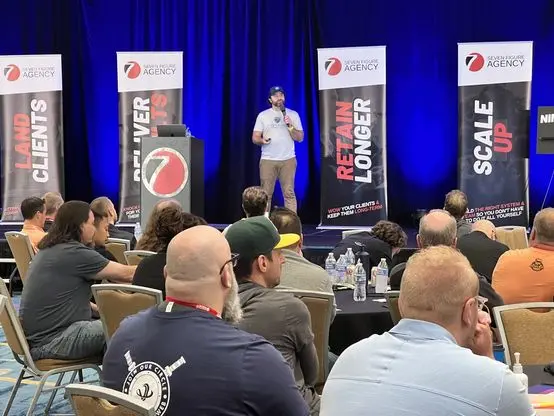




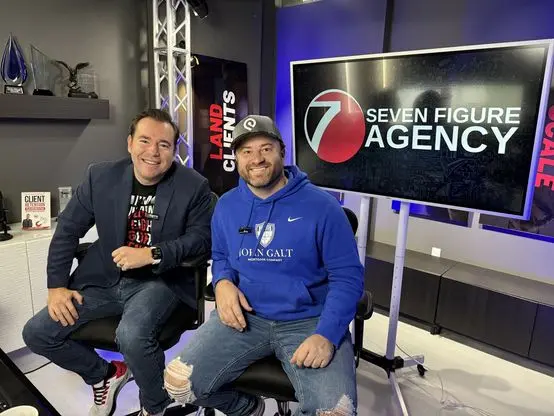


Editor’s Choice on TopMarketingAgencies.com
Platform Marketing is an Editor’s Choice pick in the Real Estate category on TopMarketingAgencies.com, the editorial directory of the best niche marketing agencies in the country. Listings are editorial, not pay to play. Agencies are scored on niche depth, tenure in the specialty, client retention, verifiable results, and transparency, then re-scored every year. You can read the full profile on the Platform Marketing listing or see how the category stacks up on the top real estate marketing agencies page.
Want Retention Like This?
Tim built a model where one realtor per market, weekly calls, and real community turned into 1 to 2% churn for years. The system he used is the one we teach.