You’ve read the articles. You’ve watched the videos. You’ve probably even played around with ChatGPT a few times. But you still haven’t actually implemented AI into your agency in any meaningful way.
I get it. It feels overwhelming. There are thousands of AI tools, hundreds of “AI agency” courses, and everyone seems to have a different opinion on where to start. Analysis paralysis is real – and it’s keeping most agency owners stuck on the sidelines while their competitors figure it out.
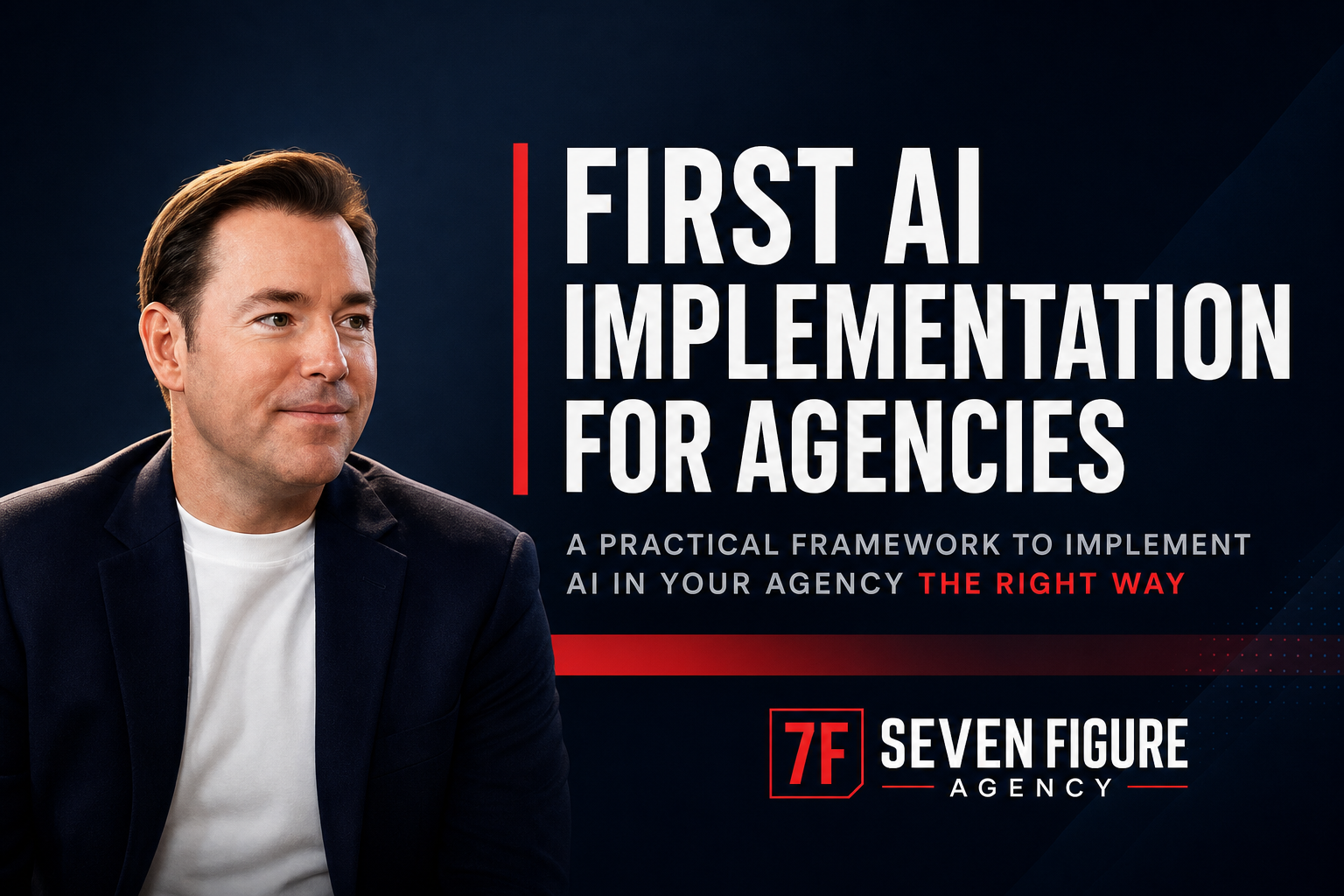
So let me make this simple. On the latest Scaling Together episode, I shared the one AI implementation I’d recommend every agency start with today – and it’s probably not what you’d expect.
Stop Trying to Do Everything at Once
The biggest mistake I see agency owners make with AI isn’t picking the wrong tool. It’s trying to implement AI across their entire business simultaneously.
They read one blog post about AI for content creation, another about AI for ad management, another about AI for client reporting, and suddenly they’re trying to overhaul every system in their agency at once. New tools for the content team. New tools for the media buyers. New tools for account management. New tools for sales.
That never works. It creates chaos, your team gets confused and frustrated, client deliverables slip while everyone’s learning new systems, and nothing gets implemented properly. Two months later, everyone’s back to doing things the old way because the “AI initiative” was too painful.
Pick one thing. Do it well. Get results. Then expand. That’s how you build lasting AI adoption – the same way you build any system in your agency.
The One Implementation I’d Start With: AI Brand Guides
If I had to pick a single AI implementation to start with – the thing that creates the most value with the least complexity – it’s this: create a custom brand guide for every client using AI.
Here’s what I mean. For each client in your agency, build a structured document that captures:
- Their brand voice – how they talk, their tone, their personality, the words they use and the words they’d never use
- Their unique selling propositions – what makes them different from every other plumber, lawyer, or dentist in their market
- Their service areas and service offerings – specific to their market, their geography, their specialties
- Their target customers – demographics, pain points, motivations, what keeps them up at night
- Their competitors and competitive positioning – who they compete against and how they differentiate
- Their success stories and testimonials – real results they’ve achieved for their customers
- Their company history, culture, and values – the stuff that makes them human and relatable
You probably already know most of this information. It’s scattered across intake forms, kickoff call notes, old strategy documents, and your account managers’ heads. The brand guide consolidates everything into one living document – and then it becomes the foundation for everything AI does for that client.
Why This Works as Your Starting Point
When you have a solid brand guide, every AI-generated output immediately gets better. Dramatically better. Content sounds like the client, not like a robot. Ad copy reflects their actual positioning, not generic marketing speak. Social media posts match their voice. Email campaigns feel personal.
Without a brand guide? You’re constantly fighting with AI to get decent output. You’re rewriting everything. You’re spending more time editing AI output than you would’ve spent writing it yourself. That’s the frustration most agency owners hit, and it’s why they give up on AI too early – they never built the foundation that makes AI work well.
The brand guide is what turns AI from “kind of useful sometimes” into “genuinely transformative.” It’s the missing piece that nobody talks about because it’s not as sexy as the latest AI tool demo.
How We Built Brand Guides at Plumbing & HVAC SEO
At our agency, we’ve built brand guides for every single client. And we use AI to help build them – which means the process itself is a great hands-on introduction to AI for your team.
Here’s the basic process we follow:
- Gather existing materials. Pull the client’s website content, their Google Business Profile, their social media profiles, any intake forms they filled out, your kickoff call notes, and any previous marketing materials they’ve shared. Get everything in one place.
- Feed it into your AI tool. Use Claude or ChatGPT to synthesize all of that information into a structured brand guide. Give it a template to follow so every guide is consistent across your client base. This is where the magic happens – AI is excellent at synthesizing scattered information into a coherent document.
- Review and refine with the client. Share the brand guide with the client for their input and corrections. This is actually a huge value-add – most clients have never seen their brand articulated this clearly. It builds trust, shows professionalism, and often sparks great conversations about their business that strengthen the relationship.
- Use the guide as context for everything. Every time you use AI for that client – content, ads, emails, social posts, whatever – you include the brand guide as context. The quality improvement is immediate and dramatic. Your team will notice the difference on day one.
The whole process takes 2-3 hours per client the first time. After that, the guide gets refined organically as you learn more about the client’s business. It’s a living document, not a one-and-done exercise.
AI-Powered vs. AI-Supported: Know the Difference
There’s an important distinction I want to make sure you understand. Being an AI-supported agency means you’re using AI tools here and there to help with specific tasks. You use ChatGPT to draft a blog post sometimes. You use an AI tool to analyze some data. It’s helpful, but it’s ad hoc. It’s not systematic.
Being an AI-powered agency means AI is woven into the fabric of how you operate. It’s part of your systems, your processes, your delivery model. It’s not a bolt-on tool that some people use when they remember – it’s built into the workflow that everyone follows.
The brand guide approach is actually your bridge from AI-supported to AI-powered. Because once you have that brand guide infrastructure in place, every other AI implementation you add works better, faster, and with less friction. The brand guide is the connective tissue that makes all your AI tools work together coherently.
Brian Stearman at Lawncare Marketing Mechanic built his agency to roughly $1M per year serving 8-10 new clients per month. Matt Coffy at PracticeBloom runs 100+ clients at $1.2M per year. These guys didn’t get there by doing things manually at every step. They built systems that scaled. AI is the next evolution of that same principle – and the brand guide is the system that makes it all work.
Your 30-Day AI Implementation Plan
If you want to get started right now – not next quarter, not when you “have more time,” not after you finish that one more course – here’s your plan:
Week 1: Pick your most established, longest-standing client. Gather all existing materials about their business. Create your first AI brand guide using the process above. Take notes on what works and what you’d change.
Week 2: Use that brand guide to produce one week’s worth of content using AI. Compare the quality side-by-side to your current output. Iterate on the guide based on what you learn. Start a second brand guide for another client.
Week 3: Build brand guides for your next 3-5 clients. Start training one team member on the brand guide creation process. Let them own it.
Week 4: Hand the brand guide process to your trained team member. They now own this for all new clients going forward. Start thinking about where else AI can plug in – ad copy, reporting summaries, client communications, competitive analysis.
That’s it. Four weeks, one focused initiative, and you’ll have a real AI workflow running in your agency. Not theory. Not a plan to make a plan. An actual implementation producing actual results that your team and your clients can feel.
Frequently Asked Questions
What’s the best first AI implementation for a marketing agency?
Build complete brand guides for each client using AI. This creates a foundation that makes every subsequent AI implementation more effective. It consolidates scattered client information into one document, dramatically improves AI output quality, and gives your team a practical, low-risk introduction to working with AI tools.
What should be included in an AI brand guide?
A complete brand guide includes brand voice and tone, unique selling propositions, service areas and offerings, target customer profiles with pain points and motivations, competitive positioning, success stories and testimonials, and company history and values. It becomes the context that AI uses to produce on-brand, client-specific output every time.
What’s the difference between an AI-powered and AI-supported agency?
An AI-supported agency uses AI tools occasionally for specific tasks – it’s ad hoc and tool-by-tool. An AI-powered agency has AI woven into its core systems and processes so it’s part of how work gets done by default. The brand guide approach is the first step in moving from supported to powered because it creates systematic infrastructure, not just individual tool use.
How long does it take to see results from AI implementation?
With the brand guide approach, you can see measurable quality improvements in AI-generated content within the first week. A full 30-day implementation plan gets the system running across multiple clients and starts building team capacity. The efficiency gains compound over time as your team becomes more proficient and you layer additional AI workflows on top of the brand guide foundation.
Ready to build AI into your agency the right way? Book a free strategy call and let’s create your roadmap.