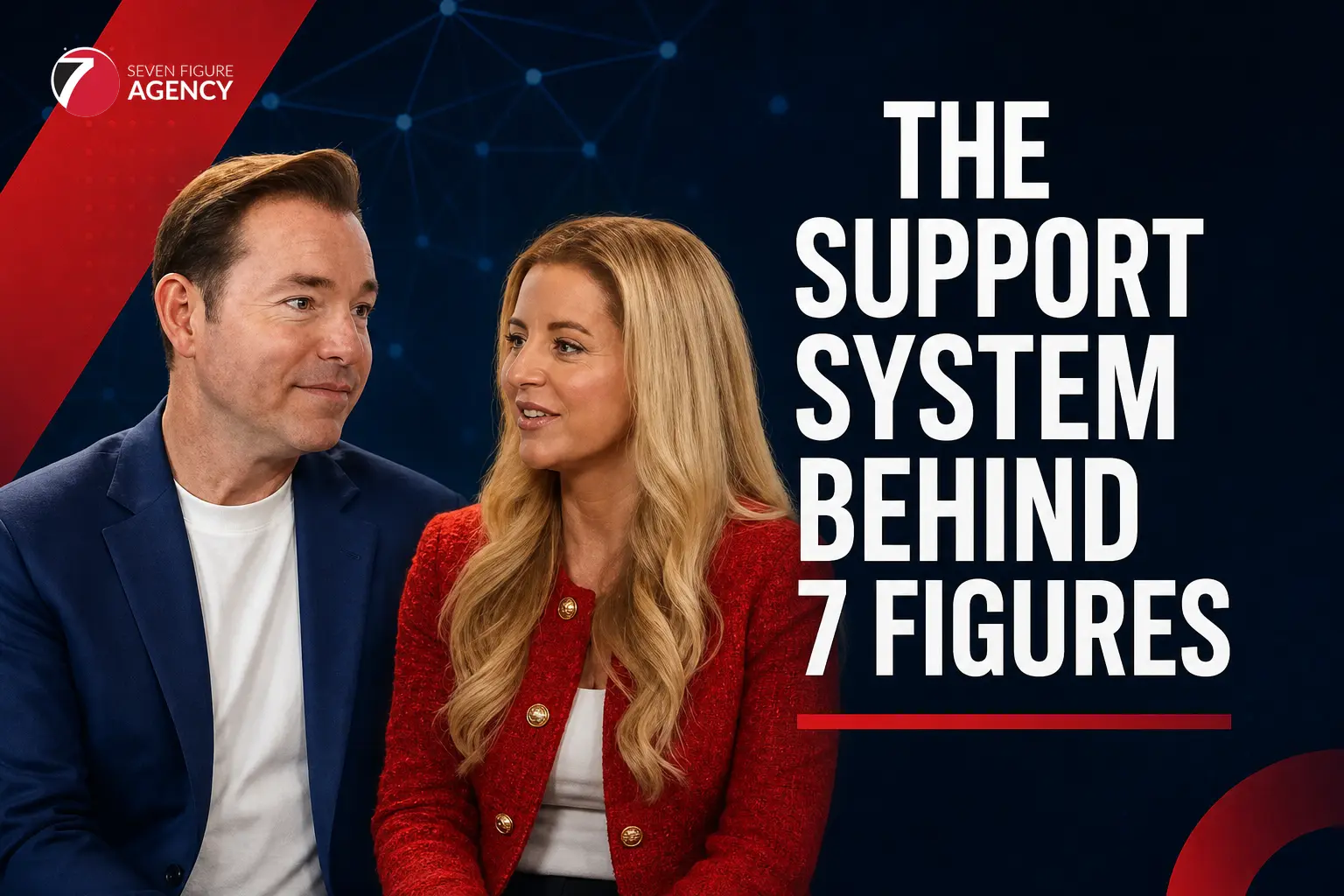
Nobody Talks About the Unsexy Infrastructure That Makes Multiple Seven Figures Possible
Everyone asks about the business systems. The funnels, the sales process, the team structure, the level 10 meetings. And yeah – those matter. But the question Yesenia and I get more than almost any other is simpler than that: “How do you actually do it? Two businesses, three kids, homeschooling – how does any of this work day to day?”
The honest answer is that it works because of infrastructure most people never see. Not business infrastructure – home infrastructure. The support system behind the businesses is what makes the businesses possible. Without it, everything falls apart, and we’d be back to Uber Eats every night, scattered calendars, and burning out by Thursday.
Here’s the full picture of what it actually takes to run two multiple seven-figure businesses as a couple – including the parts that don’t make it into the Instagram highlight reel.
Family First Isn’t a Slogan. It’s a System.
We homeschool our three boys. That was a big decision – we pulled them out of traditional schools where they were comfortable, had friends, and had routines. But the whole family was feeling stretched. Too many events, too much homework drama, too many competing schedules pulling everyone in different directions.
So Yesenia spent an entire summer building a homeschooling system from scratch. Not just picking a curriculum – building the entire operation. Today that looks like:
- Three teachers – one for each of our boys
- A PE coach who comes in the morning for fitness before academics start
- Social time on weekends with friends from their old school nearby
- Extracurriculars built into the weekly rhythm
It took three months to set up and it’s not cheap. But the trade-off is that our kids’ education runs on a system we control – not one that forces us to work around someone else’s schedule. And because the system runs without us hovering over it, Yesenia and I can actually focus on the businesses during business hours.
The House Manager Role
This is the hire that changed our daily quality of life more than any business hire we’ve ever made.
We brought on a house manager named Andreina who handles everything from cooking meals to doing laundry to opening Amazon packages to ordering groceries. Before that? We were doing Uber Eats all the time. Eating at our desks. Scrambling between meetings and household logistics.
Now we eat real meals that Andreina cooks. We eat quickly – sometimes at the desk, sometimes at a table – but the food is healthy and ready without either of us spending time on it. That sounds small, but when you’re running two businesses, the cumulative energy drain of “what are we eating tonight?” is real.
We also have Josh’s mom who helps with our youngest (who just turned five) during the daytime. At any given time, there are multiple people at our house – teachers, a coach, Andreina, family. It’s a full operation, and that’s the point. The home runs like a business so the businesses can run like businesses.
The Daily Rhythm Behind Two Seven-Figure Companies
People assume we have some elaborate biohacking morning routine with ice baths and journaling and 90 minutes of meditation. We don’t. Here’s what it actually looks like:
Morning
Josh: Wake up, do the X3 workout, take our five-year-old down from bed and get him ready for the morning, get all three kids set up for their day, then start work – usually on the walking pad while taking a meeting or reviewing the day.
Yesenia: Wake up, work out, have breakfast, say hi to the kids, sit down at the desk and start the day.
No elaborate rituals. Just movement, family, and then work.
The Work Day
Depending on the day, it’s either meeting-heavy (Monday for SFA, Wednesday for Plumbing & HVAC SEO) or white-space focused (content creation, strategic planning, podcast recording). Yesenia blocks Tuesdays and Thursdays for content. Fridays include a women’s mastermind and podcast recording at the studio.
Lunch is fast. We grab whatever Andreina made, eat it quickly, and get back to it. “Sit and chat is for after work,” as Yesenia puts it.
Evening
Around 5:30 or 6:00 PM, we unplug. Dinner together. Time with each other. Time with the kids. Bedtime stories. Prayers. Then our own wind-down time.
Yesenia breaks it down with a specific target: 20 minutes per day with each child, 20 minutes together as a couple, and some time alone. That’s not a lot – but it’s intentional, and it’s non-negotiable.
We’re Tired Too
This is the part I want to be real about, because I think the entrepreneur content world makes it seem like successful people have unlimited energy. We don’t.
Yesenia said it directly: “We’re tired too when the day is done. There’s no special elixir that makes us inhuman not to be tired.”
We work out. That helps. We eat healthy because Andreina cooks for us. That helps. We’ve eliminated a lot of the household friction that used to drain our batteries. But at the end of a day full of meetings, content creation, leadership decisions, and running two organizations – yeah, we’re exhausted.
The difference isn’t that we don’t get tired. It’s that we’ve built a system around ourselves that minimizes the things that drain energy without producing results. Cooking, cleaning, grocery runs, homework management, household logistics – all of that has been systematized or delegated so our limited energy goes toward the work that actually moves things forward.
The Business Foundation That Makes All of This Work
The home system only works because the business systems work, too. If we didn’t have a leadership team at Plumbing & HVAC SEO running the day-to-day, I’d be in operations meetings all week. If we didn’t have the right people in the right seats at Seven Figure Agency, every member question would route back to us.
Here’s how the two businesses are structured so they don’t consume every waking hour:
- Plumbing & HVAC SEO ($7M/year, 47 employees): Full leadership team handling sales, marketing, client onboarding, and operations. One weekly level 10 meeting on Wednesday at 10 AM. Leaders run their own department meetings without us. The whole thing was built with “business, not a job” as the operating principle from day one.
- Seven Figure Agency (350+ agencies served): Growing team with all meetings consolidated to Monday. Quick team huddle in the morning, then the level 10, then leaders break into their departments. Content and webinars happen on scheduled days.
The thought process from the beginning was always: build a business, not a job. Put a team in place that can run the day-to-day. Hire the right person in the right seat for every leadership position – head of sales, head of marketing, head of fulfillment. They become the leaders the rest of the team looks up to, and you get to focus on the visionary work.
Cohen and Justin at Cleaner Marketer went from $8K to $110K in 14 months by applying this same principle – building systems and hiring right so the founders could work on growth instead of being stuck in delivery.
What Agency Owners Can Take from This
You don’t need a house manager and a homeschooling team to apply these principles. But you do need to ask yourself: what’s draining your energy that isn’t producing results?
For some agency owners, it’s cooking and household tasks. For others, it’s inbox management, bookkeeping, or client communication that could be handled by an account manager. The principle is the same: identify the energy drains, build a system or delegate them, and protect your capacity for the work that actually grows the business.
Three things to evaluate this week:
- What non-business tasks are eating your work hours? Meal planning, errands, household management – anything that interrupts your productive time.
- What business tasks could someone else handle? Client updates, operational check-ins, scheduling, inbox management – run each through the filter of “does this need to be me?”
- Where is your energy going versus where it should go? Track your actual time for a week. Compare it to the three things a visionary should focus on: relationships, big ideas, and team culture. If there’s a mismatch, that’s your starting point.
Building freedom isn’t about working less for the sake of working less. It’s about building the infrastructure – at home and in the business – that lets you put your best energy toward the things that create the most impact.
If you’re ready to build those systems and stop being the bottleneck in your own agency, book a free strategy call and let’s map out what that looks like for your specific situation.
Frequently Asked Questions
Is a house manager realistic for someone who isn’t at seven figures yet?
You don’t need a full-time house manager to apply the principle. Start with a weekly cleaning service, a meal prep service, or a grocery delivery subscription. The goal is to remove household friction that’s eating into your productive hours. As revenue grows, you can layer on more support. The point isn’t the specific hire – it’s recognizing that your energy is a finite resource and protecting it.
How do you and Yesenia avoid bringing work stress into family time?
Structure. When we unplug at 5:30 or 6:00 PM, that’s the boundary. We’re intentional about 20 minutes with each child and time together as a couple. Is it perfect every night? No – we’re tired, and some days are harder than others. But having a defined end point to the work day creates a real separation. Without that boundary, work bleeds into everything.
How did you decide to homeschool instead of keeping traditional school?
The whole family was feeling the strain. Too many events, too much homework drama, schedules that didn’t align with how we wanted to live. Yesenia spent a full summer researching and building the homeschool system before we made the switch. It was a big investment – three teachers, a coach, extracurriculars – but it gave us control over our family schedule, which made everything else possible.
What’s the one thing that made the biggest difference in managing energy?
Eliminating decisions that don’t matter. When Andreina handles meals, groceries, and household logistics, that’s dozens of micro-decisions removed from our day. Decision fatigue is real, and the fewer low-value decisions you make before noon, the more mental energy you have for the high-value ones. A walking pad during meetings also helps keep physical energy up throughout the day.
Do you ever feel guilty about having so much help?
No – because the alternative is worse for everyone. Burned-out parents who are half-present at dinner and stressed about tomorrow’s meeting schedule aren’t better for their kids than parents who have support systems in place. The infrastructure isn’t about being lazy. It’s about being intentional with where your energy goes so you can be fully present when it counts.