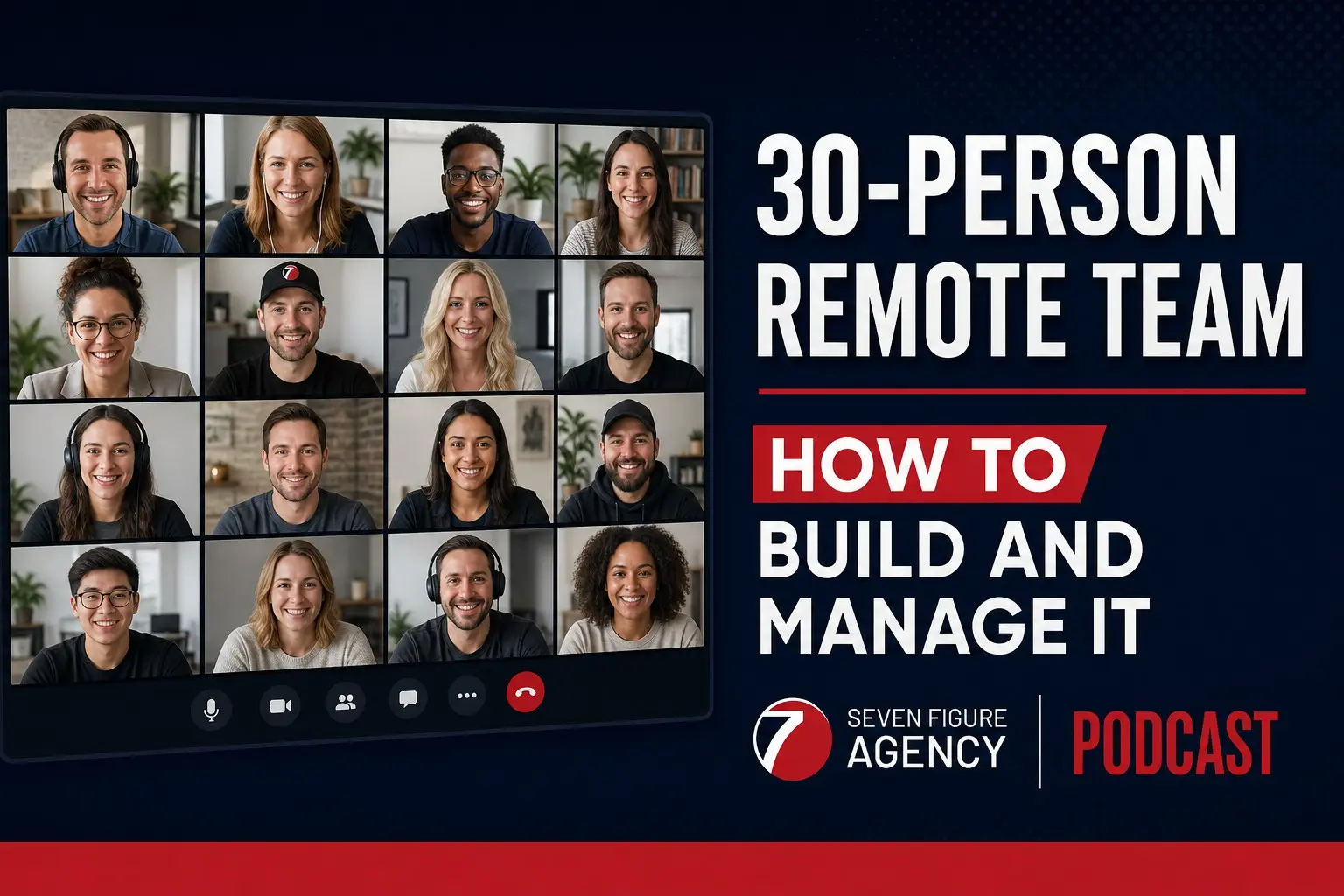
Tyler Williams runs a 30-person agency from outside Alaska – fully remote, a mix of onshore and offshore team members, serving 65+ plumbing clients across North America. No central office. No commute. No geographic limitations on who he can hire.
When Tyler came on the Seven Figure Agency podcast, I wanted to dig into how he actually makes this work at scale. Because here's the thing most agency owners miss about going remote: it's not about the tools. It's about the culture you build and the people you hire.
The Team Structure Behind $160K MRR
Mammoth Marketing runs about 30 people supporting roughly $160K in monthly recurring revenue across 65-67 plumbing clients. The team is a blend of onshore and offshore talent – people across multiple time zones, all working remotely.
Tyler's service stack is focused: website design, SEO, Google Ads, Meta Ads, and CRM automations. That focus matters when you're running a remote team. When every team member is serving the same type of client with the same core services, your SOPs actually work. Your training compounds. Your quality stays consistent even when people never sit in the same room.
Compare that to a generalist agency trying to manage remote teams across ten different service lines for twenty different industries. The complexity multiplies fast, and remote work makes it worse because you can't lean over and ask a question.
The Hiring Rule: Task People With Leadership Potential
Tyler shared a hiring principle on the podcast that I think every agency owner at the $100K+ MRR mark should hear: always hire task people with leadership potential.
What does that mean? You hire people who can execute – who can do the actual work of running campaigns, building websites, managing accounts. But you specifically look for the ones who show signs of being able to lead a team down the road.
This is how you scale without hitting the ceiling every time you need a new manager. Instead of hiring a manager and hoping they can learn the work, you hire doers and promote the ones who naturally step into leadership roles.
It's the same approach we recommend inside Seven Figure Agency. At the early stages, you need people who can produce. But if every hire is purely tactical with zero leadership DNA, you'll hit a wall where you personally have to manage every single person. That doesn't scale.
Culture on a Virtual Team: Daily Standups and Icebreakers
One of the hardest parts of running a remote agency is maintaining culture. When nobody shares an office, you have to manufacture the moments that happen naturally in person – the hallway conversations, the lunch runs, the spontaneous “hey, check this out” interactions.
Tyler solves this with a few deliberate practices:
Daily Standups
The team does daily standups – quick syncs where everyone shares what they're working on, what they're blocked on, and what's coming next. This isn't a 45-minute meeting. It's a fast alignment check that keeps people connected and accountable.
Icebreakers
Tyler incorporates icebreakers into team meetings. It sounds small, but when your team is spread across time zones and never meets in person, those two-minute “what's your favorite [X]” conversations build real relationships. People who know each other on a human level collaborate better than strangers who only interact through task assignments.
Internal Reviews
The team does internal reviews of their work – looking at campaigns, auditing deliverables, and giving each other feedback. This serves two purposes: quality control (catching issues before clients see them) and team development (everyone learns from each other's work).
The Tool Stack That Runs a 30-Person Remote Team
Tyler keeps his tool stack tight. Here's what Mammoth Marketing uses to run operations:
- Google Workspace – email, docs, sheets, the basics. Nothing exotic, just the tools everyone already knows.
- ClickUp – project management and task tracking. With 65+ clients and 30 team members, you need a system that shows who's doing what and whether it's on track.
- Google Meet – video calls for standups, client meetings, and team syncs.
- Claude AI – Tyler uses AI (specifically Claude) to review meeting recordings and surface client pain points. More on this in a moment.
- Metricool – for scheduling and distributing social media content across platforms.
Notice what's not on this list: no elaborate tech stack with 15 tools that each solve one problem. No custom-built internal platform. No $10,000/month in SaaS subscriptions. Tyler runs a $2M+ agency on standard tools that anyone can set up.
The lesson: your tools don't create your advantage. Your systems do. The tool is just where the system lives.
Using AI to Surface Client Issues Before They Become Problems
This might be the most forward-thinking part of Tyler's operation. He uses AI – Claude specifically – to review meeting recordings and surface client pain points that human account managers might miss.
Think about what that solves. In a 30-person agency managing 65+ clients, you've got dozens of calls happening every week. Account managers have good days and bad days. They might miss a subtle complaint, an unspoken frustration, or a question that signals the client is considering leaving.
By feeding meeting recordings through AI, Tyler creates a safety net. The AI catches patterns across conversations – topics that keep coming up, sentiment shifts, questions that suggest a client doesn't understand what's being done for them. That intelligence flows back to the team so they can act on it before it becomes a cancellation.
This is where the industry is heading. The agencies that figure out how to use AI for operational intelligence – not just content generation – will have a massive retention edge.
Going Fully Remote: How Tyler Made the Move
Tyler started Mammoth Marketing in Fairbanks, Alaska. That's a town of about 32,000 people – not exactly a deep talent pool for digital marketing professionals.
Going remote wasn't a pandemic reaction for Tyler. It was a strategic necessity. He knew he wanted to serve plumbing companies nationally, and he knew Alaska's labor market couldn't supply the team he needed. Remote work opened up hiring to anyone, anywhere.
The mix of onshore and offshore team members gives Tyler both quality and margin. Some roles – especially client-facing account management – benefit from native English speakers in U.S. time zones. Other roles – campaign management, design, content production – can be filled with talented offshore team members at a fraction of the cost.
For agency owners thinking about going remote or hiring offshore, Tyler's approach is a solid template: start with onshore for client-facing roles, add offshore for execution roles, and build the systems (standups, icebreakers, reviews) that keep everyone connected regardless of location.
The Takeaway for Scaling Agency Owners
Tyler's team model proves that you don't need a physical office to run a $160K MRR agency with 65+ clients. But remote doesn't mean unstructured. Here's what makes it work:
- Niche focus – everyone on the team serves plumbing clients. One niche means repeatable SOPs, consistent training, and shared expertise.
- Hire doers with leadership DNA – task-first hiring with an eye toward future managers.
- Manufacture culture – daily standups, icebreakers, and internal reviews replace the spontaneous office interactions remote teams lose.
- Keep tools simple – Google Workspace, ClickUp, Google Meet. Nothing exotic.
- Use AI for operational intelligence – review meeting recordings to catch client issues before they escalate.
If you're at the stage where you're building out your team and trying to figure out how to structure a remote operation, watch the full interview with Tyler – he goes deep on every aspect of how Mammoth Marketing runs.
And if you're an agency owner looking to build a team and scale past the $50K-$100K MRR mark without burning out – book a free strategy call. We've helped hundreds of agencies build the systems, teams, and processes that create real freedom.
Frequently Asked Questions
How many employees does a $160K MRR agency need?
Tyler Williams runs Mammoth Marketing with about 30 team members supporting $160K MRR and 65+ clients. That's roughly one team member per two clients – though the exact ratio depends on your service stack, level of automation, and whether you use offshore talent for some roles.
Should agency owners hire onshore or offshore team members?
Tyler uses a mix of both. Client-facing roles (account managers, strategists) tend to be onshore for time zone and language alignment. Execution roles (campaign management, design, content) can be filled offshore at a lower cost without sacrificing quality. The key is building systems that keep everyone aligned regardless of location.
How do you maintain culture in a remote agency?
Tyler uses three main practices: daily standup meetings for alignment and accountability, icebreakers during team calls to build personal connections, and internal work reviews where team members give each other feedback. These manufactured touchpoints replace the organic interactions that happen in a physical office.
What project management tool should agencies use for remote teams?
Tyler uses ClickUp to manage 65+ client accounts across 30 team members. The specific tool matters less than having a single system where everyone can see task status, deadlines, and ownership. Google Workspace handles communication and documents, while Google Meet handles video calls.
How can agencies use AI in their operations?
Tyler uses Claude AI to review meeting recordings and surface client pain points that human team members might miss. This creates a safety net across dozens of weekly client calls – catching sentiment shifts, recurring complaints, and early warning signs of churn before they become cancellation requests.