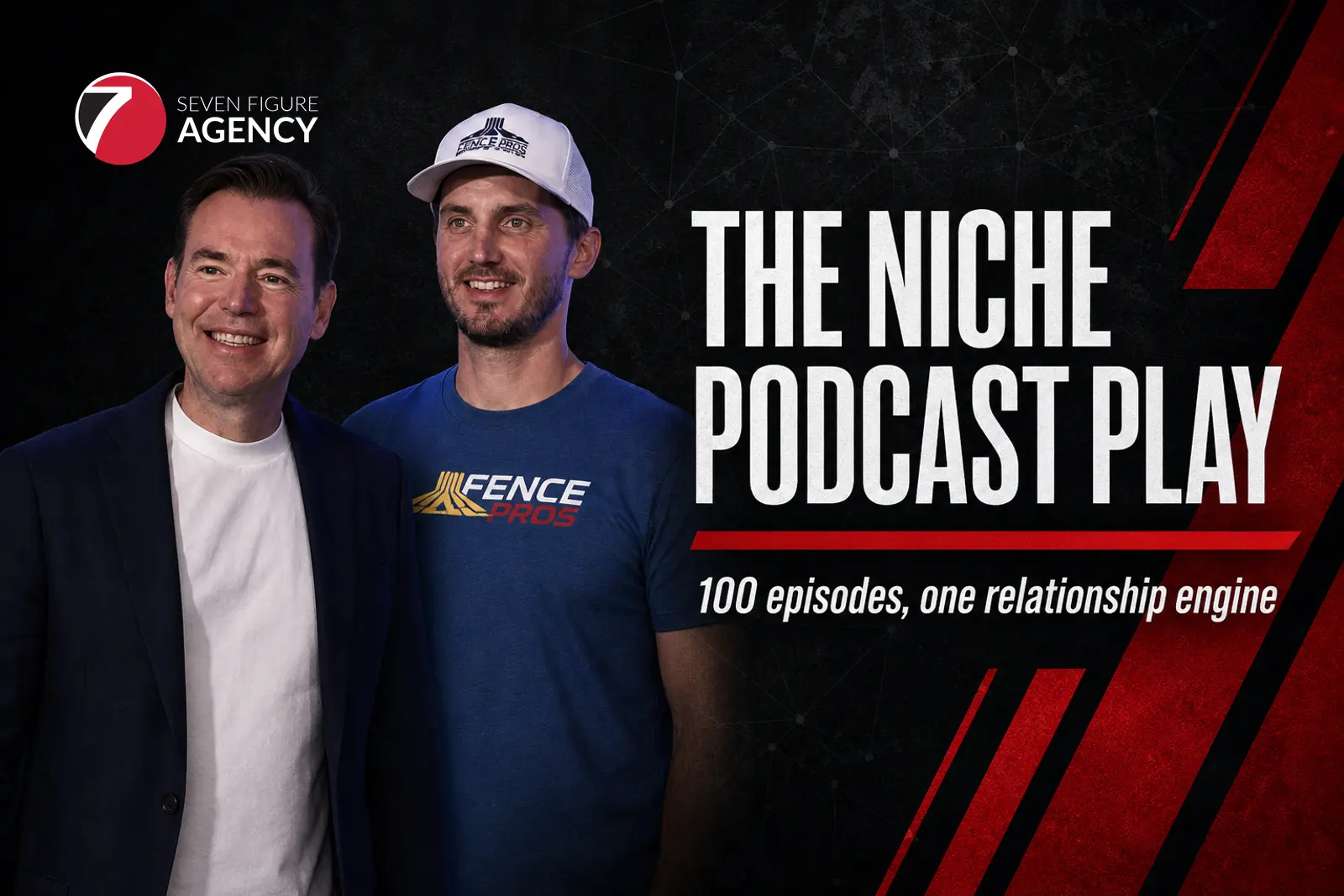
Ask Alex Danner which single play he would credit most for taking his agency to $160,000 per month in recurring revenue and he does not say SEO. He does not say ads. He says the podcast.
“I don't think there's any possibility of growing anywhere close without having that.”
He has roughly 100 episodes now at Fence & Deck Marketers, serving fence and deck contractors. What follows is exactly how he runs it, including the parts he keeps deliberately lazy.
Alex's full story, from a $200 SEO client to $160K MRR, is here.
The podcast is not a content play. It is a relationship engine.
Most agency owners think about a podcast in terms of downloads. That framing kills it, because a niche B2B show aimed at contractors is never going to post big audience numbers, and you will quit when the stats disappoint you.
Alex uses it as the reason to get on a call with anyone in his industry. Association leaders. Industry coaches. Manufacturers. Vendors. Big operators. Prospects.
The offer is irresistible in a way a sales call never is: I want to feature you, promote you, and make you look good to your industry for 45 minutes. Nobody hangs up on that.
His experience: “Some people won't respond, but if I get ahold of them, nobody says no really. Everybody pretty much will say yes if you ask in person, you make it easy to schedule, and all that stuff.”
Then he compares a recorded Zoom conversation to meeting in person: “Maybe not as good as in person, but it's pretty close. People can have a pretty good idea who you are.” A one-hour recorded conversation does most of the work a conference handshake does, and you can do several a week from your desk.
Who he books, and it is not just prospects
Alex's guest list is intentionally wide. Anyone who can bring value to his audience gets an invitation.
- Prospects. He has run targeted pushes, for example pulling the attendee or member list from a manufacturer event he knew was high quality, then inviting those owners onto the show and selling from the relationship afterward.
- Industry influencers. Coaches and association figures whose audience overlaps his exactly. Those episodes turn into invitations to their events and joint ventures.
- Vendors and manufacturers. They know every contractor in the space and are motivated to be seen.
- Tactical guests. Operators who can teach something his contractor audience actually needs.
Notice the second category. That is where the real compounding happens. Get in with someone who carries weight in the industry, and referrals start arriving from people who have never spoken to you.
Alex has offered paid joint ventures to many of those people. Nearly all said no to the money and stayed involved anyway. His read on it now: they probably regret turning down the commission.
The workflow is deliberately light
This is the part I want every agency owner to read twice, because the reason most agency podcasts die is over-production.
Booking: Ask in person when possible, make scheduling easy, and give guests as little to prepare as possible. Alex used to send information packets. He stopped. Exactly one guest in 100 episodes asked for a pre-call. His line to guests: “It's just like this. We have a conversation. I didn't have to prep for this. I figured you're gonna ask me questions and I answer them.”
Prep: He has a standard question page. Beyond that, he feeds background about the guest into ChatGPT, gets a batch of questions, skims them, and calls it good. During the recording he types follow-up questions as they occur to him and asks the guest to elaborate on answers. That is the entire prep process.
Recording: Zoom today. He wants to move to Riverside for the quality. Do not let platform selection delay episode one.
Frequency: The goal is weekly. Reality is a couple per month, because you run out of people, reset, and refill the pipeline. Weekly target, monthly floor, and you still stack 100 episodes over a few years.
Syndication: one recording, many placements
Alex records video and pushes it everywhere:
- Audio goes to Buzzsprout, which distributes to all the podcast platforms
- Video goes to YouTube and the social channels
- Emmet on his team cuts clips out of every episode for social posts
- The best clips get run as paid ads
That last step is the one almost nobody does, and it is the smartest thing in the interview.
The clip-to-ad play
When Alex interviews someone every contractor in the niche recognizes, his team cuts the strongest moment of that conversation and runs it as an ad on a dollar-a-day budget.
His logic, in his own words: “Just put my face next to somebody that everybody knows and then maybe they'll just kinda connect the lines.”
That is borrowed authority, and it is cheap. Your prospect scrolls past a video of you in conversation with a name they trust. You have not made a claim about yourself. You demonstrated the association. Repeat that across dozens of episodes and a couple of years, and you become a familiar face in the industry rather than a stranger sending cold emails.
Alex is honest that he cannot precisely measure it. He also cannot argue with $160K MRR.
Where the podcast fits in the wider system
The podcast does not work alone. It is one lever inside a system that is all running at the same time:
- Industry events and a booth, where he meets guests in person and books recordings on the spot (the booth playbook is here)
- Monthly webinars, which he keeps running even after sessions where nobody showed up
- A nurture email sequence that runs constantly. One client signed recently and told Alex the emails were the reason, the first time anyone had said that out loud
- Speaking slots at industry conferences, often sourced from podcast relationships
- A published book
- SEO and paid ads underneath all of it
Alex calls it the omnipresent system, and he sells the same idea to his own clients. His warning is that it is hard to quantify, and that is precisely what makes people quit. SEO gives you a clean return number. Google Ads gives you a clean number. Being everywhere in your industry does not, right up until prospects start arriving already sold.
What he had to do instead of measuring: “Just kind of having faith like it's just gonna work out.” Then the honest gut check: “Why would I think I'm smarter than you to be able to outsmart this when you did this and everybody else did this? Why would I be special?”
How to start your niche podcast this month
- Write down the 20 most influential people in your niche. Association leaders, coaches, manufacturers, large operators, event organizers.
- Ask in person or by phone where you can. In-person asks convert dramatically better than email.
- Make it one click to schedule and give them almost nothing to prepare. Friction kills bookings.
- Build one standard question list. Add three to five guest-specific questions generated from a quick AI pass.
- Record on the tool you already have. Zoom is fine. Upgrade later.
- Publish audio through a distribution host and video to YouTube. Every episode, no exceptions.
- Have someone cut two to four clips per episode. Post them, then put a small daily ad budget behind the ones featuring recognizable names.
- Commit to a full year before judging it. Relationships compound, downloads do not matter.
One hundred episodes sounds like a mountain. It is two conversations a month for four years, and it produced the most durable client acquisition channel in Alex's business.
Building this out as part of a complete client acquisition system, with the events, webinars, and positioning stacked around it, is exactly the work we do with members in the Seven Figure Agency coaching program.
Frequently Asked Questions
Do you need a big audience for a niche agency podcast to work?
No. The value is in the relationships you build with each guest, not the download count. Alex treats it as a reason to get influential people in his industry into a recorded conversation, which converts into referrals, joint ventures, speaking slots, and clients.
How often should an agency owner publish episodes?
Target weekly, accept a couple per month. Alex aims for one a week and averages a few per month because guest pipelines run dry and need refilling. Consistency over years matters more than perfect cadence.
What equipment and software do you need to start?
Alex records on Zoom and distributes audio through Buzzsprout, with video on YouTube. He wants to move to Riverside for better quality but did not wait for it. Start with the tools you already own and upgrade once episodes are consistent.
How do you get busy industry leaders to say yes?
Ask in person at events when you can, make scheduling frictionless, and give them almost nothing to prepare. Alex has had exactly one guest in about 100 episodes request a pre-call. Being featured and promoted is an easy yes.
How do you turn podcast episodes into leads?
Cut clips from every episode for social, and run the clips featuring recognizable industry names as low-budget ads. That puts your face next to people your market already trusts. Guest relationships also produce direct referrals, event invitations, and speaking opportunities.
Can you invite prospects onto your podcast?
Yes, and Alex does it deliberately. He has targeted lists from high-quality industry events, invited those owners onto the show, and sold from the relationship afterward. Lead with value in the episode and keep any pitch to the end or a follow-up conversation.