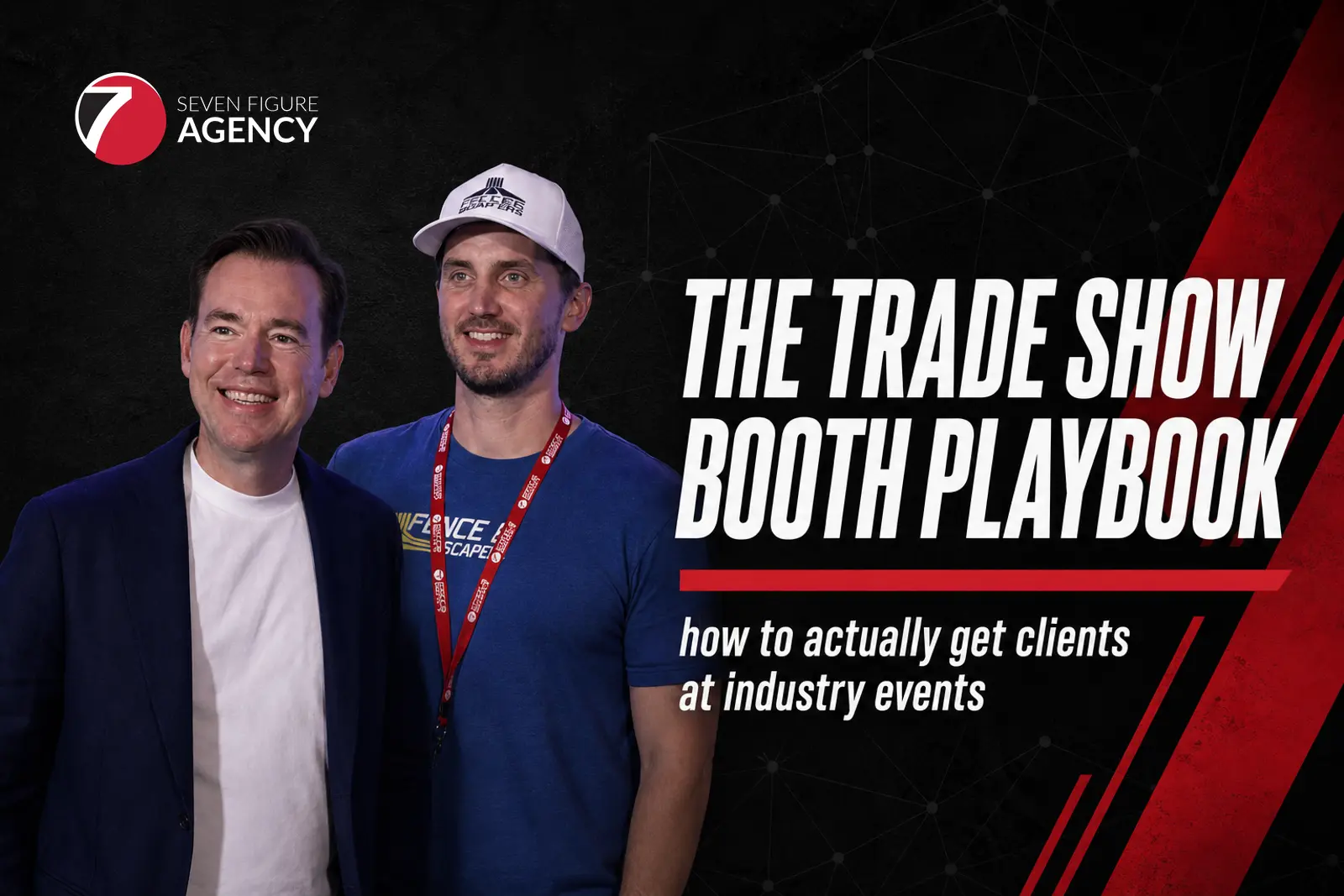
There is a spinning bar hanging at a fence industry trade show booth. Hang on for 100 seconds and Alex Danner hands you a $100 bill from a stack he brings to every show. Five people have done it.
That bar is one of the reasons his agency, Fence & Deck Marketers, is at $160,000 per month in recurring revenue with 26 full-time team members. Not because of the gimmick itself. Because of what the gimmick lets him do for eight hours straight while every other vendor stands behind a table asking people if they want to talk about marketing.
Alex is a self-described big-time introvert with a software engineering background. Trade shows are the last place he wanted to be. They became his single biggest growth lever. Here is his actual approach, pulled from our interview.
Alex's full story, from a $200 SEO client to $160K MRR, is here.
Why the events mattered more than the ads
Before events, Alex was running Facebook ads and doing SEO and hoping the leads would compound. His words: “It was very stagnant at that point. We weren't getting a whole lot of traction.”
The plan he kept hearing inside Seven Figure Agency asked for the uncomfortable stuff. Get into the industry. Set up a booth. Speak on stage. He resisted, then did it.
His reasoning after the fact is worth sitting with: “If you're just some internet marketing guy and they just see your face everywhere but they've never met you in person, to me it only goes so far.”
Contractors buy from people they have met. Everything else you do, the SEO content, the retargeting, the emails, works harder after the handshake than before it.
The booth math nobody wants to do
Every agency owner runs the same calculation and talks themselves out of it. Five to ten thousand dollars to get set up. What if we do not sign a client?
Alex ran that math too. His resolution: “Well, hopefully we get at least one.” And they usually did.
Run the real numbers before you talk yourself out of it. At $2,000 to $4,000 per month, one client from a $7,000 show pays the show back in two to three months and then keeps paying for years. One client is not the ceiling. It is the break-even.
And the clients are the smaller half of the return. The relationships with the association leaders, industry coaches, manufacturers, and event organizers are the part that compounds into speaking slots, joint ventures, and referrals for the next five years.
Rule 1: have a reason for people to walk up to you
Alex got the idea from Brian Niebler, a mentor of his who used a hanging challenge at roofing shows. Alex called the company that made the equipment, found out the owner was going out of business, and bought the last unit off him, the one he had used himself.
How it works at the booth: the bar spins on bearings, so it is far harder than it looks. Hang for 100 seconds, win $100 cash. Alex brings a stack of hundreds. Almost nobody wins.
What it actually does for him:
- People come to you, so you never have to open with “want to talk about marketing?”
- Groups form. Guys challenge each other. Someone drags a friend over to try.
- You get content out of it. Real footage of real people in your niche having fun at your booth.
- The day goes faster and it stops feeling awkward, which matters if you are not a natural at working a room.
- After they fail, they are warm. That is when the conversation happens.
The specific gimmick does not matter. Hanging challenge, pull-up bar, putting green, spin the wheel, cornhole. What matters is that you are not the boring vendor handing out flyers.
Rule 2: qualify off the name badge
Once someone is at the booth, Alex reads the badge. Company name, role. He is looking for owners of fence and deck companies, not employees, not other vendors.
He is selective on purpose: “If you got a big group, you kinda have to be selective of who you wanna go after. Before you know it, the whole group will be gone.”
The opener is small and human. You have a deck company or a fence company? Are you the owner? How did last year go? If it is going well, that rolls into the offer: if you want us to look at it, we will do a custom audit.
He does not have a script and freely admits he is probably not pushy enough. This is the honest version of trade show selling. Simple qualifying questions, a real conversation, and one clean next step.
Rule 3: book the appointment in the booth or lose the deal
This is the hardest rule in the interview and the one most agency owners break.
Do not collect a business card. Do not take an email and phone number and tell yourself you will call them when you get back. In Alex's words: “That's a guaranteed disaster.”
Get them on the calendar while they are standing in front of you. Discovery call booked, date and time. They may show, they may not, but a booked appointment converts and a business card in a lanyard pocket does not.
The same rule applies to podcast invitations. If you meet someone with influence in the industry, schedule the recording right there.
Rule 4: never work the booth alone
Alex brings Matilde from his team to every show. She is more organized, more naturally social, and she runs logistics. His admission: “Frankly, without her, I probably wouldn't even sign up for some of these shows 'cause I would forget.”
Two people is a structural requirement, not a luxury. One person holds the booth while the other walks the floor hunting the specific people you came to meet. If you are solo, you are stuck behind the table all day and the relationship half of the trip does not happen.
Rule 5: know who you are hunting before you land
Alex's first answer when I asked how he approaches events was not about the booth at all. It was about deciding in advance who you need to meet.
Before the show, identify the people with influence: association leaders, industry coaches, the biggest operators, manufacturer reps, and whoever runs education for the conference. Learn their faces. Then work the floor and the after-hours mixers looking for them.
The ask when you find them is not a pitch. It is an invitation onto your podcast. That is a low-friction yes that starts a real relationship. Alex: “Nobody says no really. Everybody pretty much will say yes if you ask in person and you make it easy to schedule.”
Rule 6: getting on stage is a follow-up game, not a talent game
Alex now speaks at industry events. Here is how that actually happens:
- Find the person who runs education for each event. Someone owns the agenda. Find out who.
- Be relentless about following up without being annoying. Call them. Same discipline as a sales follow-up.
- Submit through the process. Most events let you submit multiple session proposals at once, often around five.
- Build a genuinely good presentation and send it. On Alex's team, Emmet helps build the decks.
- Meet the education person in person if they are at the show. Introduce yourself. Send a gift afterward.
On that last point, Alex applies the gifting strategy well beyond client relationships. A thoughtful $100 gift to someone who controls a stage is not a big spend. “It's not the end of the world to spend 100 bucks on something.”
He is also blunt that it usually comes down to knowing somebody. Which is exactly why rules 5 and 6 stack: you meet the person at the booth or the mixer, get them on the podcast, and then the speaking submission lands on the desk of someone who knows your name.
What the flywheel looks like once it is running
Here is the full loop Alex is running now:
- Book the show and bring two people
- Draw a crowd with something fun so conversations start themselves
- Qualify off the badge, ask about their year, offer a custom audit
- Book the appointment in the booth
- Hunt the influencers on the floor and after hours, invite them onto the podcast
- Turn podcast guests into joint ventures, referrals, and speaking slots
- Speak at the next event, which makes the following year's booth conversations easier
- Clip everything into ads and social so your face is in front of the niche between shows
Alex now says yes to essentially every show. In the beginning he could not afford to. Today, if he does not sign a client at a show, that is fine, because the network he builds there is worth more than the deal.
His actual take on it: “As I was going to the conferences and getting out of my comfort zone, speaking on stage, it just kinda snowballed from there.”
If you are dreading your first booth
Alex did too. He is an introvert who would rather be behind a keyboard, and he still built the biggest part of his growth engine standing in a convention hall.
Three things make the first one survivable. Bring a teammate. Bring something fun so you are not the one initiating every conversation. Have exactly one goal, which is booked appointments and podcast recordings, not signed contracts.
Then do it again. His words on what got him there: “I'm gonna do all the pieces, and I'm just gonna go for it.”
Want the full playbook for owning your industry, from event selection to booth setup to the follow-up sequence? That is a core part of what we build with members inside the Seven Figure Agency coaching program.
Frequently Asked Questions
Are trade shows worth it for a marketing agency?
They are when your agency serves one industry. A booth typically runs $5,000 to $10,000 all in, and at $2,000 to $4,000 per month per client, a single signed client pays it back within a few months. The bigger return is the relationships with association leaders, coaches, and event organizers that turn into speaking slots and referrals.
What should you put at your booth to attract people?
Anything competitive and fun that creates a crowd. Alex uses a spinning hanging bar with a $100 cash prize for 100 seconds. Pull-up challenges, putting contests, and prize wheels work the same way. The goal is to remove the awkward cold open and get people talking to you first.
How do you turn a booth conversation into a sales appointment?
Qualify with the name badge and a couple of easy questions, then offer a custom audit of their market and book the discovery call while they are standing there. Never settle for a business card with plans to follow up later.
How do you get speaking slots at industry conferences?
Find whoever runs education for the event, follow up persistently, submit through their proposal process (many accept multiple submissions), meet them in person at the show, and send a thoughtful gift. Most stages come down to being known by the person who owns the agenda.
Do you need to bring a team member to a trade show?
Yes. One person holds the booth while the other works the floor to find the specific people you came to meet. Working the booth alone means you never leave the table and the relationship-building half of the trip never happens.
What if you are an introvert?
Alex is one, and he is candid that speaking, booths, and mixers were all uncomfortable. Bring a teammate, use an activity so prospects approach you, and measure the trip by booked appointments and podcast recordings rather than closed deals.