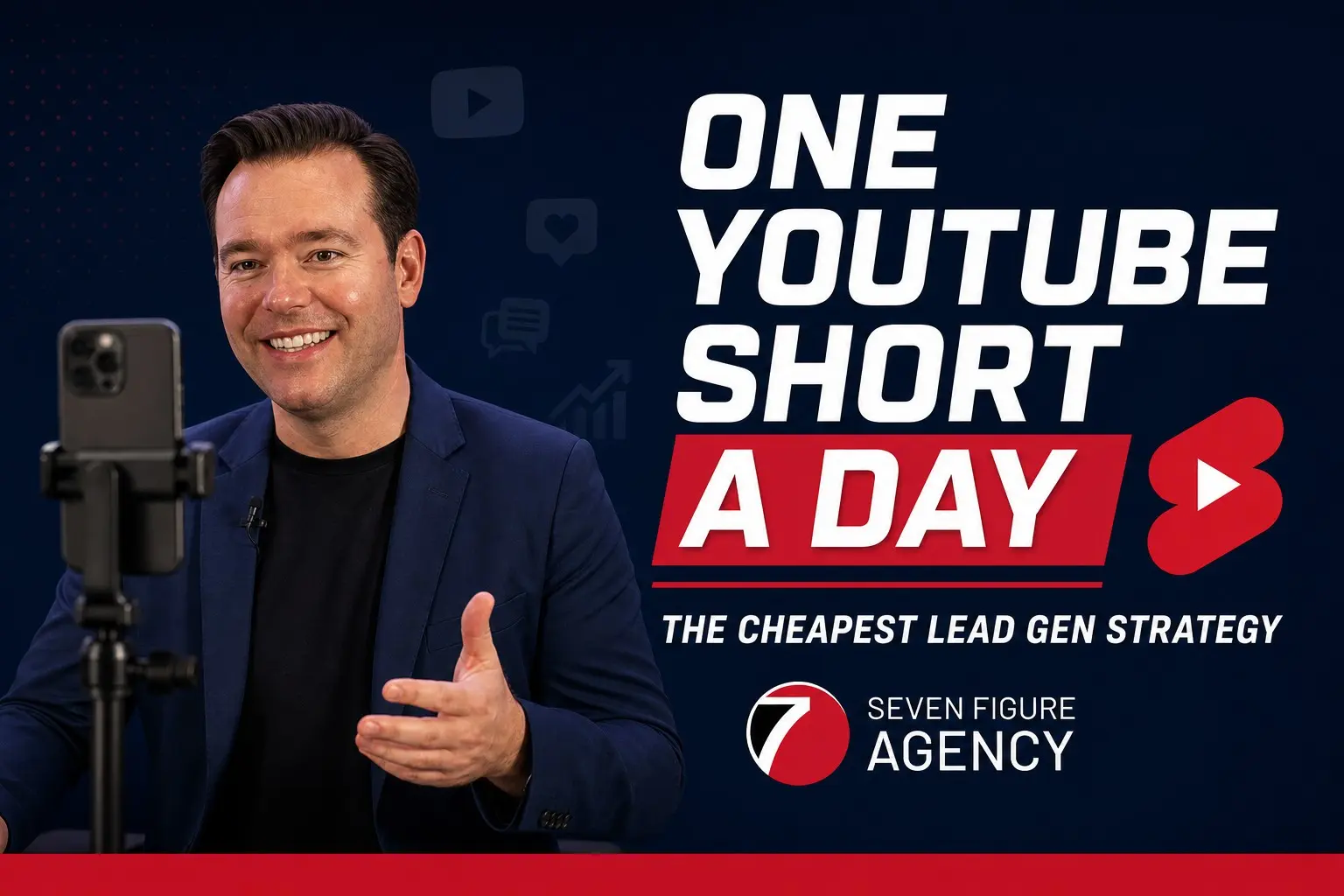
Tyler Williams posts one YouTube Short per day. Sometimes two. That's it – that's the strategy that turned into his cheapest and most effective lead generation channel, beating out paid ads, referral partnerships, and everything else he'd tried over 10 years of running an agency.
No professional studio. No scripts written by a copywriter. No $5,000-a-month video production team. Just Tyler, his phone, and something worth saying to plumbing company owners.
When Tyler came on the Seven Figure Agency podcast, he broke down exactly how this content strategy works, how he ramped it up from three times a week to daily, and why roughly 50% of the leads that come into Mammoth Marketing already know who he is before they ever fill out a form.
How It Started: Three Shorts a Week
Tyler didn't launch with a daily posting schedule. He started with three short-form videos per week – simple, vertical videos where he talked directly to plumbing company owners about marketing.
“The strategy at first was consistency,” Tyler explained. “Like, that was the first thing – how can I do this? I think we started with three times a week, just one short three times a week.”
He had a video producer in Alaska at the time who helped with basic editing. Nothing fancy. The focus was on showing up, not on production quality.
Over time, as Tyler got further out of day-to-day operations at Mammoth Marketing, he ramped up the volume. Three a week became five. Five became daily. Now the team posts at least one short per day, sometimes two, plus a static post distributed across every social channel using Metricool.
The Content Formula: Turn Customer Tips Into Videos
Here's Tyler's actual content creation process – and it's simpler than you'd expect:
Every time he gives a plumbing company owner a tip or insight during a meeting, a call, or a strategy session, he turns that into a short video. Every time he answers a question a prospect asks, that becomes content. Every time he sees a pattern across his 65+ clients, he films a short about it.
“You probably give 10 to 20 tips daily to customers,” Tyler said on another one of his episodes. “Start logging and start making videos around them. Turn that camera around and give the same advice.”
The format is dead simple:
- Vertical video (portrait mode)
- Tyler talking directly to camera
- One tip, one insight, one piece of advice
- No fancy equipment – phone only
- Post to the business page, then share to personal page
He also batches content. At one point, Tyler pulled every question he'd been asked by plumbing company owners, sat down in an afternoon, and recorded 60 shorts in one session. His editors cut them up and his assistant schedules them out.
“I just record and hand the footage off to the editors and say, okay, go make this,” Tyler said. “And then actually my assistant is the one who schedules at this point.”
Which Platforms Actually Work
Tyler posts across YouTube, TikTok, Instagram, and Facebook. But here's what he's found: the vertical short-form video format performs on all of them because each platform is pushing short-form content in their algorithm.
His approach: create the content once as a vertical short, then blast it across every platform using Metricool as the distribution tool. No platform-specific editing. No custom thumbnails for each channel. One piece of content, maximum distribution.
On top of the daily shorts, Tyler also does a longer YouTube video once a week to build a different kind of presence. He sees YouTube as a separate ecosystem worth investing in – the shorts drive awareness and the longer videos build deeper trust.
He's also constantly testing formats. Morning walk videos versus studio-style talking head versus day-in-the-life content. His finding so far: a blend of both polished and casual content works better than committing to just one style.
50% of His Leads Already Know Him
Here's the stat that should stop you in your tracks: Tyler estimates that roughly 50% of the leads who come into Mammoth Marketing already know who he is through some form of online content before they ever reach out.
“Mostly I would say – I'm guessing here because I don't have the number in front of me – probably about 50% actually know of me through some form of influence on the internet somewhere,” Tyler shared.
Think about what that does to your sales process. Half of your pipeline already trusts you before the first call. They've watched your videos, they've heard your take on plumbing marketing, they've seen you show up day after day. By the time they book a consultation, they're not shopping – they're confirming.
That's the power of personal brand content for agency owners. And it didn't come from a viral hit or a lucky break. It came from one short a day, every day, for years.
Why Personal Brand Content Overtook Referral Partnerships
Tyler built Mammoth Marketing's initial client base through a JV partnership with his brother's plumbing company, Prospector Plumbing. That relationship opened doors – his brother was well known in the plumbing industry, and the association gave Tyler instant credibility.
But over time, Tyler's own content started generating more leads than the referral partnerships. His personal brand became the primary driver of new business.
This is something I see over and over with agency owners inside Seven Figure Agency. The agencies that build a personal brand around the founder – through content, speaking, podcasting, social media – eventually outpace the ones relying solely on referrals, cold outreach, or paid ads. Referrals are great. They're just not predictable. Content is.
The Frequency Play: Hit Them 5 to 30 Times
Tyler doesn't just post content and hope for the best. He has a deliberate strategy around impression frequency in tight service areas – the same principle his agency uses for plumbing clients.
“I don't want one impression on a potential customer,” Tyler said. “I want like 5 to 15, and in some cases 30. Hit them once a day and say, hey, I'm a plumber you can trust.”
He applies this same thinking to his own agency's content. By posting daily, he stays in front of plumbing company owners who are following him. They see his face, hear his voice, and absorb his perspective on marketing before they ever consider hiring an agency.
It's frequency over reach. And for niche agency owners serving a specific vertical, that math works beautifully. Your total addressable audience isn't millions of people – it's a few thousand plumbing company owners. Reach them repeatedly with useful content and you become the obvious choice.
How to Apply This to Your Agency
Here's what Tyler's approach comes down to for any agency owner watching this:
- Start with three videos a week. Vertical. Phone only. Talk to your niche about what you know.
- Mine your conversations for content. Every question a client asks, every tip you give, every pattern you notice – that's a video.
- Batch when you can. Sit down for an hour and record 10-20 shorts. Hand them to an editor or VA to cut and schedule.
- Distribute everywhere. Use a tool like Metricool to push the same content to YouTube, Instagram, TikTok, and Facebook.
- Engage with every comment. Tyler responds to every comment he gets. The volume is manageable in a niche market, and the engagement builds real relationships.
- Scale the volume over time. Three a week becomes five. Five becomes daily. Don't try to do daily on day one.
Consistency beats perfection. Tyler said it himself – some pieces skyrocket and some don't. You can't predict which ones will hit. But you can guarantee that if you don't post, nothing happens.
If you want to hear the full breakdown of Tyler's content strategy, plus how he structures his team, retains clients, and uses AI in his operations, watch the complete interview here.
And if you're an agency owner who's ready to build a predictable lead flow – whether through content, outbound, referrals, or all three – book a free strategy call with our team. We'll help you figure out what's going to move the needle fastest for your specific situation.
Frequently Asked Questions
How many YouTube Shorts should an agency owner post per week?
Tyler Williams recommends starting with three shorts per week and scaling up over time. He now posts at least one short per day, sometimes two. The key is consistency – starting small and building the habit is more important than launching at a volume you can't sustain.
Do you need professional equipment to create YouTube Shorts?
No. Tyler records his shorts on his phone with no special microphone or tripod. He shoots in front of his van, in a garage, on morning walks – anywhere he has 10 minutes. The content matters more than the production quality, especially when you're building trust in a niche market.
How does short-form video generate leads for agencies?
Short-form video builds recognition and trust with your target audience over time. Tyler estimates about 50% of his incoming leads already know him from his online content. When they finally reach out, they're pre-sold – which shortens the sales cycle and increases close rates dramatically.
What's the best platform for agency owners to post short-form video?
Tyler posts across YouTube, TikTok, Instagram, and Facebook simultaneously using Metricool. Rather than optimizing for one platform, he creates content once and distributes everywhere. For niche agencies, the total audience is small enough that multi-platform distribution is both manageable and effective.
How do you come up with content ideas for agency YouTube Shorts?
Turn your daily client interactions into content. Every tip you give, every question you answer, every pattern you see across clients – that's a short video. Tyler once sat down and recorded 60 shorts in an afternoon by pulling from questions he'd been asked. If you serve clients every day, you already have more content ideas than you need.